Хочете будувати кар’єру в Data Science та AI? Vodafone Big Data Lab відкриває новий набір —>
Наталя ХандусенкоAI Eng
25 March 2025, 13:25
2025-03-25
The source code of the neural network that transformed the field of artificial intelligence in 2012 has been made publicly available on GitHub. Let's remember the story of AlexNet, whose creators included a Ukrainian
Google and the Computer History Museum (CHM) have released the source code for AlexNet, a convolutional neural network (CNN) that many credit with transforming the AI field in 2012. The Python code, now available on CHM’s GitHub page as open source software, offers AI enthusiasts and researchers a glimpse into one of the pivotal moments in IT history.
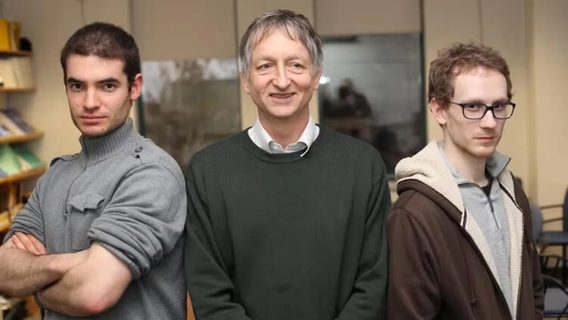
We tell the story of the legendary neural network, which was trained on a computer in the bedroom of one of its creators' parents. It was created by Ukrainian Alex Kryzhevsky, OpenAI co-founder Ilya Sutzkever, and computer scientist Jeffrey Hinton.
Google and the Computer History Museum (CHM) have released the source code for AlexNet, a convolutional neural network (CNN) that many credit with transforming the AI field in 2012. The Python code, now available on CHM’s GitHub page as open source software, offers AI enthusiasts and researchers a glimpse into one of the pivotal moments in IT history.
We tell the story of the legendary neural network, which was trained on a computer in the bedroom of one of its creators' parents. It was created by Ukrainian Alex Kryzhevsky, OpenAI co-founder Ilya Sutzkever, and computer scientist Jeffrey Hinton.
The AlexNet neural network was a turning point in the development of artificial intelligence, as it could identify objects in photographs with unprecedented accuracy at the time — correctly classifying images into one of 1,000 categories, such as «strawberry,» «school bus,» or «golden retriever,» with significantly fewer errors than previous systems, writes Ars Technica.
Examining the AlexNet code can provide insight into how a relatively simple implementation gave rise to a technology that changed our world.
AlexNet History
AlexNet was developed by University of Toronto graduate students Alex Kryzhevsky and Ilya Sutzkever, along with their supervisor Jeffrey Hinton. The project proved that deep learning can outperform traditional computer vision methods.
The neural network won the 2012 ImageNet competition. At the time, computer vision veteran Yann LeCun immediately recognized its importance, calling AlexNet «a clear turning point in the history of computer vision.» The neural network combined three critical technologies that would define modern AI.
The museum began its efforts to obtain the historically important code in 2020 when Hansen Hsu (CHM curator) approached Kryzhevsky with a request to release the source code due to its historical importance. Since Google acquired the DNNresearch team’s company in 2013, the intellectual property rights belonged to it.
CHM worked with Google for five years to negotiate the publication and carefully determine which version represents the original 2012 implementation—an important distinction, as many reproductions labeled «AlexNet» exist online but are not the authentic code used in the breakthrough.
How AlexNet worked
The breakthrough of AlexNet was not some single revolutionary technique, but rather an elegant combination of existing technologies that had previously been developed separately.
The project combined three previously separate components: deep neural networks, massive image datasets, and graphics processing units (GPUs). Deep neural networks formed the core architecture of AlexNet, with multiple layers that could learn increasingly complex visual features. The network was named after Kryzhevsky, who implemented the system and conducted extensive training.
Unlike traditional AI systems that required programmers to manually specify what features to look for in images, these deep networks could automatically detect patterns at different levels of abstraction—from simple edges and textures in early layers to parts of complex objects in deeper layers. While AlexNet used a CNN architecture specialized for processing gridded data like images, modern AI systems like ChatGPT and Claude rely primarily on Transformer models. These models are a 2017 invention by Google Research that excel at processing sequential data and capturing long-term dependencies in text and other media using a mechanism called «attention.»
For its training data, AlexNet used ImageNet, a database created by Stanford University professor Dr. Fei-Fei Li in 2006. Li collected millions of images from the internet and organized them using a database called WordNet. Amazon Mechanical Turk workers helped tag the images.
The project required serious computing power to process this data. Kryzhevsky ran the training process on two Nvidia graphics cards installed in a computer in his bedroom at his parents' house.
What happened next?
In the 13 years since the breakthrough, the creators of AlexNet have used their expertise in various directions, each contributing to the field in a unique way.
After the success of AlexNet, Kryzewski, Sutzkever, and Hinton formed a company called DNNresearch Inc., which Google acquired in 2013. Since then, each member of the team has gone their separate ways. Sutzkever co-founded OpenAI in 2015, which launched ChatGPT in 2022, and recently launched Safe Superintelligence (SSI), a startup that has raised $1 billion in funding. Kryzewski left Google in 2017 to work on new deep learning methods at Dessa.
Hinton gained recognition and fame for warning about the potential dangers of future artificial intelligence systems, leaving Google in 2023 to speak freely on the subject. Last year, Hinton was awarded the 2024 Nobel Prize in Physics, along with John J. Hopfield, for their seminal work in machine learning dating back to the early 1980s.
As for who gets the most credit for AlexNet, Hinton described the roles in the project with humor: «Ilya thought we should do it, Alex made it work, and I got the Nobel Prize.»
Як нейромережі бачать вільну та незалежну Україну? Тест dev.ua
Нейронні мережі для генерації зображень бачать світ по-своєму, їхню логіку зрозуміти часом зовсім неможливо. Але таки хочеться. На честь Дня Незалежності України редакція dev.ua вирішила провести невеликий експеримент.
Ми задали чотирьом різним нейронним мережам п’ять однакових запитів: «прапор України», «День Незалежності України», «український Крим», «перемога України» та «українці». Отриманими результатами ми ділимося з вами нижче.
У TikTok тепер можна генерувати фон за допомогою нейромережі. Ми протестували її та ділимося результатами
У TikTok з’явилася нова функція «Розумний фон». З її допомогою як фон для тіктоків можна підставляти згенеровані нейромережею зображення. Редакція dev.ua протестувала цю технологію і ділиться своїми враженнями.