Хочете будувати кар’єру в Data Science та AI? Vodafone Big Data Lab відкриває новий набір —>
Наталя ХандусенкоAI Eng
9 August 2026, 15:08
2026-08-09
Ukrainian developer creates open-source environment for parallel work with multiple AI agents — Warpforge
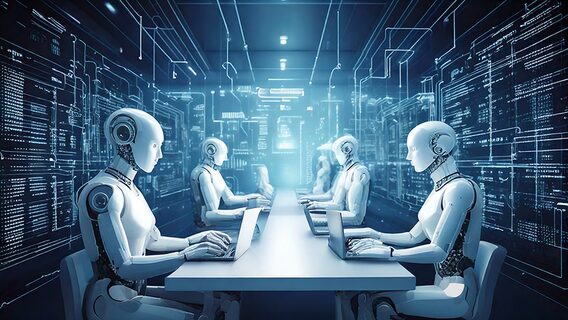
Tools like Claude Code, Codex, or OpenCode are great for individual tasks. However, when you need to run multiple AI agents in parallel on real projects, a new barrier arises: coordination and process management issues.
Tools like Claude Code, Codex, or OpenCode are great for individual tasks. However, when you need to run multiple AI agents in parallel on real projects, a new barrier arises: coordination and process management issues.
The main complexity of modern development has shifted from code generation to process management: coordinating multiple AI agents, isolating parallel changes in Git, transferring runtime context, seamlessly processing PR, and combining models from different vendors.
To solve these problems, an experienced Ukrainian developer created Warpforge — an open-source and local-first Agentic Development Environment (ADE).
What is Warpforge?
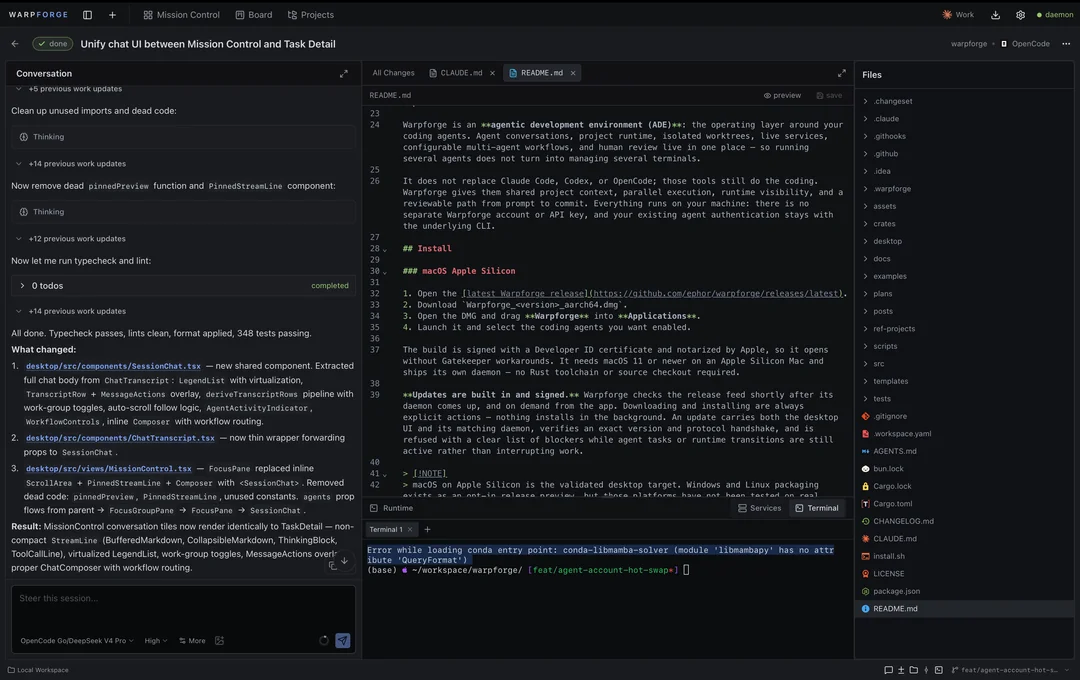
Warpforge is not another "wrapper" over the model or a new coding agent. It is an operational layer for managing tools already installed in the system (Claude Code, Codex, OpenCode, Qwen Code, Goose and other ACP-compatible agents).
The project combines agent sessions with what is usually "scattered" between IDEs, terminals, and other services: git worktrees, file and diff work, permission control, local services, Kubernetes port-forwards, logs, and final commit and push.
Key features of the tool:
1. Command Center
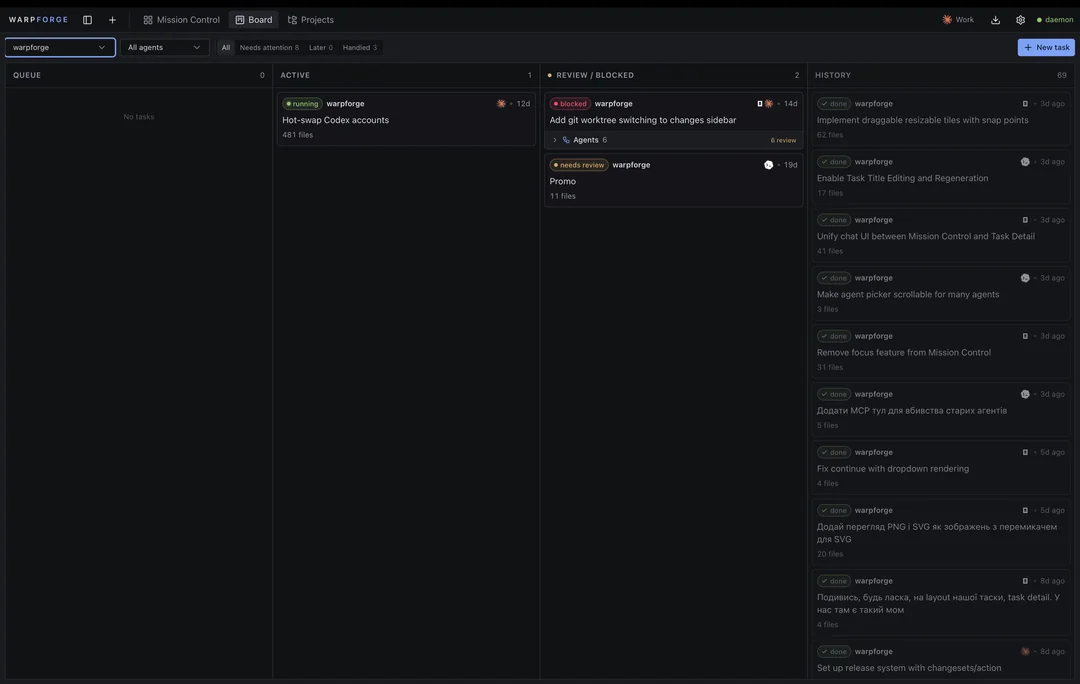
Instead of an endless list of chats, Warpforge focuses on the developer's attention. It is clearly visible what tasks are being performed, what is blocked, where a user response is needed, and what is already waiting for a human review.
2. Two orchestration modes
Free delegation via Lead Agent: The lead agent can delegate limited tasks to subordinate sub-agents directly during dialogue (for example, when Claude is running Codex or vice versa).
Configurable Workflows: Automated pipeline according to the scheme plan → implement → review ⇄ fix. Each stage can be assigned a separate agent and model (including multiple reviewers).
In this case, the transitions between stages are managed by the local daemon, not the manager-LLM. The pipeline does not commit anything automatically — any result first goes to the Needs review section.
3. Complete autonomy and security
Local-first: All data and processes remain on the user's machine.
Native CLI subscriptions: Warpforge runs already authorized CLI tools, so the user does not need to purchase additional API keys or subscriptions (even a convenient on-the-fly account switcher has been added).
Independent daemon: Even if you close the user interface, the background daemon will continue to execute tasks.
Technical architecture
The project is built as a Tauri/React client in conjunction with a Rust/Tokio daemon using SQLite and a local WebSocket API.
Interestingly, Warpforge was originally developed as a tool for managing complex local environments: dependent services, environment configuration, port forwarding and logs for running multiple backends and frontends simultaneously. Working with AI agents and git worktrees grew organically on top of this powerful runtime layer.
Accessibility
The project is completely free and distributed under the free MIT license.
There is currently a stable version for macOS (Apple Silicon). Builds for Windows and Linux are available as untested previews.
Як нейромережі бачать вільну та незалежну Україну? Тест dev.ua
Нейронні мережі для генерації зображень бачать світ по-своєму, їхню логіку зрозуміти часом зовсім неможливо. Але таки хочеться. На честь Дня Незалежності України редакція dev.ua вирішила провести невеликий експеримент.
Ми задали чотирьом різним нейронним мережам п’ять однакових запитів: «прапор України», «День Незалежності України», «український Крим», «перемога України» та «українці». Отриманими результатами ми ділимося з вами нижче.
У TikTok тепер можна генерувати фон за допомогою нейромережі. Ми протестували її та ділимося результатами
У TikTok з’явилася нова функція «Розумний фон». З її допомогою як фон для тіктоків можна підставляти згенеровані нейромережею зображення. Редакція dev.ua протестувала цю технологію і ділиться своїми враженнями.