Промо на dev.uaIT education
8 October 2026, 15:31
2026-10-08
Why DefTech teams lack business English
In 2022, Ukrainian defense companies began to enter international markets en masse. However, a specific problem emerged: technical specialists who know their product perfectly are lost in communication with foreign partners, even with a good or high level of English. The problem is not in the language as such, but in the lack of specific words and constructions for specific work situations.
A firmware engineer can flawlessly talk about his experience in an interview, but get confused when he has to explain signal loss to a foreign client. A drone operator understands technical documentation, but does not know how to describe what he sees on the camera screen. A CTO of a deftech startup reads English articles, but gets confused when he needs to pitch a product during negotiations with a foreign investor.
In 2022, Ukrainian defense companies began to enter international markets en masse. However, a specific problem emerged: technical specialists who know their product perfectly are lost in communication with foreign partners, even with a good or high level of English. The problem is not in the language as such, but in the lack of specific words and constructions for specific work situations.
A firmware engineer can flawlessly talk about his experience in an interview, but get confused when he has to explain signal loss to a foreign client. A drone operator understands technical documentation, but does not know how to describe what he sees on the camera screen. A CTO of a deftech startup reads English articles, but gets confused when he needs to pitch a product during negotiations with a foreign investor.
Where does business English end?
Standard corporate courses are built around universal situations: letter writing, negotiations, and presentations. The skills are there, but the context is not, and at deftech it is the context that decides everything.
The key difference is accuracy. A mistake in wording in the defense sector has real consequences . That is why it is necessary to know the difference between similar terms, choose the right word, and describe the characteristics of the product so that the foreign partner understands exactly what was meant.
The methodological difference between ESP (English for Specific Purposes) courses is that they start not with the question “what words to use to talk about drones?”, but with the question “what do you need to be able to do in English at work?” This is a fundamentally different entry point.
What really happens in deftech communication
If we analyze real work situations in which DFT specialists need English, an interesting picture emerges.
Technical specialists (UAV operators, assembly technicians, electronics engineers) mainly need language for troubleshooting and technical description: to name a component, describe a fault, explain the cause of a problem, give instructions to a colleague or contractor.
Engineers and R&D — talk about the production process: manufacturing flow, quality control, lead time, component shortage. Explain the delay, discuss the specification, report on the status.
Product and business side (founders, CTOs, product leads) — present the product to an international audience: explain the value proposition, discuss requirements with a foreign partner, answer technical questions during the pitch.
Each of these situations requires different vocabulary and language structures. That's why we at Yappi have developed the English for Defense & Safety line — several programs for different roles in defense technology.
What does a specialized DefTech course from Yappi look like?
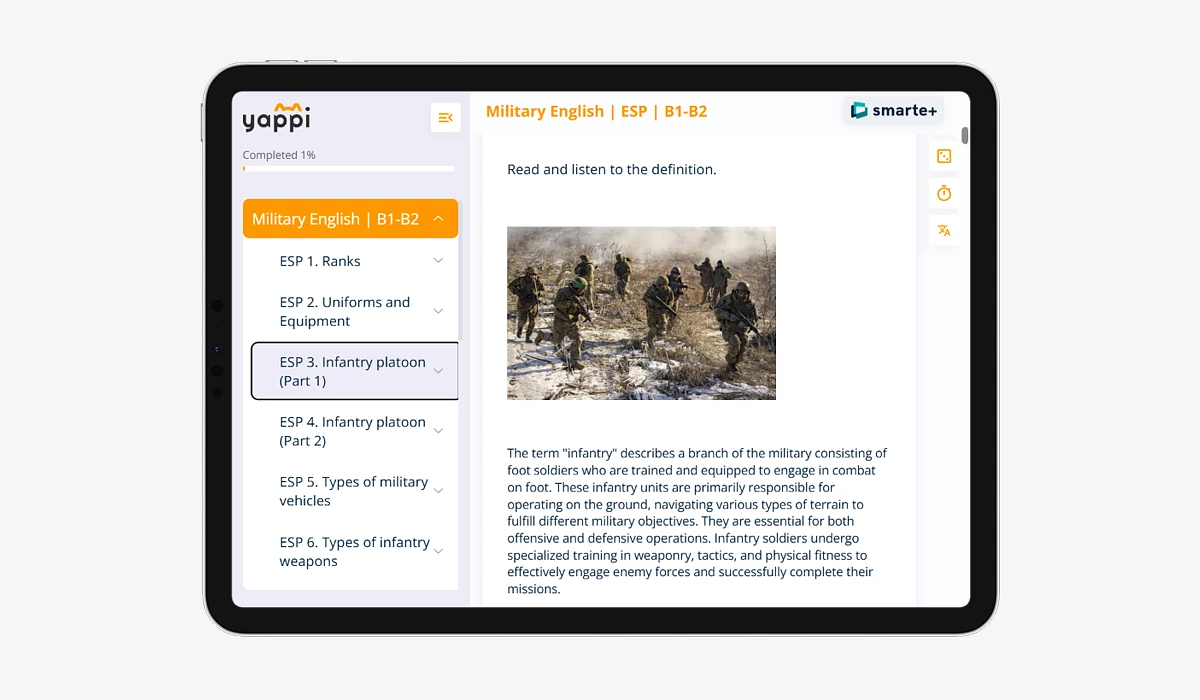
The programs included in our defense line are built around real-world work situations: international communication, technical documentation, UAV work, and radio communications.
Military English:Core Operational is a course for military personnel and instructors who work with international partners or English-language documentation. The focus is on military terminology, weapons and equipment, tactical commands, radio communications, orientation, and tactical medicine.
Military English: FPV & Drone Operations is aimed at UAV operators, commanders and technicians. The program covers the design and use of FPV drones, terrain description and camera imagery, as well as electronic warfare and countermeasures.
English for MilTech & Drone Engineering is designed for engineers, product managers, and international sales professionals in miltech. Topics include smart munitions, release mechanisms, AI vision, field service, and swarm intelligence.
Who studies English for DefTech and why?
Yappi's corporate programs are not just for technical staff. The deftech segment also trains HR and communications specialists, procurement managers, and non-technical team members who need to understand the context but don't necessarily need to know the details.
One of the main challenges for us with such programs is to find a level where the engineer doesn't get bored with the simplification, and the product manager doesn't get lost in the terms. The materials have to work for both.
The training of teachers is no less important. They must distinguish between grammatical errors and substantive inaccuracies - in deftech subjects this is not always obvious. Therefore, our programs include detailed methodological notes, sample answers, and explanations of terms for the teachers themselves.
English at deftech is no longer an option after 2022. Entering international markets, working with NATO standards, negotiating with foreign investors and partners — all of this requires the ability to work in English in a narrow, specific context. And that's exactly what we teach at Yappi.