Хочете будувати кар’єру в Data Science та AI? Vodafone Big Data Lab відкриває новий набір —>
Олег ОнопрієнкоHot News
17 September 2026, 13:43
2026-09-17
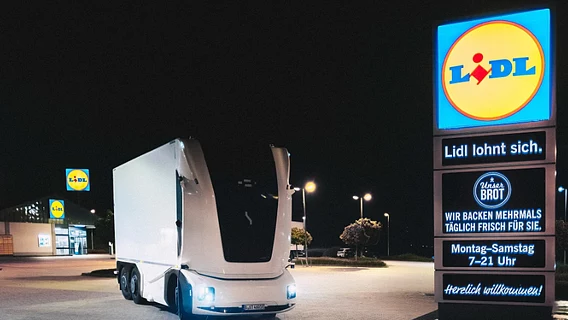
Without a cab and driver: European supermarket chain Lidl has launched an autonomous electric truck on public roads for the first time
German supermarket chain Lidl, together with Swedish technology company Einride, has deployed a fully driverless, cabless electric truck on public roads in Germany for the first time in history.
German supermarket chain Lidl, together with Swedish technology company Einride, has deployed a fully driverless, cabless electric truck on public roads in Germany for the first time in history.
As the company reported , this is the first time a European food retailer has used a cabless truck with autonomous driving capabilities in real-world daily logistics conditions.
Technical features and route
The truck operates with SAE Level 4 autonomous technology. This means that the system takes over full control on a clearly defined route without the need for human intervention or constant monitoring. In the event of an unforeseen situation, the vehicle is able to stop in a safe area on its own. The German Federal Office for Motor Transport (KBA) has already issued official approval for these tests.
The vehicle does not have a classic cabin - its movement is controlled by a complex of sensors, cameras and software. It is capable of transporting up to 15 Euro pallets. During the four-month test period, the electric truck will make up to three rail trips per day between the administrative and distribution center in Edermünde and the nearest store, transporting a total of more than 3,000 pallets of dry goods.
Why does a retailer need this?
The main reason for launching the project is the acute shortage of qualified drivers and the need to optimize complex logistics chains. Thanks to its extensive network (in Germany alone, Lidl has 39 distribution centers and over 3,250 stores), the company is looking for ways to ensure stable delivery of goods regardless of staffing crises. If the current four-month test is successful, the company plans to scale up routes with multiple stops.
At the same time, experts note that Germany and other EU countries are trying to agree on uniform regulatory standards for unmanned transport to allow such trucks to cross state borders without additional permits. According to analysts, by 2035 the market for autonomous freight transportation in Europe alone could reach 80-120 billion euros, despite serious competition from Chinese manufacturers.