Хочете будувати кар’єру в Data Science та AI? Vodafone Big Data Lab відкриває новий набір —>
Наталя ХандусенкоAI Eng
21 September 2026, 17:14
2026-09-21
How to pass the Claude Certified Architect certification from Anthropic: practical advice from Ukrainian IT professionals
QA Architect at EPAM Yehor Maksymchuk and Lead Full-Stack Engineer Bohdan Shtohrynets share their own practical experience and provide valuable advice on preparing for and successfully passing the Claude Certified Architect certifications from Anthropic.
QA Architect at EPAM Yehor Maksymchuk and Lead Full-Stack Engineer Bohdan Shtohrynets share their own practical experience and provide valuable advice on preparing for and successfully passing the Claude Certified Architect certifications from Anthropic.
Reference
Claude Certified Architect (CCA) is an official professional certification from Anthropic. It validates a developer’s expertise in building robust enterprise AI systems (production-grade), writing complex code, deploying AI agents, and integrating AI into workflows. It’s not just a test of “good prompts,” but a serious architectural exam that requires deep technical skills.
"I took the Claude Certified Architect exam first. Because I'm an architect. I didn't pass. I missed about 12 points. In the end, I passed it third — after coming in from the very bottom. Here are 8 things I wish I knew before my first attempt," wrote Yegor Maksymchuk, QA Architect at EPAM, on LinkedIn.
There are four certifications, not one: Associate, Developer, Architect Foundations, and Architect Professional. "This is not one ladder to climb, but four different roles," emphasizes Yegor Maksymchuk.
Passing score: 720 out of 1000.
Practice is not enough: every implementation of Claude Code in the pipelines on projects does not guarantee success. "The exam tests the ability to choose the best answer from two correct ones, not just the ability to do the work," the IT expert emphasizes.
Order matters: Start with Associate, even if you're a senior. "It's a cheap calibration exercise: you get to see the question format without having to take a difficult exam," says QA Architect.
There are no official laboratories: according to the IT expert, for Developer you do the practice yourself (for example, writing your own agents on the Agent SDK to see the agent cycle not on the slide).
Lack of sample questions: the official exam guide only has three sample questions. You have to assemble the simulator yourself.
Professional may be easier than Foundations: Foundations often proves to be the most difficult of all four exams.
Associate's benefit: it's worth taking for anyone who works with model output — there's a module on evaluating this output, says the IT specialist. "For a tester, these are the most useful two hours out of all four exams, in terms of complexity and input requirements."
Yehor Maksymchuk emphasizes: "The most expensive mistake is to come to the exam with the thought "I do this every day". That's what I came with."
The IT expert also shared advice, which he called "a practical action for tomorrow to prepare for": "Open the exam guide for your certificate and answer those three example questions without peeking. If even one answer raises doubts, you need a simulator, not another course."
Yegor Maksymchuk tells more about preparing for certification in his YouTube video, namely, he analyzes who each certificate is for, which free Anthropic Academy courses to take, and how to assemble a Claude question simulator from the exam guide.
Training Strategy from Lead Full-Stack Engineer
Unlike Yegor Maksymchuk, who has already passed the certification, Lead Full-Stack Engineer Bohdan Shtogrinets is currently in the process of training.
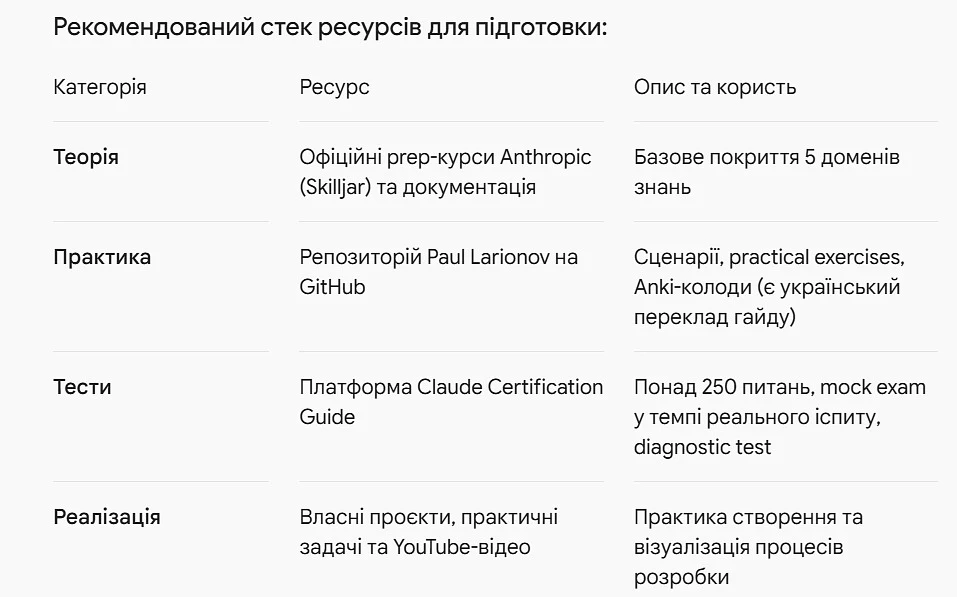
"I'm currently preparing for the Claude Certified Architect — Foundations certification from Anthropic. And the first thing that catches my eye is the lack of official materials for preparation. Official courses on Skilljar provide mainly theory in five domains. There are few practical examples. There are even fewer tests where you can practice in the format of a real exam. And this is the most important thing here. The exam is built on scenarios, and knowledge of the theory does not guarantee that you will choose the right solution in a specific situation," wrote Bohdan Shtogrinets in a LinkedIn post.
Source: Bohdan Shtohrynets
Key observations
The IT expert's main observation is that working with tools, MCP servers, and orchestration cannot be learned solely from theory. He gives an example from the Anthropic documentation, where a detailed description of a tool is defined as the most important factor in its correct operation. At first glance, this seems like a trifle, but practice proves the opposite. If you give an agent two tools with similar descriptions (for example, "searches for documents" and "receives a document"), then it becomes noticeable in the logs that the system periodically gets confused and calls the wrong tool.
The second observation of the specialist concerns the distribution of weight of topics (domains) on the exam. The Agentic Architecture section covers 27% of the test, while Claude Code accounts for 20%. This means that the tool that a developer uses in his daily work covers only a fifth of the exam.
The largest testing block is dedicated directly to architecture design: the specialist needs to clearly understand in which cases the system needs a full-fledged agent, and when a deterministic workflow will suffice.
Bohdan Shtohrynets concludes that the developer Anthropic provides only a theoretical basis, while IT professionals have to gain practical experience and validation of knowledge on their own.
“Claude can generate test cases for requirements that are not in the product.” Senior QA engineer explained how to use AI to analyze business requirements before creating test cases
Як нейромережі бачать вільну та незалежну Україну? Тест dev.ua
Нейронні мережі для генерації зображень бачать світ по-своєму, їхню логіку зрозуміти часом зовсім неможливо. Але таки хочеться. На честь Дня Незалежності України редакція dev.ua вирішила провести невеликий експеримент.
Ми задали чотирьом різним нейронним мережам п’ять однакових запитів: «прапор України», «День Незалежності України», «український Крим», «перемога України» та «українці». Отриманими результатами ми ділимося з вами нижче.
У TikTok тепер можна генерувати фон за допомогою нейромережі. Ми протестували її та ділимося результатами
У TikTok з’явилася нова функція «Розумний фон». З її допомогою як фон для тіктоків можна підставляти згенеровані нейромережею зображення. Редакція dev.ua протестувала цю технологію і ділиться своїми враженнями.