Хочете будувати кар’єру в Data Science та AI? Vodafone Big Data Lab відкриває новий набір —>
Ігор Вишневський Hot News
13 March 2025, 09:00
2025-03-13
"There are a lot of problems with registries, especially basic ones. We simply don't have one place where information about all the people in the country is stored." Strimco CEO Roman Lansky — about the "kitchen" of Ukrainian govtech
Co-founder of Strimco, Roman Lansky, is one of the most public figures in Ukrainian govtech. One of his first well-known projects was the IT component of the emergency medical care reform, which began to be implemented during the tenure of Ulyana Suprun. Strimco specialists are currently involved in a number of projects directly related to the war and its consequences. In particular, they are working on expanding the functionality of the «Reserve+» and «Army+» applications, as well as the International Register of Damage Caused by the Russian Federation’s Aggression against Ukraine.
dev.ua talked to Lansky about the «rules of the game» in Ukrainian govtech, donor funding and its absence — in particular, in the context of USAID. Also — about cooperation with the Ministry of Defense and other ministries, outdated IT standards that they still cannot abandon, and how to win tenders without «political bending.» In addition, the co-founder of Strimco shared with us his small top of the greatest successes and failures of digitalization and his assessments of who drives this process in the government, besides the Ministry of Digital Affairs.
Co-founder of Strimco, Roman Lansky, is one of the most public figures in Ukrainian govtech. One of his first well-known projects was the IT component of the emergency medical care reform, which began to be implemented during the tenure of Ulyana Suprun. Strimco specialists are currently involved in a number of projects directly related to the war and its consequences. In particular, they are working on expanding the functionality of the «Reserve+» and «Army+» applications, as well as the International Register of Damage Caused by the Russian Federation’s Aggression against Ukraine.
dev.ua talked to Lansky about the «rules of the game» in Ukrainian govtech, donor funding and its absence — in particular, in the context of USAID. Also — about cooperation with the Ministry of Defense and other ministries, outdated IT standards that they still cannot abandon, and how to win tenders without «political bending.» In addition, the co-founder of Strimco shared with us his small top of the greatest successes and failures of digitalization and his assessments of who drives this process in the government, besides the Ministry of Digital Affairs.
About the journey to govtech and current projects
Roman, let’s start from the beginning — how did you come to govtech and establish yourself in this domain as a team?
As a team, we gathered around the customs reform, when Max Nefyodov took over as head of the Customs. We continued to work there for another year and a half, and after that, it was a kind of IT office at the Customs.
As of 2020-21, we had about 15 people in the project management team: PM and VA, and it was a very large team for govtech at that time. Rarely did any agency have a team of this size. Of course, except for the Ministry of Digital. But not any other ministry.
When it became clear that the full-fledged reform of the customs service was finally blocked, we decided that we needed to keep this team, regardless of our exit from the project. At that time, there was a change in the political leadership of the Ministry of Health with a large demand for an IT team. So we managed to «repark» all the people there thanks to our expertise and my good reputation with donors, since I worked at the Ministry of Health before the Customs Service during the time of Ulyana Suprun, so I had the connections and the ability to quickly find the necessary funding for such a large team.
But already at that moment we began to understand that when there are 15 people, it is not so easy to find enough work for such an IT team within a single state body. Many other ministries also approached us with various requests for IT projects. So the idea of reorganizing into an IT company arose.
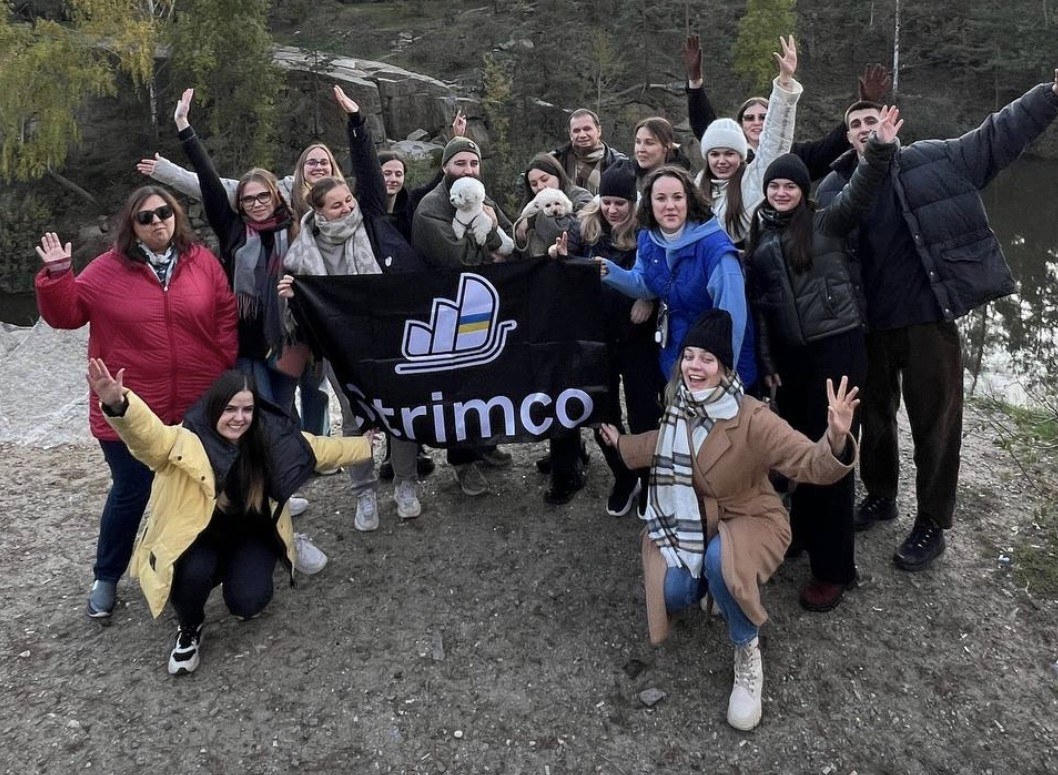
With the Strimco team
Our strength was that we had a lot of experience working both on the donor side and within government agencies, understanding their needs, processes and capabilities. This is usually lacking for many teams working in traditional IT business sectors and wanting to try their hand at govtech. They have a poor understanding of how procurement works, regulations, the SDLC of these projects and how bureaucrats and donors make decisions at different steps, what the risks are. With this knowledge of the field and a good reputation in the community, it was relatively easy for us to get started.
Can you specify the main projects you are currently working on?
Our typical project is essentially a customer empowerment in product management and business analysis. To put it simply, we usually close a request where there is a political customer who says: «I want, for example, to create a digital service that will solve a certain problem. But I don’t have enough team to do it. Come, think of how it will work and help create it.»
I will try to divide our projects by domains. In defense, our work revolves around «Reserve+» and «Army+», as well as e-VLK. Defense is currently one of the largest — and simply the most visible communication domain where we are involved.
However, we also have a large domain in education. We work with AIKOM, with preschool-out-of-school systems. This is, roughly speaking, a central database for everything that happens in education.
We have a very large track on reparations. It is difficult to say who exactly is the customer from the point of view of Ukrainian stakeholders. Because this is, first of all, the International Register, which is created at the request of RD4U. This is a structure created by the Council of Europe for Ukraine. They are the key customer, and in Ukraine our counterparties are both the Ministry of Justice and the Ministry of Digital Economy.
We also have a large track in agro. It is now a little, let’s call it politically correct, «transforming» due to the USAID collapse. For example, we worked on a large project «eFish». This is a huge system that digitizes fisheries and reduces state losses due to poaching and evasion of fees, increases revenues from the sale of catch quotas, etc. Also in agro, we are working on «eHemp», a project that concerns industrial hemp.
Historically, we had a medical domain, because there were few teams in the country with our level of expertise in eHealth, but now we have completely moved away from it. Firstly, because we did not want anyone to interpret it as if we were getting projects in this area because we had worked there before, and to invent some stories about dishonesty based on this. And, secondly, it is disappointing to watch how important systems that you work with are not launched. Because for us it is of great importance not only to receive money under the contract.
Our benchmark is a running system. And the Ministry of Health in this regard is our worst nightmare, because most of the projects we did there as a private team did not launch.
A special pain is «eKrov», the significance of which is difficult to overestimate in war conditions. It has been lying «in a drawer» for a year and a half. It hurts to see how your work turned out to be wasted.
And why, what are the reasons? Some political resistance, or is there no money to finish and implement something?
The Ministry of Health IT team is in a state of systemic failure, and what’s worse, they are making almost no effort to change it. When Minister Lyashko started working, strong IT teams were formed around the Ministry of Health, including ours. But gradually most of the professionals left, and now there are almost no personnel left who are capable of building and launching real digital products.
«eBlood» is one of the best-prepared systems we’ve ever created. But it’s still not launched. The reason? The constant desire to «add a little more functionality.»
And instead of releasing the MVP on time and gradually increasing the system’s capabilities, the process dragged on so much that the first planned functions had already lost their relevance due to changes in the regulatory framework.
Digitalization of large-scale industries does not work on the principle of one-time perfection. It is impossible to immediately create an ideal system that covers all processes — the reform must be step-by-step, with releases of viable versions and gradual improvements.
But the main challenge here is the lack of local leadership. There is no strong product manager who could not only lead the process, but also cut out the unnecessary, clearly focus on priorities, and push the changes forward.
How typical is this situation for govtech? When, conditionally, you plow for a year or more, you already have a result, but at the end it doesn’t «take off» due to political reasons or sabotage?
One of the hardest things about our job is spending a year, investing a lot of resources and effort, and then seeing that the project never took off.
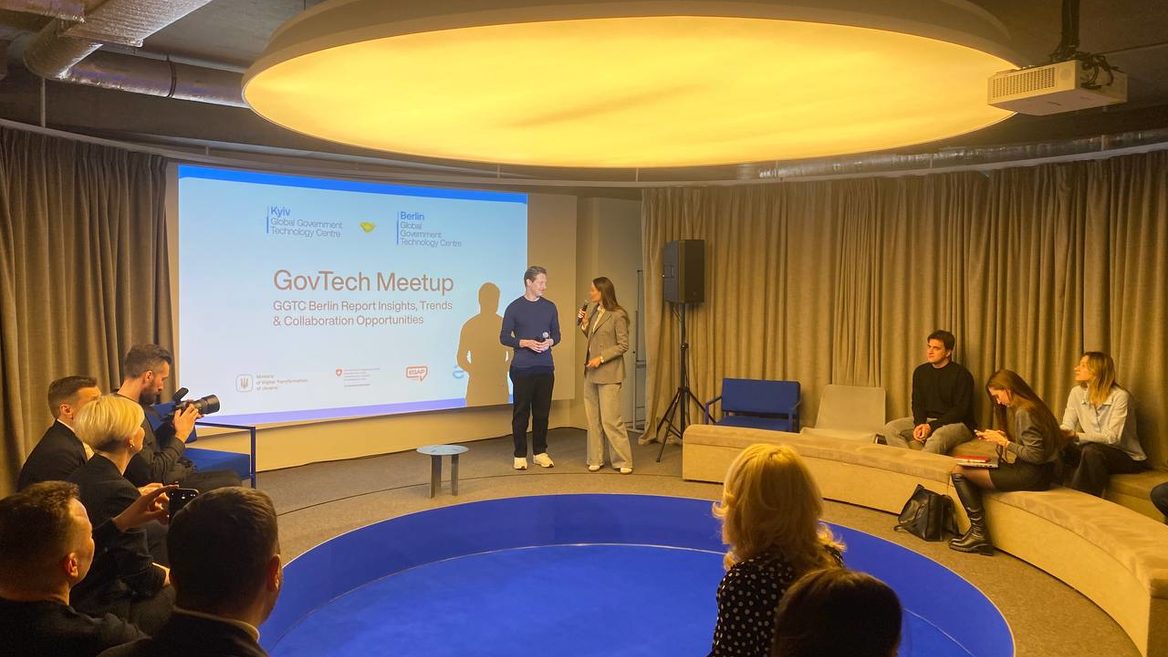
Roman Lansky speaking at Gov Tech Nights
We constantly measure the conversion of launches, and in govtech our rate is over 80%. This is incredibly cool for this field, where projects often drown at the concept stage.
But this is not a coincidence. We have long since built a benchmarking methodology to understand at the very beginning who is worth working with and who is not. We have a check of potential customers: how much of a real chance do they have of bringing the project to launch, whether they have the leadership and willingness to promote change. And, of course, there is a filter for integrity — because there is nothing to be done with shady types in long-term reforms.
But even with this, about 20% of projects never reach release. And when we were still working within government structures, and not as an independent company, this figure was almost 50%.
Without strong ownership and a middle level that really pushes for change, projects simply languish and get lost. Unfortunately, in govtech, this is a classic of the genre. But we are working to reduce the number of such stories.
You yourself mentioned that one of Strimco’s main projects at the moment is the Loss Register. How are things going with it?
This project is huge, there are more than 40 types of damage. From what concerns a person personally — property, life, health, death of a relative — to losses for business and the state. Moreover, a business can be small, and sometimes it is Azovstal. There are also many losses for the state — for example, environmental, or lost or destroyed cultural values.
Our key stakeholder here is the Ministry of Digital Affairs, as all applications are now submitted through the «Diya» portal.
There is an ambition to launch all categories by 2025. Currently, only three are operational: damage/destruction of real estate, death and disappearance of a close family member. But the plan is to cover the entire spectrum. I would say that this is an optimistic-realistic ambition.
The main risk is financing. The project was heavily dependent on USAID, and this creates a high chance that we will not be able to invest within the planned timeframe. Currently, the financing is being reformatted, because this is a project of great political significance.
Moreover, this is a unique service. For the first time, a Ukrainian can submit an application to an international structure through «Diya». This has never happened before. This is not just digitalization — it is a change in the very approach to government services.
You often voice rather categorical assessments of the situation or the actions of individual officials. Doesn’t this hinder business in govtech? After all, officials and politicians are easily offended…
It is wrong to give such assessments in a business sense. But we still have the «spirit of activists» who cannot get past the failure in crucial issues or, even worse, the shady undercurrents. Yes, this creates problems for us. It would be logical to keep quiet and just work, especially if there is an interest in continuing our work. But, unfortunately for business and fortunately for our culture, we do not do this.
At the same time, we don’t want to turn into «harsh» guys and girls who are politically unconstructive. Therefore, we use it only when we see no other options and the issue is critical. Honesty is important, but how exactly it is applied is also important.
About USAID grants: «Almost half of the budget for 'digital' has been cut»
During the previous answers, the words «donor» and USAID were mentioned several times. How much has the termination of USAID funding affected you specifically?
It didn’t affect us critically, because our portfolio of USAID projects was about 20%. We can survive the loss of a few projects.
We were lucky that we thought about it in advance and diversified. We are not dependent on one counterparty or one donor. In this regard, we «put our eggs in different baskets.» But there are companies that have suffered greatly from this.
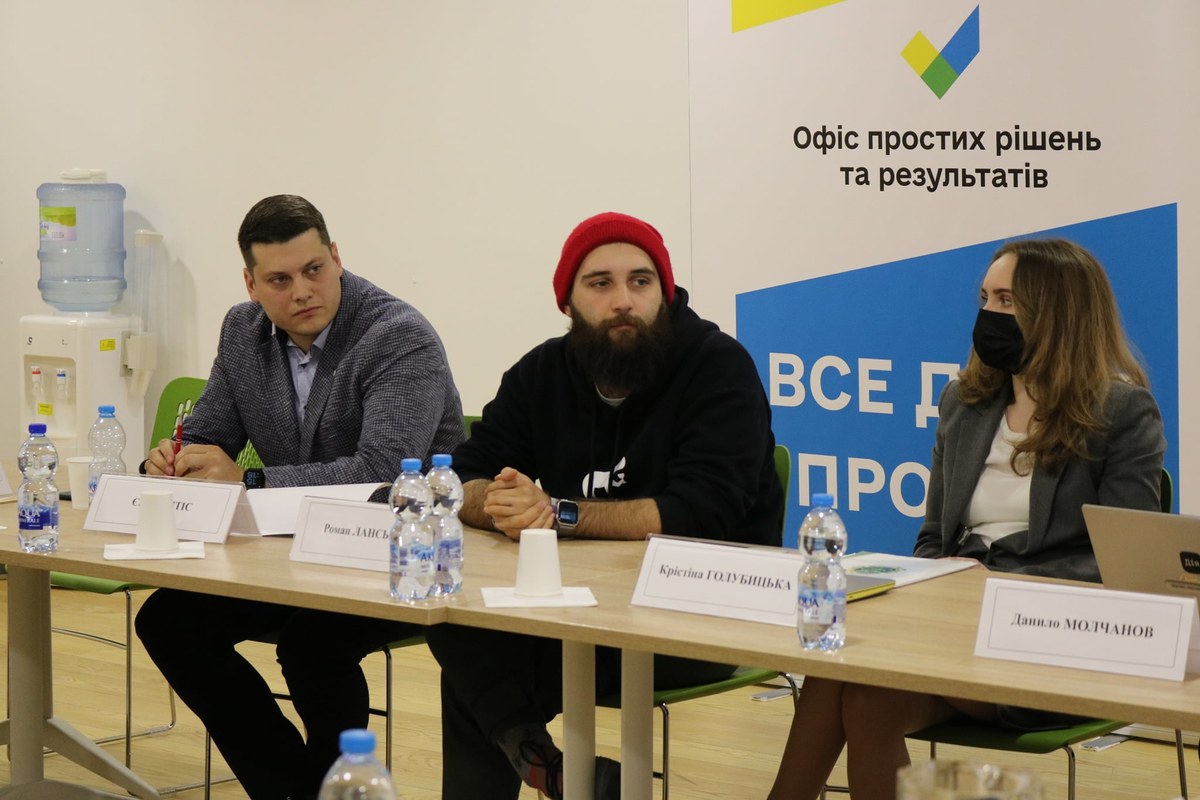
During an interview with dev.ua at the Strimco office
Here is an important point: donor funding is the funding that is allocated, first of all, for the development of something new. That is, there was a kind of «pact on the distribution of directions» between the government and donors — donors do something new and transfer it to the state, and the state itself supports it further. Therefore, if you look at what the state mainly allocates funds for in govtech — it is the administration of systems, but very rarely — the creation of new ones.
That is, if we are talking about development, then state money from the entire govtech palette is 10-20%, and donors are, roughly speaking, 80-90% of everything. It is difficult to say how much of the donor aid was financed specifically by USAID, but according to my estimates, it is 40-45%.
The biggest blow was to the donor-funded project teams. They actually worked as part of the ministries, but without the right to sign. Due to the reduction in funding, some simply disbanded.
For example, the DTA project (Digital Transformation Assistance) had just launched and had a five-year budget of $150 million, which is astronomical money for Ukrainian govtech. USAID also had a cybersecurity project with an even larger budget.
But, for example, USAID has never financed defense projects because it has policies that prohibit it. Therefore, the defense sector has not felt this crisis. On the other hand, the agricultural domain, which largely relies on USAID resources, has suffered more, IT projects are being stopped.
Is there a possible domino effect, albeit a delayed one, where Europe will also reduce grant funding for Ukraine over time?
In fact, the state had enough «money» to do it itself, but instead the funds were allocated for stories of «suspicious turbidity». Conventionally, in the Pension Fund, one company has been sitting on financing for about 20 years, which serves the fund’s systems and also had at least full-time joint ownership rights to the system. If you look at their budgets on Prozorro, over the past four years, almost half a billion hryvnias have been «let down» on this company alone, that is, solid money even by donor standards. And there are many such stories.
The state is hampered not only by funding problems, but also by outdated processes. Long procedures, archaic IT standards, and virtually Soviet-era GOSTs — all of this hinders the development of govtech no less than a lack of funds.
But if the approach to using public resources is reformed, govtech will be able to exist without grants, although not on such a scale.
As for funding from Europeans, it is unlikely to stop. In addition, Japan continues to invest significant funds, and this flow also does not look threatening. Moreover, most likely, it may, on the contrary, grow to slightly replace US funding. This is the age-old question — why do donors give money? This is primarily a political issue, not charity. European countries are interested in influencing the development of Ukraine, and in the field of digitalization this influence is especially noticeable. Financing digital reforms is part of a broader strategy for Ukraine’s integration into the European space. The EU has an obvious interest in our country staying on this course and being closely connected with European political and economic processes. Now it looks like Europe is not going to distance itself from Ukraine in any way from a political point of view. On the contrary, it looks like they are beginning to realize that they need to live without the States.
In fact, for them it’s a pittance. Because if you look at European budgets on govtech, we are like a children’s sandbox in comparison. And there is a sand pit, which is dug by serious tractors.
«Govtech is Agile, pushed through Waterfall and told that’s how it should be»
You also mentioned the rather outdated norms and standards in state IT. Are you trying to push changes at the level of legislation or bylaws through IT unions, the Cabinet of Ministers, or some sane deputies?
This is one of the reasons why we created the GovTech Alliance. We brought together key relevant companies in govtech that could try to influence this issue. But the process is difficult. The main problem is standards for the sake of standardization. Instead of considering them as a tool for effective work, they are more like a description of bureaucratic ritual that has no real purpose.
People often come to the Ministry of Digital Affairs with a request — friends, this is the Soviet GOST, what is it? And they even have a separate organizational branch that is currently working on updating these standards and recently published some changes. They are positive, but for me it is still a «lightened GOST.»
They still follow the same bureaucratic tradition, but they cut out the absurd things. Any standardization and bureaucracy must answer some questions — so what? Soviet standards were focused on finding those responsible for mistakes and punishing them. And what vision is embedded in the current iteration is not clear.
Moreover, when you look at Soviet standards, they were all designed for waterfall, which is natural. Because if you are making software for a nuclear reactor or for a howitzer, you need to do it only using waterfall, in stages. But when you are making «Action», «Reserve+» or «Dream», then you need a little more flexible approaches than in waterfall. We once spoke with a very smart CDTO, and he aptly compared the situation: «Govtech is Agile, which was pushed through Waterfall and said that’s how it should be.»
But when you suggest, «Maybe we should just abolish these standards,» this idea seems too radical to most people. Everyone immediately reacts, «Well, there was a standard, and now it’s gone — that’s not possible.»
Standardization for the sake of standardization is a separate cult, and it is firmly entrenched in govtech.
And what does it actually look like to receive an IT order from the state? Is it always a tender or not? How to win it, how tough is the competition?
I would divide this into different baskets, and the main one is tender. When I was a customer myself, the process looked like this: first, market screening. I analyzed who could actually close my request, and communicated with them: «Here is such a project, these are the specialists we need. Are you interested?» If the company was interested, I gave my estimate and asked for an approximate cost estimate. In essence, this allowed us to compare market expectations with reality and get them interested in applying for a tender. Because govtech is not an attractive area for business. Tenders, risks with law enforcement agencies, politics. Therefore, without active work on getting teams interested at the start, no one simply enters these processes.
In fact, there are not many players in the govtech market. I would say that there are about 15 service companies. But among them there are those that historically work with one small domain and that’s it. And there are those that work with many. There are very few companies like Strimco, focused exclusively on Govtech, up to 10. And, accordingly, if you, as a customer, want to get a result, then you are looking for some reputable people in this market.
You are actually limited to competing with 10, well, maybe 15 companies. But if you don’t do a market screening, no one will come to you. Because there are so many tenders that no one comes to at all. There is no competition from dozens of companies fighting for every cent. Rather, you, as a customer, need to persuade a normal company to apply to you for a tender.
These are the realities of the tender system, that’s how it works. There are also direct purchases, but very rarely. Because this is public money, even if it’s donor money. And therefore donors also have to report why they chose this company and not another. Their auditors will be horrified by the fact that they could hypothetically have some kind of corruption risk. Donor compliance is usually even stricter than state compliance, but the procedures themselves are bureaucratically easier and shorter. Therefore, it’s easier to work with donors in terms of tender history.
On cooperation with the Ministry of Defense: «Even at the current pace, it will take at least three to four years»
And tell me, what does your cooperation with the Ministry of Defense look like regarding the reform of the electronic VLK and other things? Does it have its own IT team, what is its capacity? How are responsibilities distributed?
The IT team of the Ministry of Defense is currently probably one of the most capable in govtech, it is definitely in the top 3. But they have many of their own characteristics.
Basically, they are connected with the fact that they are under enormous political pressure. This is natural — it is difficult to expect anything else when it is the Ministry of Defense in war conditions. But at the same time, this creates a lot of managerial chaos, because they can receive tasks directly from key figures in the country — to do something urgently. And this cannot be ignored.
There is CDTO Kateryna Chornohorenko, there is her directorate, there is an internal IT office. At the same time, they also have a kind of second link — military units that deal with IT. Although they are mainly not directly subordinate to the ministry, but work more for the Armed Forces of Ukraine, they still provide a certain resource.
Photo from Roman Lansky’s FB. With Kateryna Chernogorenko and Alena Zhuzha
I will explain using the example of «Army+». A political order for «Army+» is, roughly speaking, either Kateryna’s idea, or the president, prime minister or minister said something, and she acted as a conductor of political will. Her directorate is mainly engaged in the legalization and implementation of these things. The IT team is a kind of product owner of this story. In this role, we act as a product management team.
We get requests: «We need such and such a report.» Then a brainstorming session is held, a long process of conceptualization begins, and we are usually already involved at this stage. When there is at least a page of the concept — what it will be and how it will work — our main work begins.
We translate high-level policy requirements into a detailed design. We define what the entire process will look like, what the interface elements will be, how everything will work at the base level.
And then there is development support. Our task is to make sure that everything from concept to working solution goes as efficiently as possible.
What is your opinion — why, despite the presence of a vision and high-quality teams, a huge number of processes in the same CCC remain at the level of the beginning of full-scale? Despite the presence of an electronic queue as a tool, when you arrive there yourself, you still always stand in a real kilometer-long queue.
There is no mystery here. If a certain system has been built for decades, even with the most professional team you will not turn it into something sensible in six months, a year or even two. Even at the current pace, it will take at least three or four years, or maybe more.
People often do not imagine the scale of processes, because in their lives and in their needs they are related to, roughly speaking, one function, and in this system there are 199 more. That is why even the ideal digitalization of any sphere at a normal pace takes 5-10 years. This is not because someone is «slowing down», but because the entire ecosystem is changing, and not just a convenient button is added.
Govtech successes and failures. «It is abnormal when a private vendor manages the policy of a state body in the «digital""
Besides the Ministry of Digital Affairs, because digitalization is their professional affiliation, who else are the drivers of digitalization in the Ukrainian government?
I have already mentioned the Ministry of Defense. I would also single out the Ministry of Education in this regard. There is a difficult watershed here regarding the Ministry of Education, because there is «Mriya», which is actually more of a Mitsyfra project than the Ministry of Education. But there is also AIKOM, which they are developing — it is also moving very well.
I would also single out the Ministry of Agriculture, because they have a lot of things going on. Although they didn’t have that many projects, the Ministry of Culture was moving well. The teams of the Ministry of Veterinary and Psychiatry and the Ministry of Social Affairs are currently being updated, I hope they will move much more actively, because for me personally these areas are the second most critical during the war, and will be the first after. And they have a lot of problems.
Name your top 3 successes of Ukrainian govtech. In all the time since it became common to talk about digitalization…
Probably the coolest thing that ever happened in govtech was that the Ministry of Digital Affairs created a network of CDTOs (deputy heads of state bodies for digital). This success does not seem obvious, but I worked in govtech before the Ministry of Digital Affairs was created. And back then it was very difficult to explain why anyone needed IT in state structures, and there were very few areas where «digital» was developing at all. The CDTO network is a kind of spider’s web that was able to overcome this and tie it into a single whole.
The second victory is «Diya» as an application, not as a portal. This is a strong rethinking of how the state can communicate with you. If even Time journalists noted this, it is already an obvious story. It seems obvious, but it cannot be called a victory.
What’s the third? On the one hand, I really like how the defense industry is progressing. But for me, it’s more about a promise than about a reform that has already been completed. Imagine — tomorrow they change the team and say: «That’s it, we’re stopping the reforms, because the army only needs paper.» Therefore, I can’t say yet that the digitalization of the army is a fait accompli. But it is definitely one of the tops in this story.
Photo from Roman Lansky’s FB page
There are many cool govtech projects in Ukraine. Everyone knows ProZorro and ProZorro.Sales, there are powerful procurement initiatives from the Ministry of Health and the Ministry of Emergency Situations, the reform of emergency medical care, which I did. It was not loud — our budget for a year and a half was $150,000, which by today’s govtech standards is almost nothing. But the result is optimization of ambulance access by 40% in cities. And this is, without exaggeration, up to 10,000 lives saved per year. There are at least dozens of such projects, it is difficult to list them. «eMalyatko», «Diya.Karta», projects of colored funds, «Shlub online» and many, many more. But it is even harder to choose the top 3 — because each of them makes its own critically important change.
Therefore, I want to highlight another system-forming thing — CDTO Campus. Govtech is acutely lacking digital leaders — both at the political level and in state management. You can have money, you can have strong IT teams in the private sector, but if the state structure is unable to digest it, digitalization will stall.
For me, CDTO Campus is an initiative that can close one of the key bottlenecks in govtech and give impetus to a new leap.
Because now we have already accelerated well, but it feels like we have reached a certain plateau.
Yes, and what about the facapas? Because everything will be untypically positive without this answer…
One can mention many specific failed projects, missed opportunities, and people in the wrong places who caused damage, but it is important to focus on systemic and fundamental problems, so I will also highlight three.
The first global facap is the state of the registries. There are a lot of problems with the registries, especially the basic ones. We simply don’t have one place where information about all the people in the country is stored.
About 70% of people — those who have biometrics — have a UNZR (our version of Citizen ID). But if a person doesn’t have biometrics, then they essentially don’t have one.
When you try to design any services for citizens, it’s always a terrible vinaigrette with identification. So we start looking — is this person in the UNZR, can we find him through the EDRPOU? And if this is a non-resident, but a person with a temporary residence permit? The same story with addresses.
We already have our own standardized branch of these corner cases for these cases. If not, then we look here, and if not again, then we look there. And if it’s not quite a citizen, then go here. If it’s a child born in a marriage between a Ukrainian and a foreigner, then just hide in the haystack.
This is probably a global facap, because it is very difficult to build quality services on such a foundation, and resources are spent many times more than they should be. But registries are always in the shadows. They do not receive enough focus and resources, because their reform is difficult to «sell» as a political success.
It’s easy to show that you’ve launched a new convenient service — for example, the deferral has been digitized in the app, it looks awesome! But the fact that this digitization covers only 50% of people, because the rest are simply not in the registers — these are nuances that won’t make it into the presentation.
If, with political pomp, it is announced that the Pension Fund register is finally in order, the reaction will be simple: «Well done, keep working.» Therefore, registers are always a matter of political benefits. And until their condition becomes a political issue, they will continue to remain in the shadows.
For example, the Ministry of Digital Affairs made a certificate of unmarried people, spending a lot of resources on this project. Even certain architectural changes in «Diya» had to be made. But at the same time, it gives a very strong political benefit, because it is recognizable. Given that the Ministry of Digital Affairs is the only agency that was actually able to obtain political resources for its initiatives, it is difficult to accuse them of doing something wrong. They found a balance between what is needed for political purposes to obtain resources and what is truly important. But, to be honest, as a technocrat, I really want us to deal with exclusively pragmatic things, without all this political game. However, this is a utopian fantasy from the world of pink ponies — the reality is that without political cards and compromises, major projects simply will not take place.
The second global facap is vendor lock-in (supplier monopoly). This is a chronic govtech disease that blocks development and makes the state hostage to private companies. Well-known examples: the Pension Fund, the Ministry of Social Affairs, the Ministry of Justice, and even the Ministry of Health, albeit in a milder form. It is abnormal when a vendor essentially manages the digital policy of a state body. You come and say: «We will do this project.» And they answer you: «We will not. We will do another. And if you don’t want to, we will simply stop supporting your system, and it will collapse. Goodbye.» They set you any prices and conditions. And now you are faced with a choice — to accept or rewrite the system. But coming to the government and saying: «I need a few million dollars and three years to simply get out of the monopoly of the previous vendor» is almost unrealistic. You will be fired because you are not bringing results and are doing something that is electorally incomprehensible.
Vendor lock is a weight on your leg. And the more functionality you add, the heavier it becomes. And then it gets even worse. Some state systems don’t even legally belong to the state. Most don’t have proper documentation. If the vendor company goes bankrupt or disappears tomorrow, we’ll have a national problem, because some systems will collapse and not get back up.
Well, the third global failure of our sector is its internal insolvency, which is based, first of all, on a simple human thing — salaries. Plus, lifelong PEP status (Register of National Public Figures) is the last nail in the coffin of the attractiveness of public service. Bank audits, financial monitoring, the risk of accidentally getting involved in some story because of one signature, endless declarations — all this creates a reality in which truly professional people go to the public sector only out of altruistic considerations, a sense of duty and enthusiasm. But it is impossible to build a working mechanism of such a scale on such motivation.
As a result, we have 15-25% of effective and professional civil servants. Another 55-60% are simply bureaucrats who can’t work anywhere else because they are not qualified enough for business, but they do something minimally useful so as not to be fired. And 15-30% are shady schemes and people whose integrity can be questioned.
It turns out that in order for these two categories of shady schemers and incompetent hamsters to be replaced by professionals, you need to start with the banal — good salaries. But raising salaries for officials is political suicide. It’s a kind of spiral that is very difficult to get out of.
And now the important thing. Despite this reality, there are people who do incredible work, holding the system on their shoulders. They implement reforms, launch services, and drive processes, although they often work in conditions in which others would have given up long ago. So, if you see that there are professional and honest people in the public sector, support them publicly. They don’t have the best conditions anyway, and without normal recognition of their work, the chances that they will stay there for a long time become even smaller.
«Slowing down the country’s digital transformation.» The termination of USAID financial assistance has put all new projects in Ukrainian GovTech on hold