Хочете будувати кар’єру в Data Science та AI? Vodafone Big Data Lab відкриває новий набір —>
Марія БровінськаWeapon
21 August 2026, 14:08
2026-08-21
Instead of an infantryman with 30 kg on his back. The story of the Ukrainian robot "Plastun", which first learned to overcome 100 km
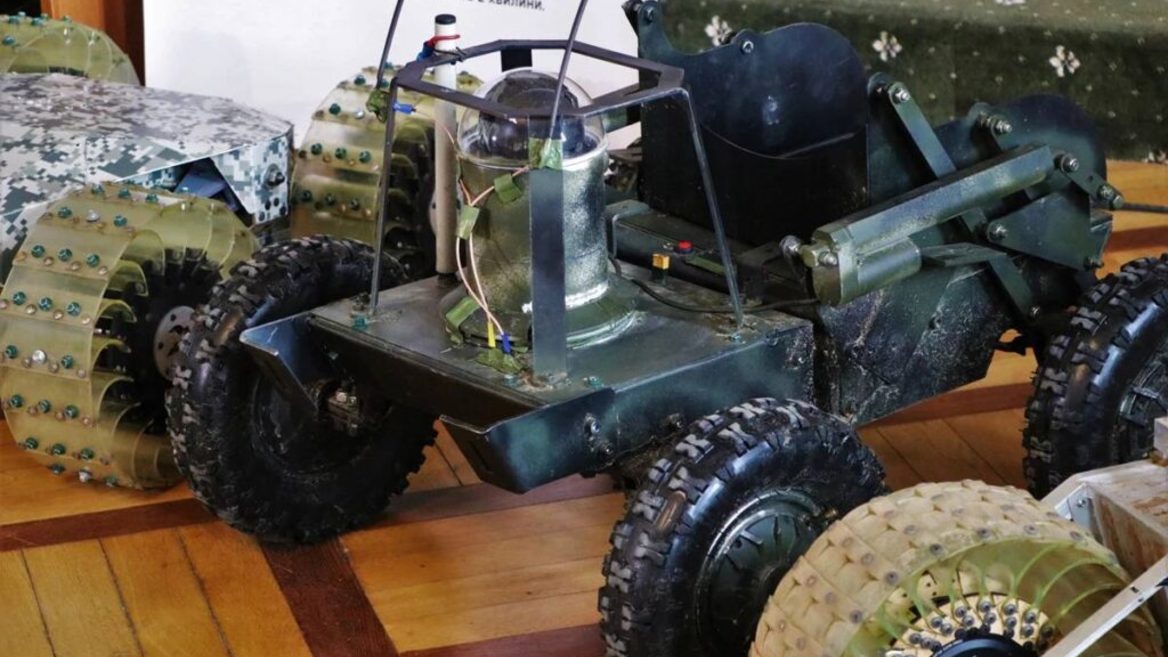
In 2023, the Ukrainian military first launched the Plastun NRC onto the battlefield. Every kilometer that the Plastun robot covers instead of a military one is the saved life of an infantryman who did not have to walk under the enemy’s sights with a 30-kilogram backpack. This is a saved crew who did not come under attack from a Russian FPV drone.
However, all this time, the Ukrainian military on the front line faced a severe limitation. The declared passport range of the Plastun was 25 km, but the reality of the fighting turned it into only a 10–12 km radius of action, after which the robot had to return to recharge. Because of this, routes had to be laid along the shortest line — and at the front it often passes under the fire control of mortars and drones. The small range also forced charging points to be kept closer to the front line, and people regularly risked their lives by going there to service the equipment.
This summer, Lviv engineers from PAWELL Battery found a way out of this technological trap, increasing the range of the Plastun fourfold — to 100 km.
In 2023, the Ukrainian military first launched the Plastun NRC onto the battlefield. Every kilometer that the Plastun robot covers instead of a military one is the saved life of an infantryman who did not have to walk under the enemy’s sights with a 30-kilogram backpack. This is a saved crew who did not come under attack from a Russian FPV drone.
However, all this time, the Ukrainian military on the front line faced a severe limitation. The declared passport range of the Plastun was 25 km, but the reality of the fighting turned it into only a 10–12 km radius of action, after which the robot had to return to recharge. Because of this, routes had to be laid along the shortest line — and at the front it often passes under the fire control of mortars and drones. The small range also forced charging points to be kept closer to the front line, and people regularly risked their lives by going there to service the equipment.
This summer, Lviv engineers from PAWELL Battery found a way out of this technological trap, increasing the range of the Plastun fourfold — to 100 km.
Fits in the trunk of a car — and saves dozens of wounded people every month
«Plastun» appeared as a direct response to the military’s request: they needed a machine that would perform dangerous work instead of a human.
The result is an ultra-light robot weighing about 35 kg, which one or two people can transport in a regular car, quickly prepare and send on a mission. At the same time, it is capable of carrying up to 50 kg of cargo — more than its own weight — or evacuating a wounded person weighing up to 120 kg on a special stretcher.
The platform is immediately universal: it can be equipped with various equipment for various tasks. There are logistician, miner, and kamikaze modifications. Modules for surveillance, electronic reconnaissance, and electronic warfare are being developed, as well as a sensor system that can simultaneously «hear» sounds, sense ground movement, and detect objects using radio waves.
Logistical deadlock: why a short run of equipment forced people to approach the line of fire
But what went wrong? In real combat conditions, the main limitation of the «Plastun» was its range — how far the robot could work without returning to base. The declared range of the «Plastun» NRK was 25 km. But in fact, this is a working radius of only 10–12 km: the robot was tied to the company rear and after each departure had to return to recharge.
With such a margin, the route has to be laid in the shortest possible line — under drone and mortar fire.
There was another problem: a robot with a range of 25 km cannot operate far from a charging point. It has to be kept closer to the front line, which means that people also have to regularly travel there to service the equipment.
Then the team of Lviv engineers from PAWELL Battery thought: what if we replaced the Plastun battery with one that would provide several times more energy? The standard lithium-ion battery was replaced with a solid-state one — and compatibility with the electronics of the robot itself was maintained.
The result was stunning: the new battery increases the Plastun’s energy reserve more than four times, and the estimated range is now 75–100 km instead of 25 km.
«The energy reserve made it possible to drive longer and safer: around, in lowlands, on reverse slopes, with pauses in shelter. The robot stops performing a single flight and works for a whole shift,» explains PAWELL co-founder Pavlo Esyp.
New chemistry: one battery allowed Plastun to travel four times further
The developers changed the battery chemistry itself, switching to solid-state cells instead of conventional lithium-ion cells. This allows them to extract about 60% more energy from each kilogram of battery.
The result: the robot has four times more energy on a single charge, and the battery weight has only doubled.
«The new battery fits the same electronics, the same operating voltage range, and the same battery management system as the standard one. The manufacturer of Plastun does not need to remake the robot itself, the power electronics, or the charging infrastructure — the battery simply takes the place of the old one,» says Pavlo Esyp.
The ceiling of possibilities for «iron»: how a range of 100 km changes the front
Increased range opens up missions that were previously difficult or impossible to complete:
Securing deep positions — those that today can only be reached by wheels and only at night.
Multi-point routes — one departure with arrival at 3–4 positions instead of four separate flights.
Long-term duty — the robot can leave, stand in a shelter on the route and wait for several hours until it is needed: for evacuation, for transporting ammunition during an assault, for relaying communications. Previously, each hour of waiting «ate up» the power reserve needed to return, so the robots were kept at the base.
Mining and demining are tasks where movement is not limited to «getting there»: the platform maneuvers for a long time at low speed in one area.
The developers say that the battery has become the factor that determines the ceiling of the capabilities of any ground robot. The engines, suspension, communication and cameras are already of sufficient quality — the robot will perform as many tasks as there is enough energy. Therefore, the new battery was made compatible with the standard electronics of the «Plastun» so that it could be installed on other platforms without modifying the robot itself — and the same principle of a four-fold power reserve could be scaled to other ground complexes of the Defense Forces.
Lviv developers have created a ground-based drone «Plastun», an Alpha Strike reconnaissance aircraft, and a robot for transporting ammunition. They are already ready to launch mass production