“The one who turns data into decisions and decisions into action faster will win.” 7 questions to the CPO of SKIFTECH about overrated AI, staffing shortages, and the war of the future
Ukrainian defense tech continues to grow faster than any other branch of domestic IT — and at the same time faces challenges that simply do not exist in the peaceful industry. What worries manufacturers the most today? What specialists do they lack? Which technologies are overvalued, and which will determine the course of war in a few years?
In the series «7 Questions for Deftech CEOs», we ask the same seven questions to the heads of Ukrainian defense tech companies to show what Ukrainian miltech really lives for.
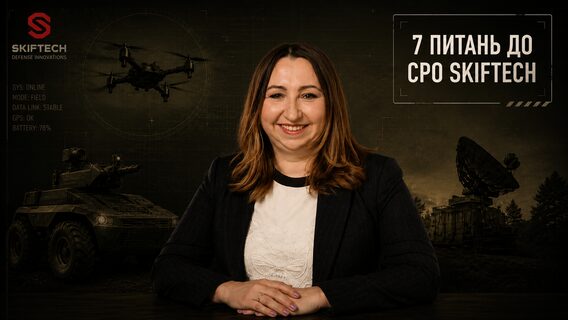
The heroine of this issue is Chief Product Officer of SKIFTECH company Anastasia Melnikova.
Ukrainian defense tech continues to grow faster than any other branch of domestic IT — and at the same time faces challenges that simply do not exist in the peaceful industry. What worries manufacturers the most today? What specialists do they lack? Which technologies are overvalued, and which will determine the course of war in a few years?
In the series «7 Questions for Deftech CEOs», we ask the same seven questions to the heads of Ukrainian defense tech companies to show what Ukrainian miltech really lives for.
The heroine of this issue is Chief Product Officer of SKIFTECH company Anastasia Melnikova.
Reference
SKIFTECH (LLC «SKIF» NVK) is a Kharkiv defense technology company founded in 2018 by people from the paintball and laser tag business, which since 2014 has reoriented itself to the production of full-cycle laser combat training systems. The company creates tactical simulators (in particular, for RPG-7, SPG-9, AGS-17, Stinger MANPADS), which are used by more than 80 military units and training centers of the Armed Forces of Ukraine.
According to SKIFTECH, training on their equipment increases the survival of soldiers on the battlefield by 30%. The company has codified some of its products with the Ministry of Defense of Ukraine, is a participant in BRAVE1, and also became the first Ukrainian MilTech company to receive a contract from the US Army to develop laser simulators — along with Lockheed Martin, General Dynamics Mission Systems, and Saab.
— What is the biggest problem facing Ukrainian softtech right now? What pain is bothering your business the most right now?
The biggest challenge for Ukrainian miltech today is the speed of scaling. The war catalyzed the emergence of dozens of strong technology teams and products, but the transition from a successful prototype to mass production and stable contracts remains a difficult challenge.
For our business, one of the biggest challenges is balancing the speed of change on the battlefield with the speed of internal processes.
The adversary is constantly adapting, so the product must evolve continuously. It is necessary to simultaneously maintain quality, scale production, and quickly implement new solutions.
We also regularly see situations where new technology enters the military faster than the methods for its application have time to appear. Therefore, today it is not enough to create a technology — you also need to create a system for training people to work with it.
— What technology is most overrated today? And what, on the contrary, is underrated?
The term «artificial intelligence» itself is often overrated. AI is not a magic solution that automatically solves any problem. In military technology, what matters is not the presence of AI in the presentation, but how well the system works in real conditions, under the influence of interference, lack of data and active enemy countermeasures.
I would call systems integration underrated.
It is not individual technologies that win, but ecosystems where sensors, controls, analytics, training, and weapons work as a single whole. It is these solutions that provide real advantage on the battlefield.
— Who is the most difficult person for you to hire and why? How do you solve this issue?
The hardest part is finding people who can bridge the gap between the military environment and the engineering team. People who understand the real needs of the user, see the context of the technology application, and are able to transform this experience into a product solution.
There also remains a high demand for strong embedded developers, systems engineers, computer vision specialists, and electronics specialists.
But our experience shows that even the best engineering team will not create a successful product without a deep understanding of the user and their real tasks.
We solve this by developing our own expertise, actively involving veterans and military consultants in product teams, and through constant feedback from end users of our solutions.
— What skill or skills are currently the most valuable for an engineer in defense tech? Why?
The most valuable skill today is systems thinking. It is important to understand not only your component, but also how it works as part of the entire system.
The second critical skill is learning quickly. Technologies and front-line requirements change so rapidly that the ability to adapt is often more important than a specific technology stack.
The ability to work with uncertainty is also extremely valued.
In defense tech, not all problems have ready-made answers, so an engineer must be ready to experiment, test hypotheses, and quickly find solutions.
— What does civilian IT misunderstand about military technology?
Many people think that defense tech is just about weapons. In fact, it is a huge number of technological areas: simulators, training systems, communications, analytics, cybersecurity, robotics, computer vision, digital twins, decision support systems.
Another common mistake is to believe that military technology lags behind civilian technology.
On the contrary, the war created an environment where innovations cycle from idea to actual application, sometimes in a matter of months.
— What will war be like in 2–3 years from a technological point of view?
We will see even greater autonomization of systems, the massive use of unmanned platforms, and a much higher level of integration between various means of reconnaissance, command, and destruction.
The key advantage will not be a separate technology, but the speed of collecting, processing and using information. The winner will be the one who can turn data into decisions and decisions into action faster.
We talk a lot about drones and autonomous systems, but we talk little about training people.
At the same time, the role of simulation and digital training environments will grow significantly, allowing the military to train more efficiently, faster and cheaper. In 2–3 years, the winner will not only be the one who has more technology, but also the one who trains personnel to use it faster. That is why the role of simulators, digital training grounds and training systems will grow as quickly as the role of unmanned platforms themselves.
— What would you like to say to IT professionals who are hesitating whether or not to go to deftech?
Today, defense tech is one of the few industries where an engineer can literally see the impact of his work on the security of the country and the lives of people.
Yes, this is a complex field with a high pace of work, complex requirements and great responsibility. But it is here that engineers can see the direct result of their work and its impact on the security of the country. At the same time, this is an environment where the most complex engineering tasks are solved, breakthrough technologies are born and the future technological independence of Ukraine is formed.
Defense tech is Ukraine’s new IT. The only difference is that today we export not only intelligence, but also create technologies on which the security of the state directly depends.
If you’re looking for more than just another product, but an opportunity to work on solutions that make a real difference, now is the time when your knowledge may be especially needed.
«The hardest thing is finding an engineer who can translate a problem into a technical solution.» 7 questions for the CEO of XTI Engineering, which creates demining equipment
«The biggest problem, as well as the biggest opportunity, of the deftech industry is the existence of Russia.» 7 questions for the CEO of HIMERA about technology, the talent shortage, AI and the future of war
«We once believed in drones. Now we have to believe in missiles.» BlueBird Tech co-founder on the new stage of Ukrainian miltech, dependence on China and the shortage of engineers — 7 questions for the CEO