“We have become an operator that does not exist, but everything works.” De Novo CEO Maksym Ageev — on arrivals at data centers, large migration from “digital Kyiv” and the price of survival
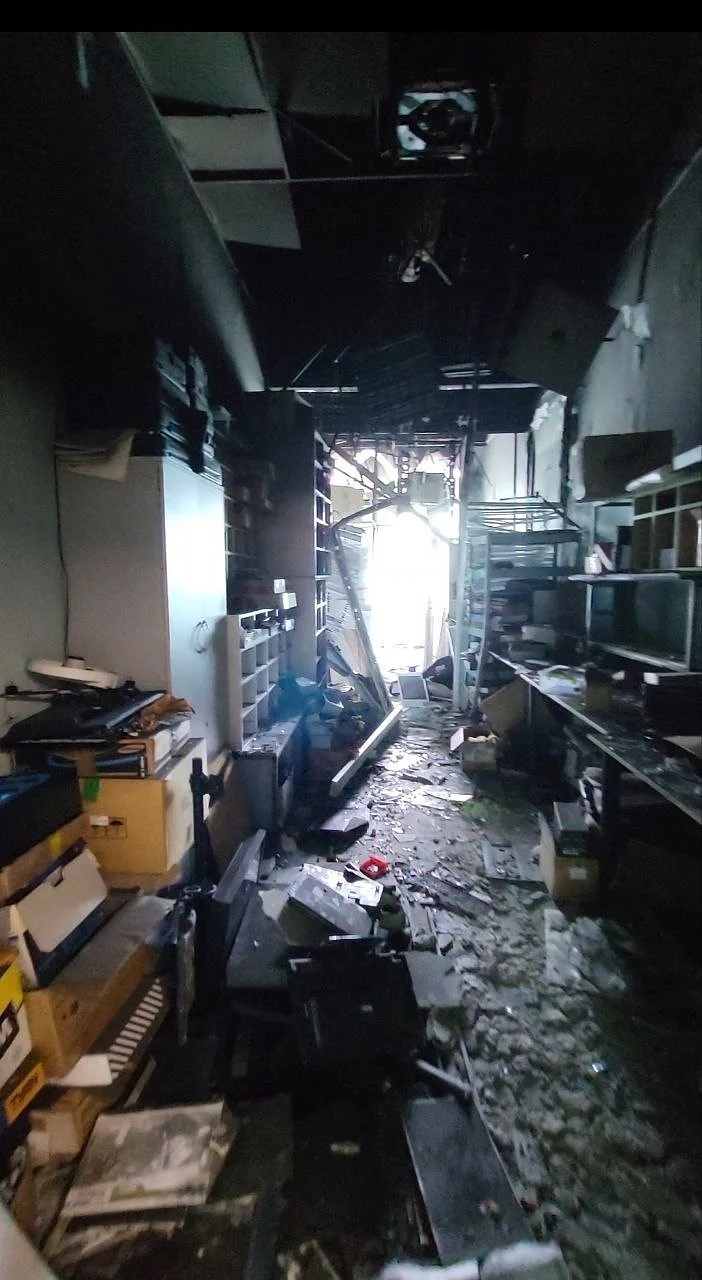
In the summer of 2026, Russian forces launched a targeted hunt for Ukrainian digital infrastructure. One of the first drone strikes in Kyiv was the data center of one of the largest cloud service and colocation operators, De Novo.
In the summer of 2026, Russian forces launched a targeted hunt for Ukrainian digital infrastructure. One of the first drone strikes in Kyiv was the data center of one of the largest cloud service and colocation operators, De Novo.
Despite the destruction, knocked-out walls, and hours-long fires, customer services were not disrupted, and no critical systems or banking transactions were disrupted.
De Novo CEO Maksym Ageev met with journalists and frankly told how the company saved iron in gas masks, why the concept of classic SLA no longer works, why digital Kyiv is rapidly emptying, what hinders migration to western Ukraine and abroad, and what threatens the loss of technological sovereignty.
About Day "D" and shutting down servers in gas masks
This year was clearly divided into “before” and “after” July, when the Russians began a targeted program to destroy data centers. De Novo was one of the first to be hit in the capital.
"We’ve been preparing since the beginning of the year. We kind of understood what was coming. But to say that we were shocked is an understatement. You never know in advance how you’ll behave under such stress. This story cannot be rehearsed in civil defense training. The damage to our facility was extremely severe. We’ve already spent over $200,000 just to dismantle the damaged part of the building and remove construction debris after the flights."
Despite the direct hit, the playground was not disconnected from the power supply:
"We were on fire for six hours… Everything burned down. But on backup sites we managed to maintain continuous operation of client services, for example, one of the largest national payment systems. When after that someone starts talking about formal SLA… Guys, SLA in its pure form does not exist during war. If engineers kept the service up and running under attack, we should thank them, not issue fines."
"Did they read Lenin?": why did the Russians take up data centers only in the third year of the great war
Separately, Maksym Ageev drew attention to the change in the enemy’s tactics and the strange "pause" in targeted strikes on digital infrastructure, which lasted for more than four years of full-scale invasion:
"There is a targeted program to destroy digital infrastructure, and it makes clear technical sense. Frankly, I was even surprised why the Russians haven’t hit on all this before now. It’s like they read Lenin in their time — about the priority seizure and destruction of telegraphs, bridges, stations and telephones.
It seems that they finally realized that modern data centers are the very "telegraphs and telephones" of the 21st century. However, this plan failed: despite the crazy money spent on Ukrainian data centers, they were unable to stop the country’s digital life.
Why did the enemy spend hundreds of millions but not put a Ukrainian "number" on it?
The Russians spent amounts on attacks on data centers that significantly exceed the book value of the facilities themselves, but the result was zero: any Ukrainian can still go to the bank, call a taxi, or buy a theater ticket.
The reasons for stability lie in the architecture of the domestic market. Here they are.
The effect of "mercury drops". Ukrainian infrastructure is compact and extremely decentralized. Yandex’s 12 MW data center in the Russian Federation is far from the largest, larger than all of Ukraine’s commercial capacities combined. The Russians have plenty of room to fall. Ukrainian resources are scattered across the country in small clusters.
Paradigm shift: data instead of walls. De Novo changed its focus at the beginning of the year: the main thing is not the building of the data center, but the preservation and availability of customer data. Walls, generators and estimates are the problems of shareholders and insurers, not the user.
Prompt response from telecom and energy companies. Connectivity and highways withstood the load, allowing for quick traffic maneuvering.
"Digital Kyiv is empty": a major redistribution of capacity
Today, the capital, which for years concentrated the lion’s share of Ukraine’s server capacity, is rapidly freeing up racks. Kyiv’s data centers are currently half-empty or two-thirds empty.
"Colocation customers are in a dead end. Cloud providers are flexible: we have raised clusters in other places and transferred the load. And the company with its hardware cabinets in Kyiv is sitting as a hostage. The colocation operator is like a hotel owner: if the hotel is on fire, you cannot move the tenant to the next one, because the owner is different there."
Why the West is not saving Ukraine
The mass attempt to find shelter in the western regions has run into strict infrastructure limits. First, there is no such capacity. No regional site is capable of simultaneously accepting 20 or 50 stands — they only offer two or three.
Second, there is a lack of power and cooling. A modern cloud rack consumes 10–15 kW. Local locations are designed for base loads and do not have multi-level generator redundancy and fuel reserves for several days of autonomous operation.
Third, timing and capex. Re-equipping or building a facility from scratch requires from a year to a year and a half and significant investments.
Migration to Western Europe
Almost all major providers have drastically changed the proportion of locations. If until July 2026, 80–90% of De Novo’s resources were located in Ukraine, then by the end of the year the ratio will reach 50:50.
The company is investing about $8–10 million in deploying additional sites, in particular, developing its cluster in Germany, considering it safer and more reliable than the closer Polish data centers. The private sector is moving to foreign sites by almost 80%.
Industry response: a sustainable national infrastructure strategy
The main problem with current migration abroad or to the west of the country is its chaos. Maksym Ageyev directly calls it a digital “Makhnovism”:
"Now every ministry or department has its own cart: whoever wants to go where they want to go. It’s hard to catch such a Makhnovist army, but we all remember from history how it ended: the systemic Red Army eventually defeated it. You can’t fight against the system without your own system."
To overcome this chaos, Ukrainian commercial operators have already united in the Digital Sovereignty Alliance (they hold joint coordination meetings every week) and developed a comprehensive Strategy for Creating a Resilient National Digital Infrastructure. It was submitted to the Ministry of Digital Affairs back in the spring.
What should the future of Ukrainian "digital" look like:
A network of distributed nodes instead of giants. The market should abandon gigantism forever: large data centers are as vulnerable as dinosaurs. Instead, it is proposed to deploy a network of 5–10 small or medium-sized data centers, physically dispersed throughout the territory of Ukraine.
Complete technological homogeneity. In order for data to circulate freely across the country, the infrastructure should not be a “patchwork quilt.” Providers should use identical hypervisors, a unified approach to applications, and cloud-agnostic principles. To this end, the Alliance proposed to establish standards at the industry White Book level.
A single Control Plane for the state. The architectural pinnacle of the concept is a single logical multi-cloud control panel.
Maksym Ageev: "It’s like an admin’s workplace with three or four monitors: he sees all the state clouds and servers of different operators and can literally drag the load between data centers with the mouse in case of a threat. Today, the state does not know centrally where, who owns, and how much of its resources are located. A single Control Plane returns control to the hands of the national administrator."
Market in numbers: estimates for the end of 2026
Despite the war, digitalization is demonstrating rapid dynamics.
Growth of the Ukrainian cloud market: no less than +40–45% by the end of 2026.
The volume of the commercial (visible) cloud market: expected to be at the level of UAH 9–9.5 billion (for comparison: the market for physical data centers is estimated at a modest UAH 900–950 million, where more than half of the revenue is eaten up by the increase in electricity tariffs).
Donor aid (invisible part): estimated at another UAH 4.5 billion (over $100 million). These are mostly grant packages and bill payments through IT-Rammstein mechanisms, coalitions, and NATO funds, in particular for the deployment of critical systems of the Delta scale.
The share of Ukrainian players: domestic providers are growing proportionally (by 40–45%), will exceed the threshold of UAH 2 billion in total, but control less than 25% of the paid segment.
Hyperscalers: if we take into account the paid and donor parts, American corporations (AWS, Microsoft Azure, Google Cloud) hold about 80% of the Ukrainian cloud market. At the same time, AWS is showing a rapid growth rate in 2026, while Azure’s pace has slowed down somewhat due to the revision of free support programs.
Myths about underground data centers and strategic dead ends
As Maksym says, the idea of building secure underground bunker data centers was actively circulating in the offices of the National Security and Defense Council, the Ministry of Digital Affairs, and the Ministry of Defense, but commercial calculations put an end to it.
First, the economy will not survive: renting a regular rack in Ukraine costs $500–600 (in high-end data centers — $800–1000). The cost of placing one rack in a deep underground facility, taking into account heat removal, ventilation, and autonomous power supply, will reach $5,000–$10,000 per month.
The second is capex: the construction of one such facility will cost at least $30–40 million.
Commercial investors and customers will never compensate for such costs. Only the state itself can build and maintain an underground data center exclusively for its own defense needs, without considering profitability.
Staff shortage, high iron prices, and currency stranglehold
The Ukrainian IT sector is fighting for survival against the backdrop of several critical challenges.
This is the Global Hardware Shortage. The global AI boom has taken apart servers, processors, and memory months in advance. Configurations that cost $3 million last year now cost $10 million, and delivery times are 9–10 months. Any large-scale AI experiments are mostly on hold for now — tensor maps are being hidden until better times so as not to lose equipment under fire.
Another significant challenge is the NBU’s currency restrictions. Ukrainian operators earn in hryvnia, but are forced to build new platforms in Europe. Buying currency and transferring it abroad to purchase servers is almost impossible due to strict regulations, and one has to look for complex additional credit structures.
Let’s not forget about engineers. Unlike Western colleagues who optimistically discuss staff optimization through AI, Ukrainian data centers experience an acute shortage of specialists on the ground. Engineering teams have to constantly travel around the country, install racks and change power supplies in regional nodes, which comes up against the issue of timely booking and general availability of personnel on the market.
"Build for whom?": the main question for the state
The industry’s biggest strategic fear is the irreparable loss of data sovereignty. By pushing businesses and government agencies to “Go West,” Ukraine risks finding itself at an empty trough after active hostilities end.
"Today we have turned into a kind of 'non-existent operator': there is no office, the central data center is broken, resources are scattered. But we are fully operational. This is a planetary experiment — no country in the world has managed its digital landscape in conditions where half of the infrastructure has been forcibly moved beyond its borders."
But the question arises: if 50–70% of clients settle in Frankfurt or Warsaw, for whom will we rebuild the infrastructure in Ukraine? The war made us more expensive: the Pole has one generator and 5 tons of diesel fuel, we have four generators, 25 tons of fuel and constant repairs. If our accommodation costs more than European accommodation, no one will return here.
"Now our only task is to patch the holes, survive the winter and survive until spring. And then the state and the market will have to give an honest answer: are we returning digital sovereignty or are we finally turning into consumers of Western resources."
Maksym is worried that over time, engineers will also go after the servers. And top management will go after the engineers. Then who will remain in the capital? For years, a digital infrastructure worth hundreds of millions of dollars has been built in Kyiv — data centers, traffic exchange points, operator platforms. It will definitely not be possible to recreate the same one faster and cheaper.