Хочете будувати кар’єру в Data Science та AI? Vodafone Big Data Lab відкриває новий набір —>
Марія БровінськаWork
5 October 2026, 16:06
2026-10-05
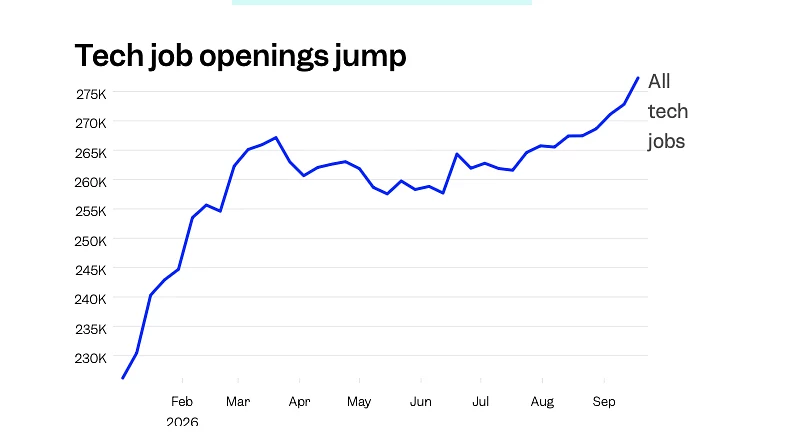
AI was supposed to take jobs away from programmers. Instead, tech companies created over 280,000 jobs
Predictions that AI will massively reduce the need for programmers have yet to be borne out by hiring data. Tech companies are once again adding to their hiring pipeline, and demand for software engineers remains high.
Predictions that AI will massively reduce the need for programmers have yet to be borne out by hiring data. Tech companies are once again adding to their hiring pipeline, and demand for software engineers remains high.
According to TrueUp data analyzed by Business Insider, companies currently have over 280,000 open tech positions.
TrueUp tracks job openings at more than 9,000 tech companies. According to the service, the number of open positions in tech increased by 22,7% to 216,625 positions in the categories that the service tracks separately. The number of vacancies for software engineers increased by 34,1% to 54,747.
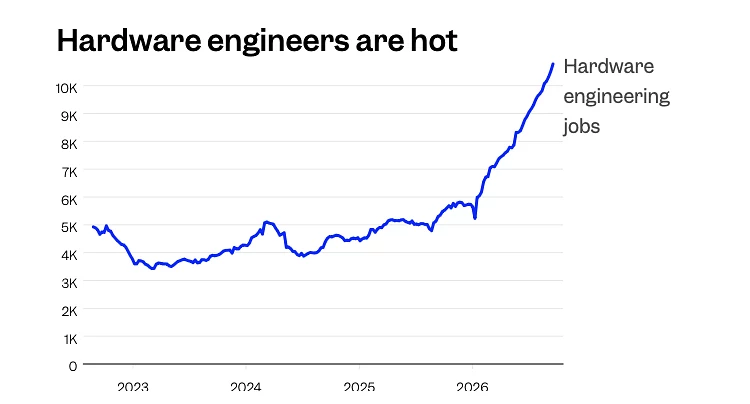
The demand for Data Science and Machine Learning specialists is growing even faster. The number of such vacancies has increased by 90,1% over the year, to 9,075. The demand for hardware engineers is also increasing: 4,004 positions are open in the category, which is 14,4% more.
AI isn’t taking away engineers — it’s changing demand
Business Insider notes that the need for engineers who work with the physical infrastructure for AI: chips, servers, data centers, robots, and manufacturing is growing especially rapidly.
At the same time, the hiring of software engineers is not showing the expected collapse after the emergence of AI coding tools. On the contrary, the number of such vacancies is growing.
According to TrueUp, Python, AWS, Kubernetes, Java, and C++ remain among the most in-demand technologies for engineering jobs. LLM, TypeScript, Google Cloud, React, and SQL are also on the list.
In other words, AI is changing not so much the hiring of engineers as the requirements for them. Companies increasingly need specialists who can work at the intersection of software, AI, data, and infrastructure.
The fastest growing AI specialties
A separate signal for the IT market is the emergence of new engineering roles around AI. For example, Anthropic recently announced a $100 million investment in a program to train 10,000 so-called Frontier Deployed Engineers — specialists who will help companies move AI projects from experiments to real-world use.
According to Business Insider, the number of vacancies for such engineers at five large consulting firms has increased to 1,404 in a year, although the total number of vacancies at these companies has decreased by about a quarter.
Thus, AI does not yet look like a technology that simply “takes jobs away from programmers.” Rather, it is changing the structure of demand: companies continue to hire software engineers, but at the same time sharply increase the need for AI, data, infrastructure, and hardware specialists.