AI writes up to 100% of the code for half of developers, but weakens their skills — study
For half of the engineers surveyed, AI is already writing 80% to 100% of the code, saving hours of work. At the same time, 76% of specialists notice a weakening of their own technical skills, and for most, the overall workload has only increased.
For half of the engineers surveyed, AI is already writing 80% to 100% of the code, saving hours of work. At the same time, 76% of specialists notice a weakening of their own technical skills, and for most, the overall workload has only increased.
These results were revealed by a joint study by the educational platform Mate academy and the fintech company Solidgate. The survey included 414 engineers, 66% of whom work in Ukraine and 34% abroad (mainly in Poland and the USA).
How engineers work with agents
The vast majority of respondents (71%) interact with AI via the command line interface (CLI), and almost half run three or more AI agents simultaneously. Instead of standard settings, developers select models for specific tasks: Claude is most often chosen, followed by GPT-5.x and Gemini.
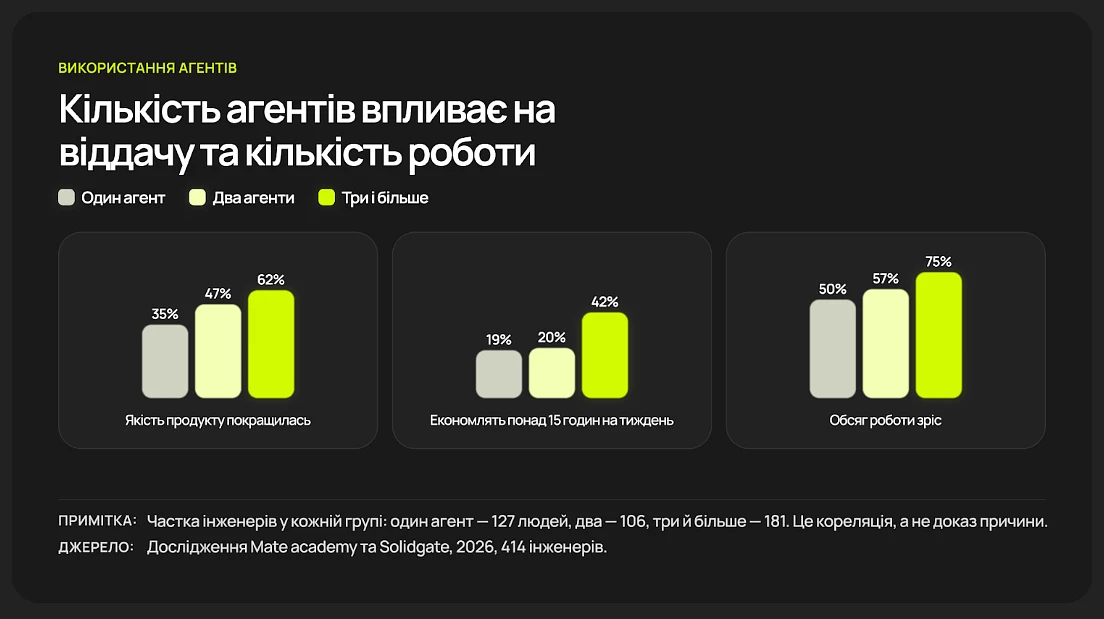
Using multiple agents directly impacts productivity. Among those who work with three or more agents, 62% report improved product quality (versus 35% of single-agent users). This group is also twice as likely to save more than 15 hours per week — 42% vs. 19%.
“The engineer now does not write code, but sets a task for the agent and is responsible for the result. In essence, he manages a team of agents. For this to work, the agent must see the context: we have Claude Code connected to ClickUp, PagerDuty and, for read-only purposes, to AWS. So the developer does not copy the context of the task manually, but gives the agent the task from start to finish,” explains Yuriy Golyuk, CTO of Mate academy.
Additional time is also saved by checking the generated code with tests (more than 10 hours per week saves 47% versus 29% for the rest) and working via CLI (46% versus 33%).
Mate academy infographics
More speed means more tasks and errors
The time saved did not reduce workload: 75% of engineers running three or more agents experienced an increase in workload. One in three of them run three to six tasks in parallel, and 12% run six to ten (only 1% of single-agent users run that many tasks simultaneously).
At the same time, quality control is becoming a weak point. Although most developers test and proofread AI code, 18% review it more leniently than human code, 7% do not review it at all, and 6% “take it at its word.” Among those for whom AI writes 80–100% of the code, the share of lenient or absent review reaches 31%.
In open responses, engineers shared the most expensive incidents caused by AI:
tests with production access keys deleted the production database;
an agent left in the loop overnight spent $12,000 on API requests;
The invented AI function went through an automated review, causing the company to lose several major clients.
Skills degradation and the “test tax”
Mate academy infographics
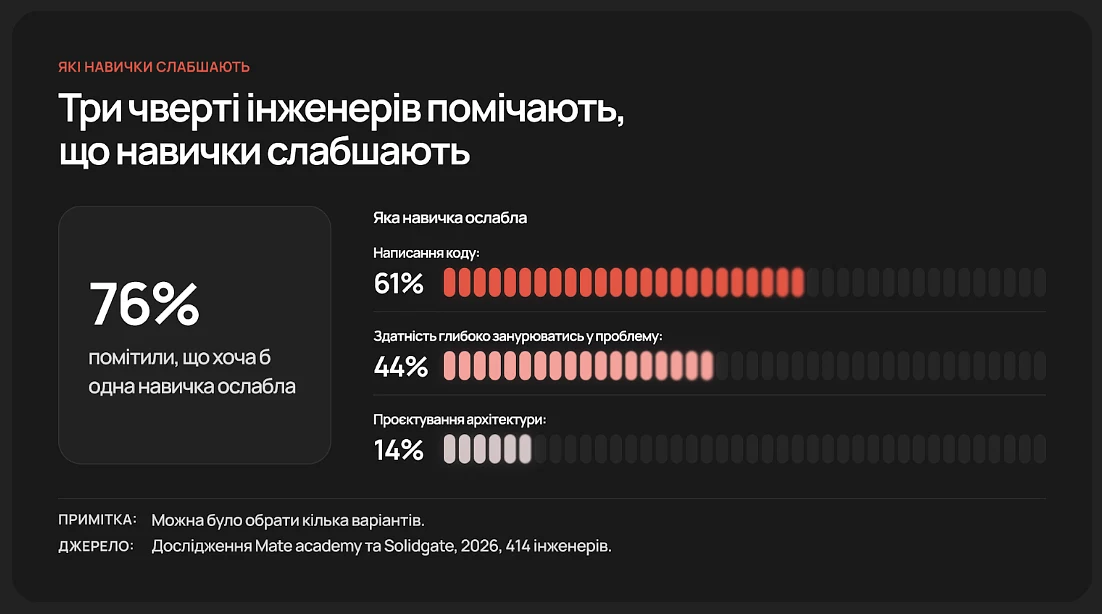
Three-quarters of respondents (76%) reported a decline in their skills. Most often, specialists lose their ability to directly write code (61%) and the ability to delve deeply into a problem (44%). To stay in shape, some developers deliberately write code by hand in pet projects, during training, or while solving problems on LeetCode.
"What we see in the survey is what DORA calls the 'review tax': agents generate more code, and the volume of reviews grows with it. If an engineer doesn't have time to review, he starts to review leniently - hence the 31% among those who have AI writing almost all the code. The answer is not only to review faster, but to change the review approach as such," says Max Baginsky, Head of Engineering at Solidgate.
The Mate academy and Solidgate survey was conducted online in September–October 2026. The majority of its participants (61%) work in product companies, and the largest group in terms of experience was made up of Senior-level specialists. The study authors emphasize that the identified relationships between indicators are statistical correlations, and not evidence of a direct cause-and-effect relationship.