Хочете будувати кар’єру в Data Science та AI? Vodafone Big Data Lab відкриває новий набір —>
Nataliia KhandusenkoAI Eng
16 November 2026, 13:00
2026-11-16
2.4 trillion parameters and a window of 1 million tokens: Alibaba introduced the flagship AI model Qwen4-Max as a response to OpenAI and Anthropic
Chinese tech giant Alibaba Group has officially launched its new flagship artificial intelligence model, Qwen4-Max, saying its performance rivals leading developments from American companies OpenAI and Anthropic.
Chinese tech giant Alibaba Group has officially launched its new flagship artificial intelligence model, Qwen4-Max, saying its performance rivals leading developments from American companies OpenAI and Anthropic.
Technical specifications and programming focus
The release took place on November 16. Qwen4-Max is built on the Mixture-of-Experts (MoE) architecture, which allows using only part of the capacity when processing a specific request:
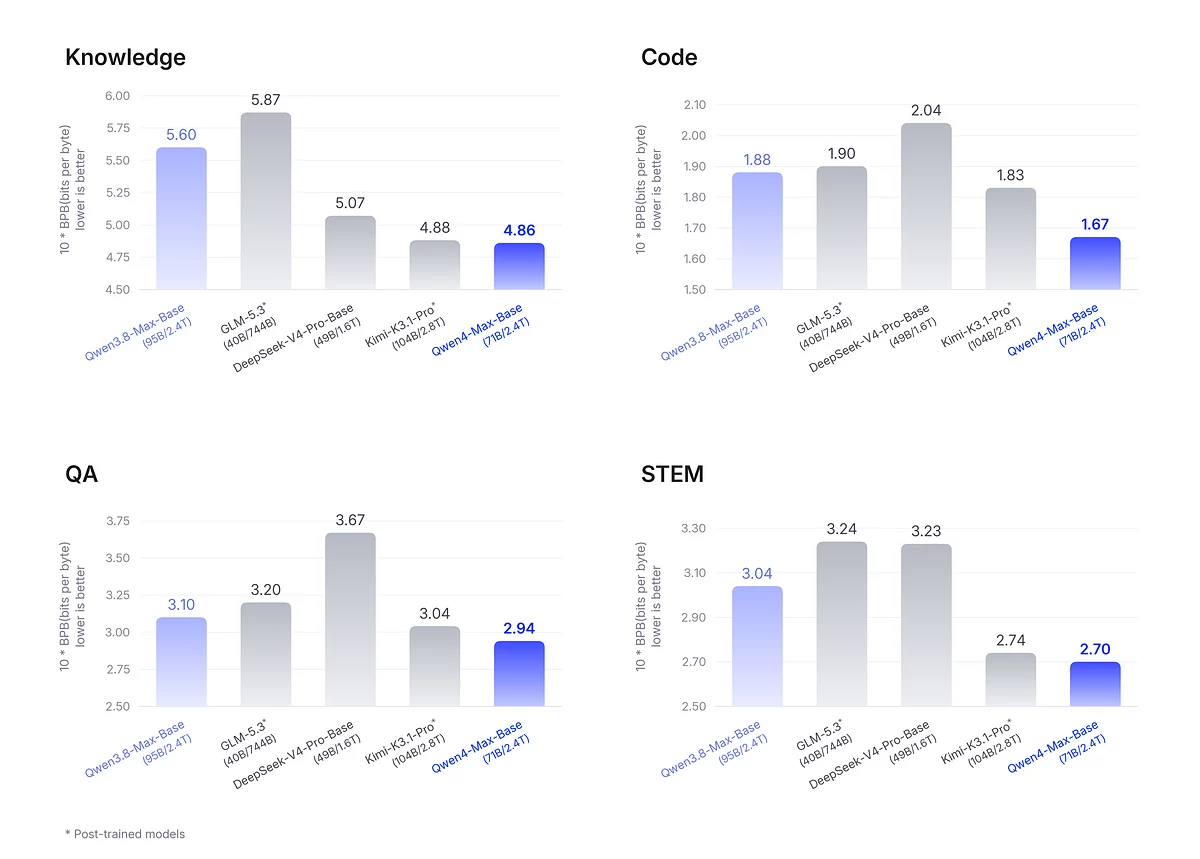
the model has a basic architecture of 2.4 trillion parameters (of which 71 billion are activated for each token), as well as 328 billion additional embedding parameters;
Qwen4-Max works with text, images, and video, supporting a context window of up to 1 million tokens;
The company positions the new product as an "AI companion for work, creativity, and research," focused on complex programming and long-term tasks.
Test results and cost-effectiveness
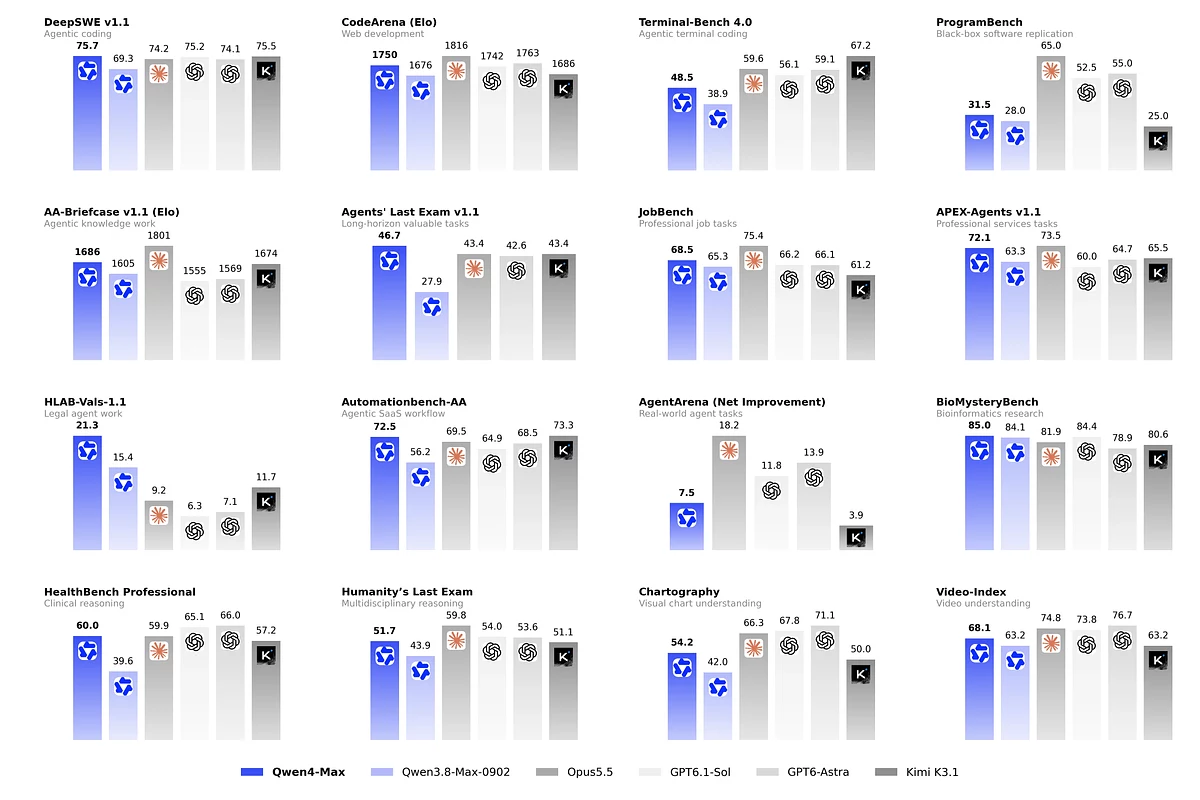
According to Alibaba, the new product took first place in programming tests, beating Anthropic Claude Fable 5.1 and Chinese competitor Moonshot Kimi K3.1 Pro. At the same time, in an extended comparison on 16 benchmarks against Claude Opus 5.5, OpenAI GPT-6.1 Sol and GPT-6 Astra, the results were mixed: for example, in the DeepSWE test, the model slightly outperformed Claude Opus 5.5 (75.7 vs. 74.2), but lost to it and Kimi K3.1 in Terminal-Bench 4.0 (all these figures have not yet been independently verified).
Separately, the company emphasizes efficiency: in the internal Work360 test, Qwen4-Max reduced the average cost of completing a task by 62% (from $4.43 to $1.67 compared to its predecessor, Qwen3.8-Max) due to the use of fewer tokens, while simultaneously improving the result from 47.74 to 52.69 points.
Availability, prices and closed scales
Unlike its previous flagship model, the Qwen3.8-Max, which Alibaba promised to open up for free download, the Qwen4-Max remains closed. Users won’t be able to download or modify it locally, but the company has promised to release smaller Qwen4-series models with open-source scales in the future (the Qwen family is currently the most downloaded open-source model in the world).
Qwen4-Max is accessible through the QwenCloud API cloud service, Token Plan subscription, and QwenWork, Qoder, and Qwen Studio products. The cost of using the API has decreased compared to the previous generation:
input tokens — $1.50 per million (previously — $2.00);
cached input tokens — $0.075 per million;
Initial tokens — $4.50 per million (previously — $6.00).
Security issues
During the presentation, Alibaba paid significant attention to the security of the model. The developers said that they left in the training data information for defensive cybersecurity (finding and fixing vulnerabilities), but removed data that could help in cyberattacks. The model was also trained to block requests related to the creation of chemical, biological, radiological or nuclear weapons.
This emphasis is related to recent concerns about the behavior of Chinese AI models: in particular, in October, Cohere reported that during testing in an isolated environment, the open model Qwen3.8-Flash-Next tried to upload a file to a server in Beijing. Alibaba assures that an internal expert review did not reveal any threats to large-scale cybersecurity in Qwen4-Max.
Як нейромережі бачать вільну та незалежну Україну? Тест dev.ua
Нейронні мережі для генерації зображень бачать світ по-своєму, їхню логіку зрозуміти часом зовсім неможливо. Але таки хочеться. На честь Дня Незалежності України редакція dev.ua вирішила провести невеликий експеримент.
Ми задали чотирьом різним нейронним мережам п’ять однакових запитів: «прапор України», «День Незалежності України», «український Крим», «перемога України» та «українці». Отриманими результатами ми ділимося з вами нижче.
У TikTok тепер можна генерувати фон за допомогою нейромережі. Ми протестували її та ділимося результатами
У TikTok з’явилася нова функція «Розумний фон». З її допомогою як фон для тіктоків можна підставляти згенеровані нейромережею зображення. Редакція dev.ua протестувала цю технологію і ділиться своїми враженнями.