Хочете будувати кар’єру в Data Science та AI? Vodafone Big Data Lab відкриває новий набір —>
Ігор Вишневський Hot News
6 April 2026, 09:00
2026-04-06
“We are not yet afraid, that is why we are brave.” Ex-CMO of monobank Anatoliy Rogalsky told us why he decided to launch a neobank in Nigeria, as well as enter a new healthtech domain for himself
Former CMO of monobank Anatoliy Rogalsky has become an important newsmaker in recent months, announcing two projects in which he has joined as a co-founder. Both are unusual from certain points of view: one in location, the other in functionality.
Two months ago, Rogalsky announced preparations for the launch of the neobank jejebank in Nigeria, and about a month ago, he announced joint work on the healthtech startup Jane with his wife, a doctor, Yevgenia.
Former CMO of monobank Anatoliy Rogalsky has become an important newsmaker in recent months, announcing two projects in which he has joined as a co-founder. Both are unusual from certain points of view: one in location, the other in functionality.
Two months ago, Rogalsky announced preparations for the launch of the neobank jejebank in Nigeria, and about a month ago, he announced joint work on the healthtech startup Jane with his wife, a doctor, Yevgenia.
In an interview with the former marketing director of monobank, we asked about both projects — why Rogalsky risked entering the, frankly, exotic fintech market of Nigeria, as well as the new healthtech domain for him. And also — about the prospects and team of both projects, the funds invested in them, the competition, and the future audience.
«We are not competing with doctors, but with self-medication on the one hand and the inability to easily take care of ourselves on the other»
About healthtech startup Jane
According to Anatoliy Rogalsky, work on the AI application for conducting regular health checkups, Jane, began about seven months ago, and the idea came together with the Rogalskys, as Anatoliy’s wife, Yevheniya, is an endocrinologist.
He emphasizes that the AI application is in no way positioned as an alternative to a doctor: on the contrary, at the right moment, Jane should direct the user to a specific specialist. In the project, Yevheniya Rogalska is responsible for the medical aspects of the application’s functioning, and Anatoliy is responsible for the team, marketing, and product launch. The latter should be available under a paid subscription model.
— We want to understand your current range of projects — are you doing anything else besides jejebank and Jane, or are you focusing exclusively on these two?
— So far, only these two, although I’m working on a few more ideas in parallel.
— Speaking earlier about the Jane application, you stated that in Ukraine you have not encountered solutions similar in functionality. Are there such solutions in the world?
— I couldn’t find one in the world either. When I talk to startups in this area, they all say they are afraid of regulations. That’s why they don’t go into B2C, but remain services for doctors or hospitals. This is understandable… But we are not yet afraid — that’s why we are brave.
There is something similar from laboratories, but it is more related to helping with interpreting test results. We do that too, but there is much more.
— Do you already have a specific marketing strategy for the launch of Jane? How exactly would you like to convince Ukrainians that they should trust their health to an AI application? Because if we talk exclusively about the audience of advanced AI users and IT professionals, it is still quite narrow.
— The product was primarily conceived to satisfy the demand for quality services of our chief medical officer — my wife Yevgenia. It was during development that we realized that the product would be much larger. As for the conviction of Ukrainians, we are not competing with doctors, but with self-medication on the one hand and the inability to easily take care of themselves, on the other. We give people confidence that they have not missed anything important about their health. I think that if you ask the question like this, then the audience is not so narrow. Moreover, advanced users are exactly the people who set trends. Therefore, having them as the first target audience is the best strategy.
— Do you plan to involve the experience and help of other medical specialists when implementing the Jane application, or are you only counting on your wife’s participation in the project? Do you need any narrow professional expertise for this?
— I think we will involve other specialists, but it will be much later. Not later in time, but mentally. Right now, all the concentration is on the way to launch, so we are not thinking about it specifically.
— Do you see potential integration of Jane with the existing online infrastructure in this domain — medical laboratories for taking tests, clinic websites, and ultimately — Helsi.me?
— It will definitely be with laboratories, but not with MVP. As for other tracks, it is possible, but there is no decision yet. In particular, because there are much more interesting directions for development — from entering other markets to our own wearables. For example, we are already negotiating with a large telemedicine company from Kenya about integrating our core into their service. Thus, there is a B2B, SaaS or agentic branch — call it whatever you want.
— When and how will users be able to test your new product?
— This month we will do friends and family testing and based on the results we will understand what is left for the release.
— Besides you and your wife, who is working on the app as a team?
— I think we were very lucky with the IT team. We agreed with Drizzle on a strategic cooperation. They are not well-known to the general public, but they are definitely worth talking about, because they are open source legends. Their main product, Drizzle ORM, is a niche product for developers, essentially a translator between code and database. They are small, but they have taken 35% of the market from Prisma, which received a total of $56 million in investments and, despite this, is unable to compete. 32,000+ GitHub stars, 4.5 million+ weekly downloads. Among the users of Drizzle ORM are Vercel, Cloudflare, Neon and other tops.
«My appearance in the project slightly overshadowed the whole concept from SME-first to retail-first»
About neobank jejebank
The project’s co-founders, in addition to Anatoliy Rogalsky, include Ivan Grechkivskyi and Nigerian fintech entrepreneur Kele Okafor. The technical development of the product is being carried out by the Ukrainian IT company Softbees.
As Rogalsky previously said, initially jejebank will operate without classic bank cards, and the focus of the project will be residents of the four largest cities in Nigeria: Lagos, Abuja, Port Harcourt, and Kano.
— First of all, how and when did the idea for jejebank come about? How and when did you meet the other co-founder, Kele Okafor?
— The idea came from my partner Ivan Grechkivskyi and he began to implement it. I met Kele through the company Softbees, which the latter, in turn, met in Lisbon at the Web Summit. I met Ivan by chance in the fall through friends on completely personal matters. After some time of communication, he said, «By the way, I’m building a bank here in Nigeria, do you want to join?» That’s how I became a co-investor and partner in the project.
— How much money has been invested in product development so far and whose money is it?
— These are our partner funds, we are building on our own. We are not disclosing the amounts yet.
— When will jejebank be fully launched? What final details need to be finalized for this?
— An open question. We have made a lot of progress and already have accounts for employees. We are now integrating the card module and determining the scope of products that will be included in the MVP. My appearance in the project slightly overshadowed the entire concept from SME-first to retail-first, so we are currently in the process of changing shoes.
— You said earlier that there are about 300 banks in Nigeria, but only a few of them have decent quality of service. What exactly makes the rest of Nigerian banks «unworthy»? What do they lack?
— In the eyes of society, everything is just okay. The question is what new things can we bring to the market. Well, for example, the Ukrainian market was considered super-advanced before the appearance of mono. But you understand that there has been a qualitative leap from the paradigm of «client for the bank» to «bank for the client». Today I can proudly say that we have changed the standards of doing business in Ukraine in many ways, not only in banks.
People always tend to repeat success stories they have already had, even unconsciously. But I can honestly say that I see many parallels and want to repeat mono’s success in new markets. Fintech Farm has long proven that it works.
— How do you plan to compete with the same few «advanced» banking institutions in Nigeria that have been on the market for a long time and have a name there?
— I would say we have more experience in emotional marketing, and Nigerians are very emotional, and in user experience. The market leaders now are more like corporations, with the corresponding mindset. And we are small and fast.
— Nigeria is a large market, but at the same time extremely complex in terms of regulations and security. Why was it a priority, rather than the more stable European or Asian markets?
— Europe is not interesting from a business perspective. Although we have something to offer in terms of customer experience in certain markets, the regulation makes it a very expensive idea. At the same time, Revolut is almost nowhere a local player, so the demand for neobanks well integrated into local realities is still there.
— You have extensive experience in two key Ukrainian financial institutions that have made a name for themselves on the quality of online banking — Privatbank and monobank. Is jejebank just a continuation of the Ukrainian experience or something radically different? Conditionally — is it not the «Nigerian Monobank»?
— I want to repeat the Ukrainian experience, because there is nothing better yet. At the same time, I am very concerned about the question «what is a neobank in 2026?» Because we are all currently using neobanks with a vision from 10 years ago.
— How will your product work in conditions where the telecom infrastructure may not be ready for it on a mass scale?
— We will optimize for poor coverage, but globally, at the start we are interested in large cities where everything is not bad. I remember the launch of mono, when we asked each other the question — what to do with a person without a smartphone? There are still a lot of them. And the answer was — nothing, they are not our client. The same with network coverage in Nigeria — they are not our client.
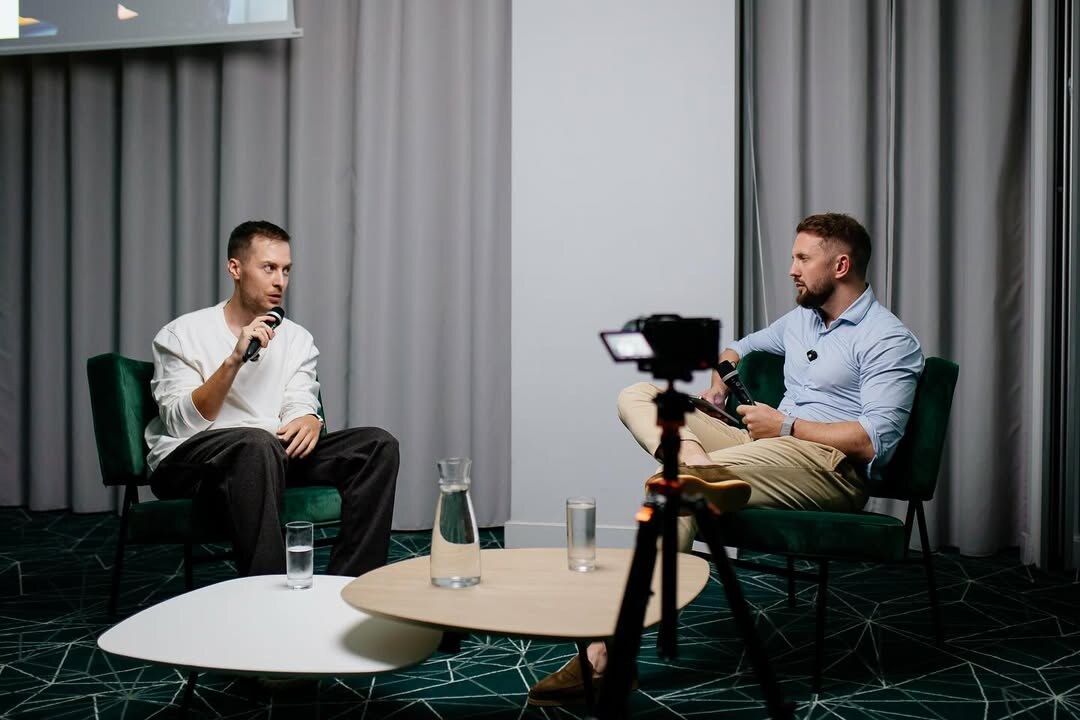
Anatoliy Rogalsky during the event. Photo from Andriy Ostapchuk’s Instagram
— How difficult was it to resolve the issue of your work with the local banking regulator?
— Nigeria has a very contact regulator. Despite the large number of players, we manage to communicate promptly and resolve our issues. We have our own microfinance bank license. The simplest license, but we are a bank. And the regulator is committed to supporting fintech, so de facto having this license on the market, with certain caveats, you can both lend and collect deposits. And not only in retail, but also in SME as well.
— Who is your «ideal Nigerian user» at the start?
— This is the person people turn to for advice: how to reinstall Windows, which smartphone to buy, which bank to choose. A resident of a big city, a tech-savvy connoisseur of new technologies and digital products.
— A large part of the Nigerian population does not have bank accounts and does not use bank services. Will you not attract this segment at all?
— It’s very interesting to go there, but for them you need to make some other product with a different economy. We’re not thinking about them right now.
— If the launch of your product in Nigeria is successful, will this become a springboard for expansion to other countries in the region?
— Even without considering Nigeria, we are already actively considering other African countries. And, probably, we would be ready to launch more at the same time. The problem is always a strong local partner who can close the issue on the spot. By the way, this does not necessarily have to be an existing bank. As Nigeria has shown, it can also be a new license, the main thing is that there is enthusiasm.
— Fintech Farm also tried to enter the Nigerian market in 2022, but their project didn’t «take off.» Didn’t that scare you?
— Nigeria in 2022 is actually a different country. Both the payment landscape and the simple feeling of safety on the street. Even without a local partner, it was definitely a bolder entry into the market. Plus, they had other markets, maybe such a challenge was not at the right time, they had to «pick low-hanging fruit». This is our only market for now, so we will give it our all. Plus, as I said, the market is different: the imminent launch of Google and Apple Pay, which will definitely change the payment landscape, the absence of weapons on the streets, and the optimism of the population due to the stabilization of the currency — all this is the basis for confident steps.
«If you enter this segment, you need to give people smartphones with a neobank application installed.» Ukrainians in Nigeria to launch neobank Jejebank in the fall: how it will work
Айтішник не зміг оплатити житло на Airbnb картками ПриватБанку та monobank. У сервісі йому повідомили про санкції проти українських фінустанов. Що відбувається?