Хочете будувати кар’єру в Data Science та AI? Vodafone Big Data Lab відкриває новий набір —>
Олександр КузьменкоAI Eng
16 October 2025, 17:34
2025-10-16
Two graduate students improved the quality of images from the James Webb Telescope using only software
Two Sydney graduate students have managed to fix the sharpness of images on NASA’s most powerful space telescope, the James Webb Space Telescope, without repairing its hardware. They have gotten tattoos of NASA’s telescope to commemorate the achievement.
Two Sydney graduate students have managed to fix the sharpness of images on NASA’s most powerful space telescope, the James Webb Space Telescope, without repairing its hardware. They have gotten tattoos of NASA’s telescope to commemorate the achievement.
As reported by EurekAlert, the work of Louis Desdoag and Max Charles allowed researchers from the University of Sydney to develop software that corrected the blurring of images taken by the multi-billion dollar James Webb Space Telescope (JWST).
This achievement is based on the only Australian-developed piece of JWST equipment, the Aperture Masking Interferometer (AMI), created by Professor Peter Tuthill from the Department of Physics at the University of Sydney and the Sydney Institute of Astronomy. AMI allows astronomers to obtain ultra-high-resolution images of stars and exoplanets by combining light from multiple sections of the telescope’s primary mirror.
However, after JWST began operating, scientists discovered that AMI performance was deteriorating due to minor electronic distortions in the camera’s infrared detector, resulting in blurry reconstructed images—a similar problem to JWST’s predecessor, the Hubble Space Telescope, which suffered from «blurry vision» after launch and required a space shuttle mission and astronauts to walk into space to fix.
Instead of developing a new lens or organizing an expensive repair mission, graduate students Louis Desdoigts and Max Charles created a data-driven, software-only calibration system that corrects focus from Earth.
Their system, called AMIGO (Aperture Masking Interferometry Generative Observations), uses advanced simulations and neural networks to model the behavior of the telescope’s optics and electronics in space. By understanding the imperfection in which electrical charge flows to neighboring pixels, the team developed algorithms that «blurred» the image and restored AMI’s full sensitivity.
«Instead of sending astronauts to install new parts, they were able to fix the situation using code,» said Professor Tuthill.
With AMIGO, the James Webb Space Telescope achieved the sharpest ever detection of faint celestial objects, including a direct image of a faint exoplanet and a red-brown dwarf orbiting the nearby star HD 206893, which is about 133 light-years from Earth.
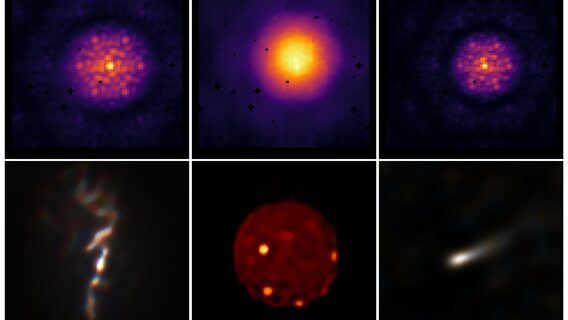
A companion study led by Max Charles, a graduate student in Sydney, demonstrated AMI’s renewed focus by taking high-quality images of a black hole jet, the volcanic surface of one of Jupiter’s moons (Io), and the dusty stellar winds of WR 137, pushing the boundaries of JWST’s capabilities.
«This work makes the vision of JWST even clearer. It is incredibly gratifying to see how a software solution expands the scientific capabilities of the telescope, and to know that this has become possible without even leaving the laboratory,» said Dr. Desdoits.
Schoolchildren and students are invited to visit virtual space — to take part in the Noosphere Space Games virtual rocket modeling competition. How to apply