Наталя ХандусенкоHot News
18 February 2026, 11:28
2026-02-18
Scientists have created a microscopic QR code with a record data storage density of 2 TB per page
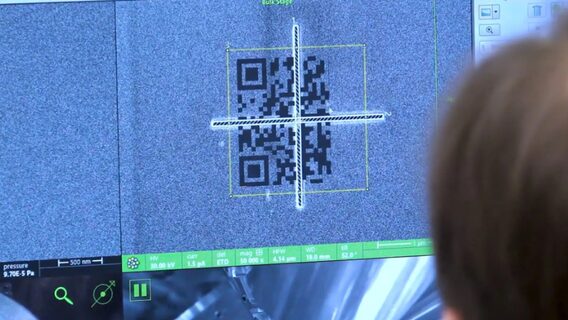
Scientists at the Vienna University of Technology, together with German startup Cerabyte, have created a QR code that is 37% smaller than the previous record holder. It is so tiny that it can only be seen with an electron microscope.
Scientists at the Vienna University of Technology, together with German startup Cerabyte, have created a QR code that is 37% smaller than the previous record holder. It is so tiny that it can only be seen with an electron microscope.
Their invention measures just 1.98 square micrometers, making it smaller than most bacteria. The Guinness Book of World Records recently officially confirmed this as a new world record, Interesting Engineering reports .
A big step for the data storage industry
Modern storage devices, such as hard drives, often fail within a few years. However, this new method uses thin ceramic films to achieve extreme durability. Such materials are typically used as coatings for high-performance cutting tools.
They remain stable under high temperatures and pressures. The team used focused ion beams to etch the code into the ceramic layer. Each pixel is about 49 nanometers wide, which is ten times smaller than the wavelength of visible light.
The code remains invisible to the human eye
"The structure we have created here is so thin that it is impossible to see it at all using optical microscopes," notes Professor Paul Mayrhofer.
He explains that while scientists can now manipulate individual atoms, such structures often shift over time, destroying the stored information.
"But even that's not the most impressive part. Micrometer-scale structures are not uncommon these days—it's even possible to create patterns from individual atoms. However, that alone doesn't provide stable and readable code."
Individual atoms often move and fill in the gaps, destroying data. A team from the Vienna University of Technology has solved this stability problem. “What we have done is something fundamentally different,” explains Mayrhofer.
“We have created a tiny but stable QR code that can be read multiple times.” This stability ensures that data will be preserved for centuries.
High density and low power consumption
The potential for data storage using this ceramic technology is simply staggering. A single sheet of A4 paper could hold over 2 terabytes of information. Unlike modern data centers, such media require neither cooling nor electricity.
They offer a “green” alternative for the information age. We currently rely on short-lived electronic media that require constant power. Without continuous maintenance and cooling, our digital history now risks simply disappearing.
“We live in the information age, but we store our knowledge on media that are surprisingly short-lived,” says Alexander Kirnbauer.
He compares this to ancient civilizations that carved knowledge into stone.
"With ceramic data carriers, we are following an approach similar to that used by ancient cultures whose inscriptions we can still read today," adds Alexander Kirnbauer.
Kirnbauer believes we should prioritize durability over temporary convenience. “We record information on stable, inert materials that can withstand the test of time and remain fully accessible for future generations.”
This transition could radically reduce global carbon emissions from data centers.
What's next?
The team is now focused on making this process faster and cheaper.
They aim to move beyond simple QR codes to complex data structures. This research paves the way for a greener digital future.
The team is already considering the possibilities of industrial application of this technology.