Хочете будувати кар’єру в Data Science та AI? Vodafone Big Data Lab відкриває новий набір —>
Оксана СтепураWeapon
23 October 2026, 18:57
2026-10-23
Ratel Robotics plans to teach NRCs to return without communication and independently navigate around obstacles
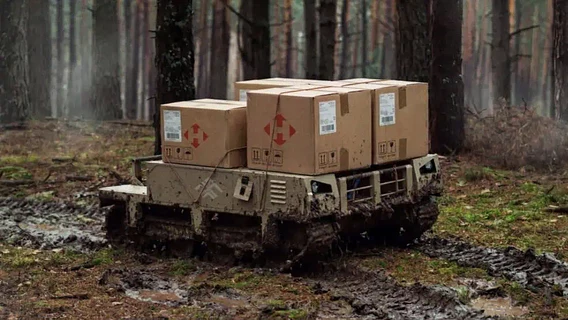
The Ukrainian company Ratel Robotics is testing the "backtrack" function for ground robotic complexes (GRC) on combat missions. While moving, the robot remembers landmarks on its path. Therefore, if communication with the operator is lost, the GRC will be able to use them to find its way back on its own. This is how the developers teach the GRC to go around obstacles without human help.
The Ukrainian company Ratel Robotics is testing the "backtrack" function for ground robotic complexes (GRC) on combat missions. While moving, the robot remembers landmarks on its path. Therefore, if communication with the operator is lost, the GRC will be able to use them to find its way back on its own. This is how the developers teach the GRC to go around obstacles without human help.
Taras Ostapchuk, founder and CEO of Ratel Robotics, talks about this on Radio Charter.
According to him, for every 150 meters of the route, the system remembers approximately 1,500 points. It is these points that the robot orients itself on when returning.
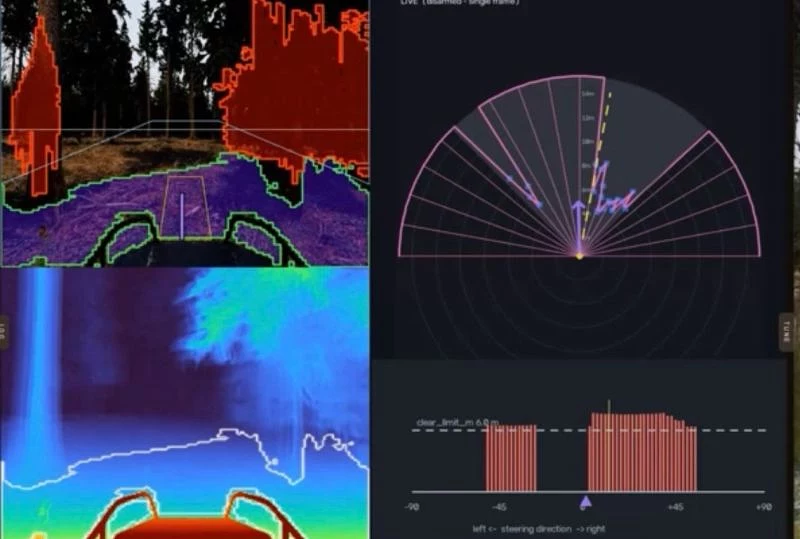
The developers also want the NRC to be able to decide for itself how to go around a tree, a hole or other obstacle. To do this, the robots are equipped with stereo cameras. They capture the space from two slightly different angles. By comparing these images, the computer can determine the distance to the objects, their size and estimate where the robot will be able to pass.
This is how the Ratel Robotics autonomous navigation system recognizes obstacles, estimates the distance to them, and plots a route. Image: Taras Ostapchuk / LinkedIn .
Robots can already deal with stationary obstacles without human intervention and without communication. Currently, they are being taught at the training ground to better navigate in the forest, to recognize trees, pits, and curbs. Next on the list of objects that should be learned to recognize by NMDs will be people and openly located mines. Developers are also working to ensure that robots can take into account the movement of obstacles and find a way around them.
"We already go around static obstacles - this is done without a person and without communication. The robot understands the size of the obstacle, understands which side to go around it from. The robot understands its size and moves in azimuth. Also, if there is a moving obstacle, it will analyze its movement and go around it," says Ostapchuk.
The company's next goal is to teach the robots to travel at least part of the route on their own. The director of Ratel Robotics hopes that by the end of 2026 or the beginning of 2027, the autopilot will be able to travel at least one kilometer out of the eight that the NRC currently covers under the control of an operator.
And by the end of 2028, the company would like to establish interaction between aerial and ground drones so that they can exchange information. However, Ostapchuk admits that this is a complex and expensive development.
"Our final goal is for our drones that are flying to communicate with those drones that are driving. This is such a final ambitious goal, I hope we will achieve it by the end of 2028. This is a very complex and expensive development. Today, our task is part of the route. If an NRC operator drives eight kilometers, then the first task will be to at least deal with the loss of communication and automate missions. I would really like it that by the end of this year or the beginning of the next, out of the eight kilometers that an operator drives at the wheel of an NRC, at least one kilometer would be done by autopilot. And so we are moving step by step towards full automation," explains the director of Ratel Robotics
Previously, dev.ua wrote that the Ukrainian company Farsight Vision introduced a navigation module for NRCs that helps robots navigate terrain without GPS.