Марія БровінськаAgroTech
9 November 2026, 10:00
2026-11-09
Without corporate email, but with a smartphone: Kernel digitized the HR function for field workers by launching the Kernel24 app. What came of it?
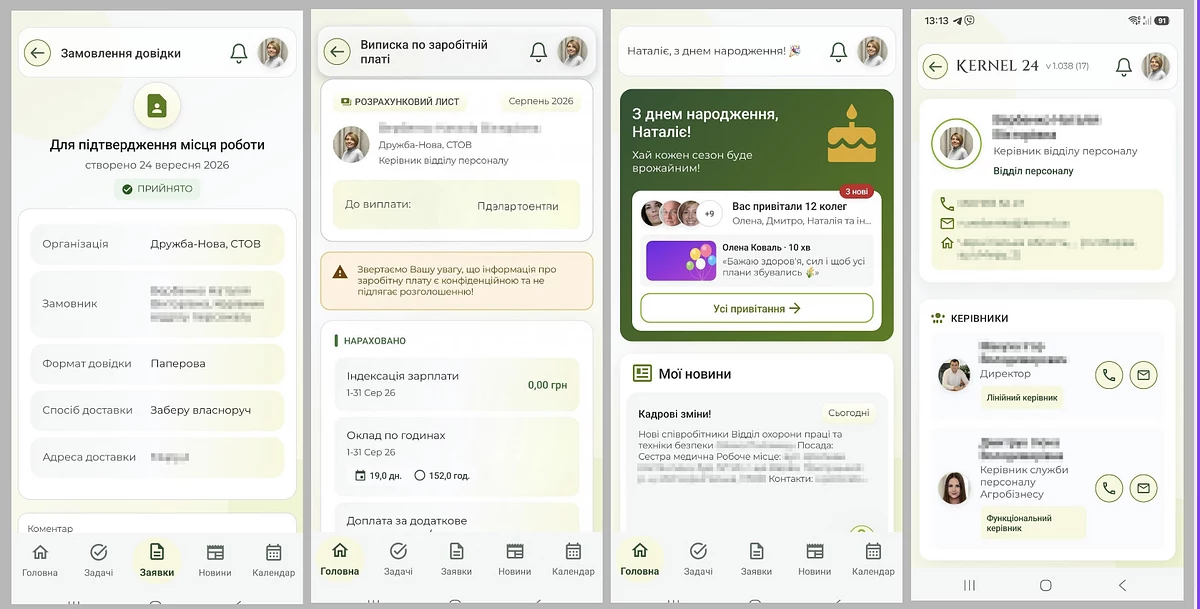
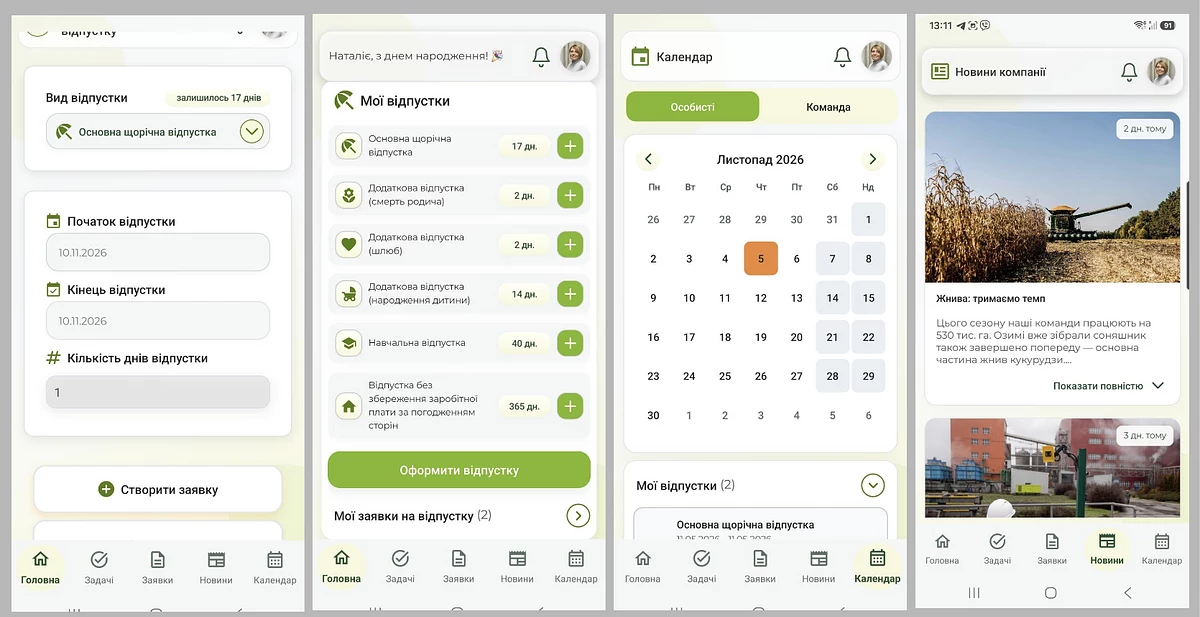
In the largest agro-industrial holding of Ukraine, Kernel, about 70% of employees of the agricultural division do not have a corporate account. These are people who work in the fields, operate machinery and are far from the offices. Previously, any HR action required paper applications, personal visits and long chains of approvals. To make digital HR services available to every employee under any conditions, the company developed and launched the Kernel24 mobile application. During the first month of work in agricultural clusters, 2,500 employees joined it, who made 680 vacation applications through the application and viewed their payslips more than 1,000 times.
dev.ua spoke with Maria Botvinkina, Head of Digital Transformation and IT Services for Document Management and HR at Kernel, about why the company decided to switch from a web portal to a mobile application, how it organized its development, and what had to be changed in HR processes.
From infoboxes to mobile applications
Kernel started looking for a way to digitalize services for employees back in 2020. The initial solution was to install infoboxes — information kiosks — at factories, elevators, and terminals. However, this approach did not work for the employees of the agricultural division. Mechanics are constantly moving between warehouses and fields, and installing a kiosk at each of their workplaces was physically impossible. Some warehouses did not have the ability to connect to the network, and the premises were often used for storing equipment, not for administrative work. Therefore, the company needed a tool that would meet the real working conditions of people.
In 2025, Kernel returned to the issue of digitalization of workers in the fields. The analysis showed that in five years the situation with smartphones has changed significantly: the share of employees without smartphones has decreased to less than 1%. This was influenced, in particular, by the war, during which people needed constant access to information. This opened up the opportunity to move from stationary information points to a personal digital tool.
At the same time, mobile app development has become cheaper and faster, thanks in part to artificial intelligence tools. This has created the conditions for the launch of Kernel24.
The team had three main tasks:
Ensure accessibility. Allow all employees to use HR services from their smartphone, without a corporate account and no need to be tied to the office.
Simplify HR processes. Digitalize typical operations and reduce reliance on paper applications and manual processing.
Create a corporate communication channel. Provide convenient access to corporate and personalized news for all group employees.
Why not a web portal?
The company had two main arguments in favor of a mobile application.
The first, says Maria, is cost-effective. Access to the corporate portal requires purchasing licenses. Extending them to 6,000–7,000 employees without corporate accounts would be too expensive.
The second is the working conditions. Field workers are often in places with unstable connectivity, so they need a tool that works in such circumstances. According to Maria Botvinkina, a mobile application is less demanding on data transfer speed than a web page: the application transmits data, while the visual part is rendered locally on the device.
It was decided to implement the Kernel24 application in stages. First, in the Agribusiness division, where there was almost no alternative to digitalization. Then the application will be extended to employees of factories, elevators and terminals, where infoboxes remain in parallel. The final stage will be the office of the management company, whose employees already have full access to the internal KernelEDocs portal
What’s under the hood of Kernel24
The application was developed on the cross-platform .NET MAUI technology. This made it possible to immediately prepare versions for Android and iOS. The backend was the internal BPM system "Kernel", integrated with the company’s accounting systems.
The frontend and backend of the application were developed by an external partner, Soft Expansion Ukraine. The companies have been cooperating since 2016 on issues of internal document flow and legally significant document flow. About five people worked on Kernel24 from the partner side: frontend, backend specialists, and business analysts. Integration with internal accounting systems was performed by Kernel’s own team.
Special attention was paid to user support. A service desk contact form was immediately built into the application. The employee can describe the problem and send a request, and the system will automatically add technical data to it: logs, phone model, and operating system version. The request is immediately processed. The support specialist determines on whose side the problem occurred and transfers it to the appropriate team. This makes it possible to collect the necessary technical information even when the user has no IT experience and cannot independently describe the cause of the failure.
How to attract workers who work in the fields
To launch the application, it wasn’t enough to simply make it available. The team needed to explain to employees why they needed the new tool and how to use it.
A few months before implementation, the project team, together with HR specialists from all agroclusters, held a facilitation session to agree on communication, a motivational program, and training.
The main role in spreading the information was played by ambassadors — people in each cluster who are trusted by colleagues and with whom they communicate regularly. First, the team trained the ambassadors, and they then showed other employees how to use Kernel24. This approach was important because of the specifics of the audience: the HR team could not physically reach each employee directly.
Communication materials were also adapted to this format. Instead of long text instructions in Word or PDF, the team prepared short videos up to 10 seconds long. Each explained one action: how to register, order or arrange a vacation, view a payslip. QR codes were placed on the information banners that led to the application download pages for Android and iOS.
2500 users in the first month
During the first month of operation of the Kernel24 application, 2,500 employees in agroclusters joined. Through it, 680 vacation applications were issued, and payslips were viewed more than 1,000 times. Among users, 75% use Android, and 25% use iOS. As of November 5, the application already has 3,630 active users, which is 76% of all employees of the Agribusiness division.
During the implementation process, the team also identified informal practices that had developed in HR processes. For example, in some agricultural clusters, a paper application for leave was approved sequentially by several managers. In the application, the company introduced a simplified scheme, according to which the application is approved by one person. This changed the usual work order, so it took time for employees to accept the new process. At the same time, the example showed that digitalization makes it possible to review the processes themselves, and not just transfer paper documents to the smartphone screen.
Kernel does not plan to leave paper-based workflow as a full-fledged alternative to digital. Paper applications are allowed only in force majeure situations — for example, when there is no electricity or communication, or if the employee does not have a smartphone.
Where does the company see economic impact?
According to Maria Botvinkina, the main economic effect is not so much related to the application itself, but to the centralization of personnel accounting that it enables. When employees work on different assets, in different conditions and with different communication signals, it is much more difficult to centralize personnel functions. A digital tool helps to unify these processes, and also reduces the risk that an application or other operation will be lost in the process.
The next step will be to expand the functionality. In the new version of the application, it will be possible to receive a certificate from the place of work — with or without indicating the salary.
The company’s future plans include several new features.
"Money until salary." The opportunity to receive part of your salary in advance without interest.
Vacancies and candidate recommendations section. Employees will be able to recommend candidates for open positions. The function should formalize the practice that already exists in the company: according to Kernel, 30–40% of vacancies are informally closed through recommendations. It is planned to provide a reward for a candidate who has started work and passed the probationary period.
"Thank you to colleagues." An opportunity to thank colleagues and wish them a happy birthday.
After stabilizing the work in the Agribusiness division, the team plans to expand the Kernel24 application to factories, elevators, and terminals. It will require almost no technical improvements, but the backend will have to be adapted to other accounting systems of these divisions.