Хочете будувати кар’єру в Data Science та AI? Vodafone Big Data Lab відкриває новий набір —>
Ігор Вишневський Work
17 July 2025, 09:00
2025-07-17
From Officials to Digital Leaders: How CDTO Campus Works and Who Can Join — A dev.ua Report
Readers interested in Ukraine’s govtech sphere have likely come across CDTO Campus over the past few years. This initiative trains Chief Digital Transformation Officers (CDTOs) for public institutions across various levels of government. These professionals are tasked with driving digital transformation across different sectors, and many are already working in ministries, central executive bodies, and regional military administrations.
However, not everyone knows how the learning process at CDTO Campus is structured, who is eligible to join, how the program is funded, and how lecturers are selected.
To explore these questions, a dev.ua correspondent visited CDTO Campus, spoke with students between sessions, and gathered insights from CEO Galyna Pustova and COO Mariia Voitko.
Readers interested in Ukraine’s govtech sphere have likely come across CDTO Campus over the past few years. This initiative trains Chief Digital Transformation Officers (CDTOs) for public institutions across various levels of government. These professionals are tasked with driving digital transformation across different sectors, and many are already working in ministries, central executive bodies, and regional military administrations.
However, not everyone knows how the learning process at CDTO Campus is structured, who is eligible to join, how the program is funded, and how lecturers are selected.
To explore these questions, a dev.ua correspondent visited CDTO Campus, spoke with students between sessions, and gathered insights from CEO Galyna Pustova and COO Mariia Voitko.
How many graduates have already completed their studies and what are the requirements for students?
Inside a spacious venue in central Kyiv, several open-space classrooms are bustling with activity. Through the glass walls, groups of students can be seen engaged in heated discussions about their projects. In one of the large lecture halls, it’s break time — though a few students have stayed behind, deep in conversation with their lecturer beside a flipchart filled with diagrams and notes. This is a typical day at the institution preparing digital transformation leaders for Ukraine’s public sector.
According to Galyna Pustova, Director of CDTO Campus, around 200 students are currently enrolled across the CDTO Campus’s four faculties: GovTech, Cybersecurity, AI, and Diia.
Each faculty typically runs four to eight programs, and competition is fierce — between 6 and 10 applicants per seat. Some programs are implemented in partnership with global tech leaders such as Microsoft, Google, and Cisco.
Naturally, these partners bring their own standards — both for the course content and for the students they expect to see enrolled.
In theory, anyone can apply, even those who are not currently civil servants. However, there’s a key condition: applicants must have a clear intention to take on a CDTO role or be actively involved in the digital transformation of public institutions.
According to CDTO Campus staff, most students come in with strong motivation and a solid background in govtech. At the same time, there are programs like «Digital Transformation in Public Administration for Local Authorities», where participants include local government professionals with limited prior experience in digitalization.
Custom-designed programs last 5–6 months and provide a comprehensive foundation for becoming a digital transformation leader in government. The partnership programs last 1–2 months, are designed for rapid immersion into the subject matter, and are tailored to address today’s pressing challenges. According to Galyna Pustova, the CDTO Campus has already graduated 1,105 students to date.
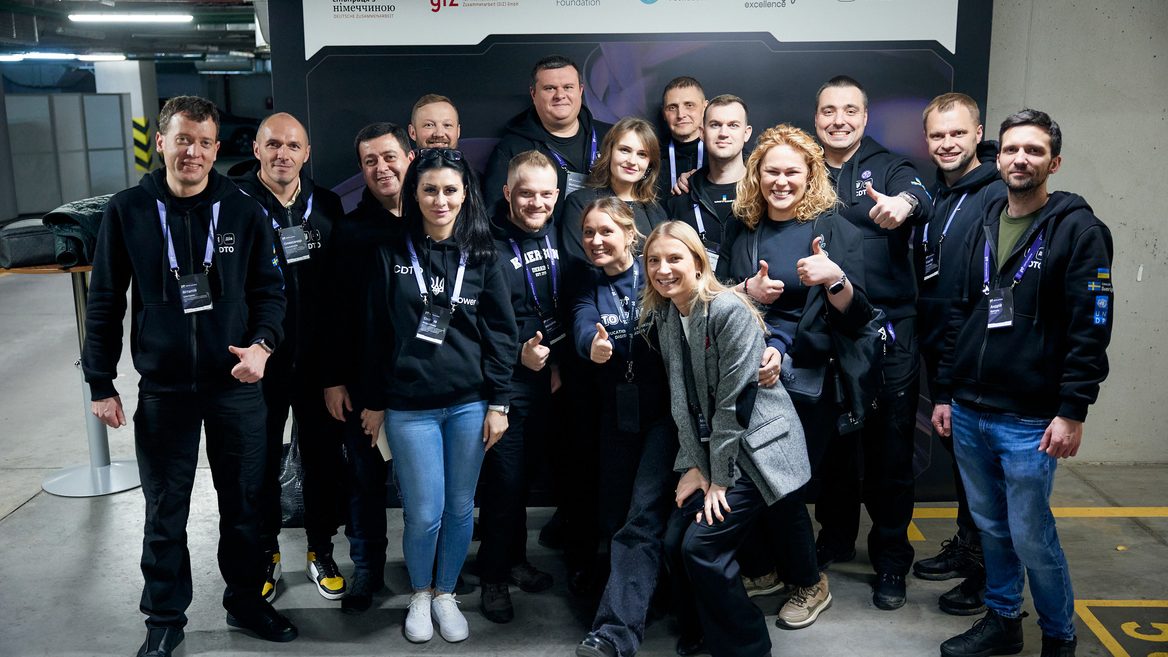
CDTO Campus students during their studies
Meanwhile, Mariia Voitko, COO of CDTO Campus, emphasized that the requirements for completing the program are strict: students must attend at least 70–80% of classes (depending on the program), complete all homework assignments, and fulfill all other mandatory components.
«Occasional cases of non-completion do happen — usually due to increased workload at a student’s main job or unexpected life changes. However, these are isolated cases. Overall, the level of student engagement and success remains very high», — said Voitko. She added that students who do not meet the mandatory requirements do not receive a certificate.
Despite the CDTO Campus being relatively young — launched as a project in 2023, with its learning space officially opened in 2024 — it has already grown significantly in both scale and impact. Among the key accomplishments:
Development of 27 educational programs across four faculties;
Launch of a dedicated mobile app for student learning;
Involvement of over 100 lecturers from government, business, and international organizations;
Creation of a Student Advisory Board.
«This is just the beginning. We have ambitious plans — both within Ukraine and internationally», — announced CDTO Campus CEO Galyna Pustova.
Real Solutions for Government Agencies Instead of diplomas
As we learned, students in certain CDTO Campus programs are divided into teams, each tasked with presenting a digital solution for a government agency. These are not full-fledged products in the traditional sense, but rather well-developed product visions or, at most, MVPs.
Since most students themselves represent public institutions, they don’t bring abstract ideas to the table — instead, they work with real requests from their respective agencies. That’s why many of the solutions developed at CDTO Campus have a strong chance of being implemented in real life.
Yehor Razohriiev, Director General of the Directorate for Digital Development, Digital Transformations and Digitalization at the Ministry of Justice and a CDTO Campus graduate, told dev.ua that his ministry, for example, tasked CDTO Campus students with a project to develop an AI assistant for providing legal consultations.
«The idea was to integrate this tool into the free legal aid system, where artificial intelligence could help citizens quickly and conveniently access basic legal guidance», — he explained.
According to the Ministry of Justice representative, such a solution would allow citizens to receive legal support without long queues, at any time, and even from remote regions. For the legal aid staff, it would reduce workload by automating responses to frequently asked questions.
According to Razohriiev, the Ministry was satisfied with the results delivered by the CDTO Campus students and is now moving forward with full-scale implementation of the product.
«The team proposed several solutions and tested different approaches to integrating AI into the legal domain. Of course, the product still needs refinement—especially in terms of the accuracy of legal responses, alignment with specific legal frameworks, and validation of outcomes. But the students’ work has already become the foundation for further development», — he noted.
The Director General of the Directorate of Digitalization of the Ministry of Justice added that the solutions proposed by the students are currently being studied and technically examined, and this digital project is a priority for the ministry.
«We plan to integrate the solution with the existing infrastructure of the BPD system and ensure its legal and technical compliance», — the official summarized.
Is CDTO Campus Part of the Ministry of Digital Transformation, and Who Funds It?
We also tried to understand how exactly CDTO Campus is integrated with the Ministry of Digital Transformation and what financial sources support its operations.
As Galyna Pustova explained, the establishment of CDTO Campus was initiated by the leadership of the Ministry of Digital Transformation, but legally it does not belong to the Ministry.
«CDTO Campus is not a legal subdivision of the Ministry of Digital Transformation of Ukraine and is not a separate state institution. It is a project implemented by East Europe Foundation in partnership with international donors», — Pustova emphasized.
At the same time, according to her, the Ministry of Digital Transformation defines the strategic directions of the project and is its key beneficiary. «So it’s not about legal subordination, but about integration, alignment of vision and plans, including through inclusion in the Ministry’s OKRs», — the CDTO Campus director clarified.
Galyna Pustova stated that the financing of the CDTO Campus project is provided by a number of partners, including Visa Foundation, the Federal Ministry for Economic Cooperation and Development of Germany (BMZ), and supported by Deutsche Gesellschaft für Internationale Zusammenarbeit (GIZ) GmbH in cooperation with the Digitality GovTech Center of Excellence.
«Our financial model is based on the principle of diversification — this means we are not dependent on a single source of funding. This is what ensures the stability of the project’s implementation, even in the event of changes on the part of certain donors. USAID is also one of our partners. Thanks to this cooperation, in particular, we were able to launch the Faculty of Cybersecurity», — Pustova noted when asked whether the crisis with USAID funding had affected them as well.
The CDTO Campus director added that some partners provide not only financial support but also help with access to expertise and technologies. «For example, Cisco, as a strategic technology partner, not only joined the educational process but also provided technical equipment for our learning space», — Galyna Pustova specified.
Exporting experience is on time, Germany is the first
When asked about feedback from donors and international partners, Mariia Voitko, COO of CDTO Campus, noted that other countries are showing growing interest in Ukraine’s approach to digital education for civil servants.
«When we were designing the project, we studied over 200 programs from around the world — most were either short-term or tailored to business audiences. In contrast, CDTO Campus programs are specifically adapted to the needs of digital transformation in the public sector», — she emphasized.
Recently, a memorandum of cooperation was signed with GGTC Berlin. «As part of this collaboration, CDTO Campus educational materials will be used to train digital leaders in Germany’s public sector. This marks our first practical step toward international expansion and the export of Ukraine’s digital governance expertise. We believe that the Ukrainian CDTO Campus model can become a foundation for similar initiatives in other countries as well», — Galyna Pustova told dev.ua.
What the Students Say
Between sessions, a dev.ua correspondent approached several CDTO Campus students to ask what brought them here, what the training gives them, how advanced their digital competencies were at the start, and what they plan to take away for their work. Among those who responded were acting CDTO and Deputy Head of the State Service of Ukraine for Transport Safety, Valerii Kulyk-Kulychenko, and Nadiia Adamenko, who works in the project office of the Ministry of Social Policy and is responsible for the MSEC reform, and previously oversaw digitalization issues at the Ministry for Veterans Affairs.
According to Kulyk-Kulychenko, he has been an acting CDTO since 2022 and has spent nearly his entire career in government bodies working in digital areas — either process automation or cybersecurity. His motivation for enrolling in the program — this is already his second program at CDTO Campus — is to improve his skills, practices, and competencies related to cybersecurity in the public sector.
«Specialists in government institutions often lack many of the necessary skills and knowledge in this area. And the digital field is such that if you don’t keep learning and fall out of context, then tomorrow you’ll simply lose your relevance as an expert. The pace of change here is extremely fast», — he noted.
Kulyk-Kulychenko shared that the current course he’s enrolled in is five months long, with two offline study days per month and weekly online sessions. «Plus, we’re divided into teams here, and the teams interact with each other throughout the program. We communicate daily, and we have a task we need to deliver», — added the CDTO of Ukrtransbezpeka.
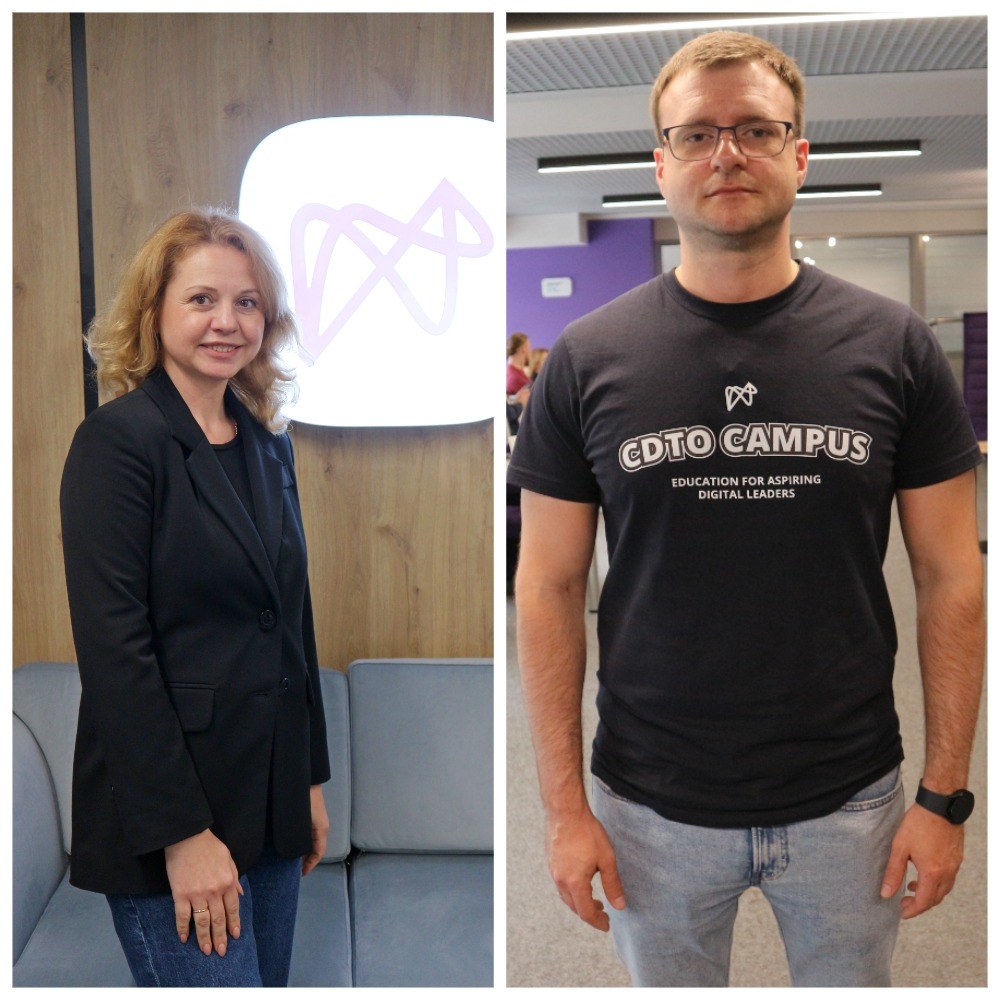
CDTO Campus students Nadiya Adamenko/Valeriy Kulyk-Kulichenko
We also asked whether his agency had delegated any projects to CDTO Campus students, as the Ministry of Justice did. He noted that Ukrtransbezpeka works with a limited circle of stakeholders — mainly transport operators — so a custom application for his agency isn’t a particularly relevant topic. «Here, the focus is on more large-scale projects that impact a significant portion of the Ukrainian population — tens of millions of people, for example», — he commented.
Before her current role at the Ministry of Social Policy, Nadiia Adamenko worked at the Ministry for Veterans Affairs, where she rose from a chief specialist in the IT directorate to head of the department. She said she first became interested in training at CDTO Campus while still working at the Ministry for Veterans Affairs, but her round-the-clock workload didn’t allow time for it.
«We started in April, and now we’re already in the offline phase — it’s a hackathon. This is already our third offline meeting, and there will be one final session where we will present our project», — said Nadiia Adamenko.
Interestingly, her group is working on developing a mobile application for free legal aid for the Ministry of Justice, which we mentioned earlier. «Essentially, our team has to go through the full product lifecycle — from initiating the idea to building an MVP», — she explained.
According to the Ministry of Social Policy representative, what matters most to her at CDTO Campus is working with real-life case studies and having access to knowledge shared by C-level professionals from Ukrainian and international govtech companies. Adamenko noted that in the process of working on the project, the team sometimes has to start over due to unforeseen factors, but that doesn’t discourage them.
«You have to be ready to reset everything at some point. And that’s exactly what just happened to us. We validated the idea within the team and created a prototype. But then our expert came and said: ‘You won’t be able to implement AI in this format because there’s legislation that won’t allow it, and you’ll never get around it.’ However, he gave us an idea for how we could partially retain the functionality but approach the processing of requests from a different angle», — Adamenko shared.
Despite all the challenges, she’s confident their team will present a «decent» basic product for the Ministry of Justice — one the ministry can continue developing further.
«Modernization of the Ukrainian Civil Service through Innovation and Technology.» A national project to train digital transformation leaders is launched in Ukraine — CDTO Campus