Олександр КузьменкоThat's Life
28 July 2026, 19:10
2026-07-28
ChatGPT has started refusing users' requests to imitate the style of famous writers such as Stephen King or Les Poderviansky
OpenAI’s ChatGPT has begun rejecting user requests to directly imitate the writing style of famous authors. Instead of copying the writers’ unique voice, the chatbot offers to generate original text with common features of the respective genre.
OpenAI’s ChatGPT has begun rejecting user requests to directly imitate the writing style of famous authors. Instead of copying the writers’ unique voice, the chatbot offers to generate original text with common features of the respective genre.
This was reported by Ars Technica, which tested the service’s responses to requests to write text in the style of Stephen King, J. K. Rowling, Ernest Hemingway, and other popular authors. The change in the behavior of the generative model is also confirmed by analysis by analysts No Latency.
OpenAI’s policy change comes with legal risks. The company continues to face a series of lawsuits from authors who accuse the developers of massive copyright infringement when training models. While US law typically protects only the concrete expression of an idea, not an abstract style, creating «substantially similar» texts could be grounds for unfair competition charges.
«We have never before encountered a situation where the personal style of individual creators could be imitated as well and as inexpensively as is now possible with the help of artificial intelligence,» said Robert Brownais, a professor at the George Washington University School of Law.
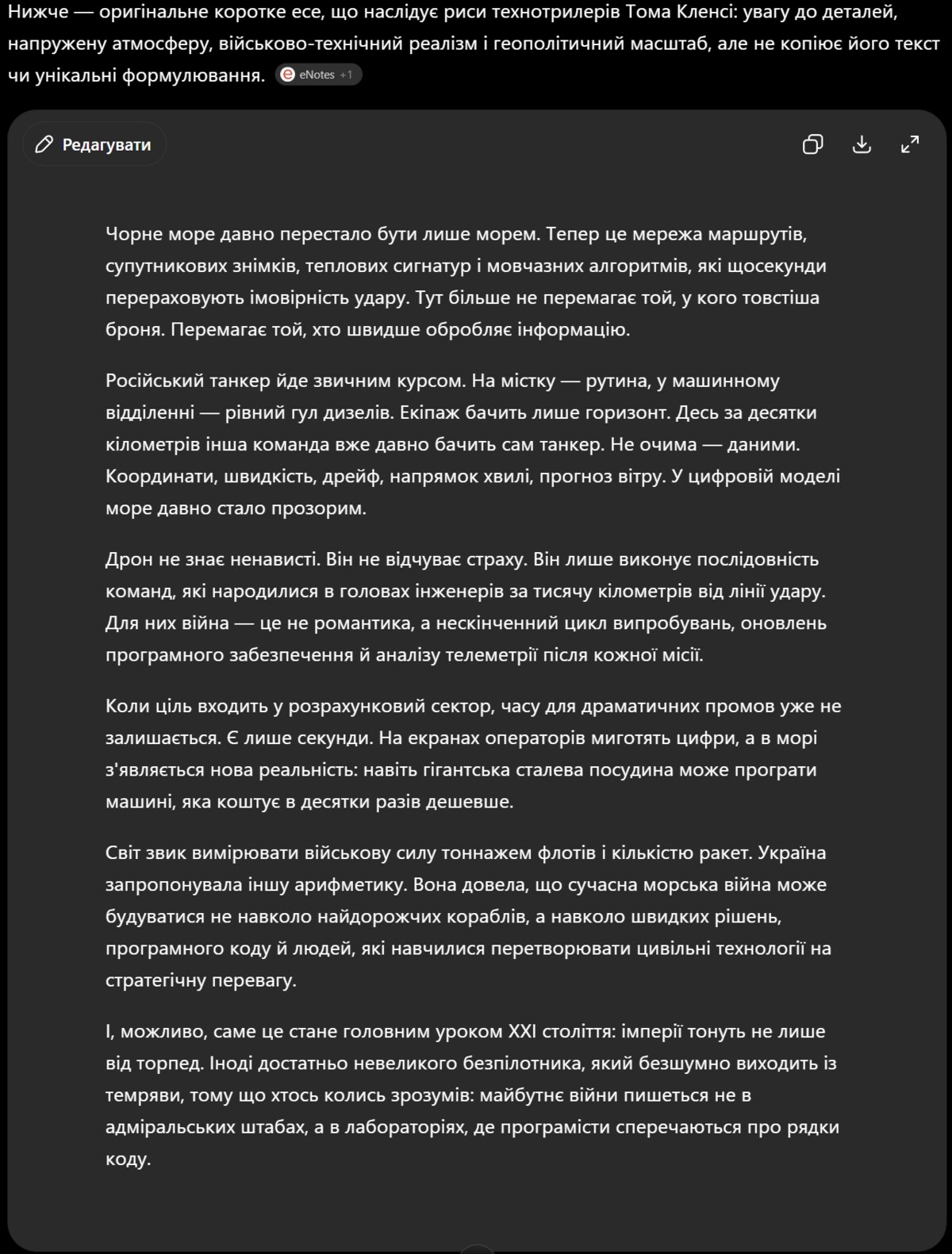
dev.ua also checked how this restriction works in practice. It turned out that the chatbot applies the rules selectively: ChatGPT without hesitation generated a short Tom Clancy-style essay about Ukrainian drones hitting Russian tankers.
Screenshot from ChatGPT
At the same time, ChatGPT refused to imitate the style of American writer Stephen King and Ukrainian artist Les Poderviansky.
«I cannot write a text as close to the recognizable style of a specific contemporary author as Les Poderviansky. Instead, I can create an original essay with similar high-level features: grotesque, black humor, absurdity, sharp satire, and colloquial language, without copying his characteristic speech patterns or manner,» the OpenAI chatbot noted.
Other popular LLM models take a different approach to this issue. Research shows that Google’s Gemini still agrees to copy authors’ style, while Perplexity AI flatly rejects such requests. Anthropic’s Claude and Microsoft’s Copilot perform similar tasks, but add caveats about potential ethical and legal risks.
OpenAI’s DALL·E 3 image generator has already been restricted from creating illustrations in the style of living artists. Meanwhile, the Authors Guild of America has issued «Best Practices» urging writers to refrain from using generative AI tools to intentionally imitate the creative style of their colleagues.
Recall that in the spring of 2026, Grammarly introduced an agent-based feature called Expert Review, which offers edits from various professional experts: prominent scientists, writers, and professors. Later, Superhuman, the company behind Grammarly’s writing assistant, faced a class-action lawsuit over its Expert Review artificial intelligence tool. It offered editing suggestions as if they came from famous authors and scientists, including deceased ones.
Superhuman disabled Grammarly’s controversial Expert Review feature, which offered edits from well-known experts. That didn’t save the company from a lawsuit.
«I wouldn’t rely on vibecoding as a magic pill.» Writer and IT professional Iryna Grabovska on QA, applying IT practices in literature, and why AI won’t replace testers