Хочете будувати кар’єру в Data Science та AI? Vodafone Big Data Lab відкриває новий набір —>
Марія БровінськаWork
13 April 2026, 09:00
2026-04-13
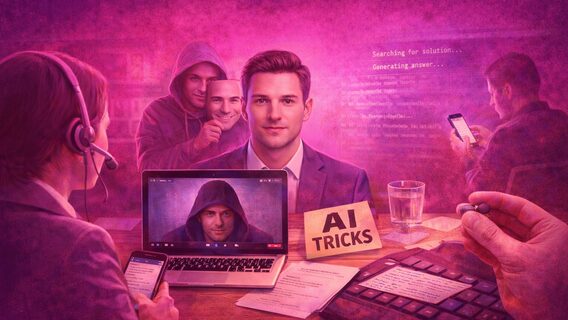
Deepfake, perfect answers, simulated network failures and seven other AI tricks of candidates that recruiters recognize in a minute
Candidates are increasingly using artificial intelligence not only to prepare for interviews, but also during them. This is no longer an isolated incident, but the new norm in the market.
However, as the practice of Ukrainian companies shows, most of such «tricks» are quite easy to read. dev.ua has collected real cases — from reading out answers to AI avatars — and explains why this is almost always noticeable.
Candidates are increasingly using artificial intelligence not only to prepare for interviews, but also during them. This is no longer an isolated incident, but the new norm in the market.
However, as the practice of Ukrainian companies shows, most of such «tricks» are quite easy to read. dev.ua has collected real cases — from reading out answers to AI avatars — and explains why this is almost always noticeable.
Content
«Perfect» answers without depth
The first and most common signal is overly correct, polished answers that do not reflect the candidate’s real experience.
Head of Global Recruitment at Master of Code Global Natalia Yerisova explains: «We are increasingly encountering candidates who use AI for preparation or even during interviews. This is usually noticeable by overly formulaic or „ideal“ answers that do not correspond to the depth of real experience.»
According to her, such cases are quickly checked. «In such cases, we ask clarifying and situational questions to check how much the candidate really understands what he is talking about,» says Natalia.
Memorized answers that «break» when clarified
Sometimes candidates don’t just prepare with AI — they literally memorize generated texts.
Talent Acquisition Lead at PlantIn Natalia Mudrak recalls: «The candidate wrote and spoke exactly like an AI, so doubts immediately arose about his sincerity. As a result, the candidate admitted that the AI was helping him prepare for communication with recruiters and preparing whole answers that could be memorized.»
Problems, says Natalia, begin when the scenario goes beyond what was prepared. «On questions that could not be predicted, the candidate was very lost and could not formulate an answer,» the specialist notes.
Screen reading and «real-time help»
Many companies are already recording attempts to use AI directly during a conversation.
«My colleague had a case where a candidate used AI even during the first HR interview and actually read out ready-made answers from the screen,» shared Tetyana Lobetska, Talent Manager at Levi9 .
She cites another typical pattern — a delay before answering and a sharp change in quality. «The candidate cannot answer the question immediately, but in a moment he gives a disproportionately deep, perfectly structured answer,» says Tetyana.
Recruiter Liliya Kostyshyn from N-iX draws attention to another type of use of AI: «Some candidates use transcriptionists or online translators to better understand the question. This is very noticeable: after the question, the candidate starts reading from the screen, his or her perspective changes.» For roles with English requirements, this is critical, the specialist adds.
Oleksandra Tolokh, Talent Operations Director, SoftServe, says that during HR interviews she sometimes notices revealing moments: the candidate seems to be answering questions, but contact is not established — the gaze is constantly averted, pauses appear, and it seems that the person is not fully listening to the interlocutor.
«In such cases, it often turns out that the candidate is simultaneously peering into the answers in AI or formulating a request to get a ready-made text. This looks not so much as a sign of technological sophistication, but as a replacement for a live conversation, because the HR stage for us is primarily about motivation, experience, and real background, which are difficult to authentically convey through generated prompts,» says Oleksandra.
Fake profiles and impersonation
With the development of AI, more complex cases appear — when candidates actually impersonate other people.
Senior Talent Manager at Railsware Ulyana Tereshchenko says: «We have already seen people using AI to generate fake resumes. Another common case is going through intro calls of scam candidates, in particular using tools to change appearance or real-time generation of answers.»
Sometimes this takes on a global scale. «We are talking about cases where fake personalities are created using AI and interviews are conducted using filters to change appearance,» Ulyana adds.
Another person comes to the interview
EVO records more radical cases. Chief People Team Olena Oleksienko says that sometimes candidates use someone else’s resume or profile, and a different person comes to the interview.
And this, she says, quickly becomes apparent. «It’s visible within the first 10 minutes of the conversation because of the mismatch in experience and communication style,» says Olena.
AI avatars instead of living people
N-iX encountered an even more radical scenario. «At one of the screening stages, we encountered a situation where a fully generated AI model of a person connected to the video call. It looked extremely unnatural: its lips moved out of sync with the sound, and its eyes were fixed in one direction,» said recruiter Liliya Kostyshyn.
Such cases, she said, are revealed very quickly and immediately end the process.
SoftServe also records similar cases. «In professional networks, profiles created or significantly „enhanced“ with the help of AI are increasingly common. This is especially noticeable among candidates from other markets who adapt their profiles to the Ukrainian context. As a result, it may seem that there are many specialists with the necessary competencies on the market, but in practice, the „live“ pipeline of candidates — those with whom you can communicate effectively and who meet staffing needs — is often much smaller. This, in turn, affects the correctness of the market assessment by both recruiters and hiring managers,» says Oleksandra Tolokh.
EPAM shares an almost cinematic history.
«There were cases when at the end of the interview the candidate’s mask would come off and it turned out that he was not at all the person he claimed to be. So, the „Ukrainian“ turned out to be a guy from Asia,» says Olga Makarova, manager of the talent search department at ERAM Ukraine.
Sometimes, she adds, this is combined with «teamwork»: the candidate is also helped by another person.
Hints that are not visible during screen sharing
Another new level of «tricks» are tools that work invisibly even while the screen is being shown.
«There are programs that can work imperceptibly even during screen sharing: they read the interviewer’s voice, form a decision, and suggest it to the candidate in a separate window,» says Delivery Director I ntetics Ivan Reznik.
However, even in such cases, the problem becomes obvious. «A person can write the correct code, but does not understand what exactly he wrote. When you start asking clarifying questions, the candidate simply cannot explain,» he explains.
«I live in Kyiv,» but I don’t know any metro stations
Head of Global Recruitment at Master of Code Global Natalia Yerisova shared another illustrative case: «One of the candidates, who claimed to live in Kyiv, could not name the nearest metro station, which immediately raised doubts about the reliability of the information.»
A simple clarification sometimes works better than any technical checks.
Prints the answer before each reply
Ciklum is noticing a new pattern. «We often see candidates typing for a long time before each answer or literally reading out the formed text,» the company said.
In such cases, recruiters change the course of the interview. «We can ask to turn off the background, ask clarifying questions and watch the reaction in real time,» Ciklum shares a life hack.
«Internet gone» to peek at the answer
Sometimes candidates try to buy time by simulating technical problems.
Tetyana Lobetska from Levi9 describes a case study: «There was a case when, after asking difficult questions, the candidate simulated connection problems, hung up, and then returned with already formulated answers. After three such „connection problems“, we decided not to continue the interview.»
Companies are not fighting AI as a phenomenon
Despite all these cases, companies are not against AI as such. On the contrary, the ability to work with it is increasingly becoming a necessary skill. Capgemini Engineering notes that training in AI is normal, but the key is the ability to confirm knowledge in a conversation. Ciklum emphasizes: it is not important whether the candidate uses AI, but whether he understands the limits of this use. And EVO adds that interviews are already changing in response to the new reality — they are becoming more practical, personalized and focused on live interaction.
AI is changing the rules of the job market — for both candidates and companies. But for now, the main principle remains the same: the interview is about the person, not the tool.
Recruiters are quickly adapting to new challenges: they are changing the interview format, adding more practical tasks, and looking more closely at the candidate’s logic of thinking.
And most importantly, almost everyone agrees on one thing: using AI in itself is not a problem. What becomes a problem is trying to replace one’s own knowledge, experience, and ability to think with it.
«Пастка початківця». 5 найпоширеніших помилок джунів на співбесідах та як їх уникнути
Напевно, кожен хоч раз у своєму житті переживав ситуацію, коли після співбесіди замість запрошення на роботу приходила відмова. «Як же так? Це несправедливо!», — чимало з нас корили долю і не розуміли, що пішло не так. Катерина Нікітіна, SoftServe IT Academy Recruiter, розповіла про п’ять найпопулярніших помилок кандидатів-початківців на співбесідах.
У 18 років «захантив» SoftServe, у 21 — відкрив власну компанію. Історія львівського IT-вундеркінда
Гліб Щур — випускник кафедри систем штучного інтелекту НУ «Львівська політехніка». На молодших курсах його запросила на роботу IT-компанія SoftServe, де він працював майже 3 роки розробником у R&D-відділі. А вже у 2021 році Гліб заснував власну компанію та став CSO у 21 рік. Розповідаємо історію львівського «самородка».