Хочете будувати кар’єру в Data Science та AI? Vodafone Big Data Lab відкриває новий набір —>
Марія БровінськаStartup
23 March 2026, 09:00
2026-03-23
"Do or die. Either we create these technologies or we disappear as a nation." DoD Solution CEO Roman Gapachilo on the transition from Intellias to defense, €1 million investment and "a computer in every drone"
Roman Gapachilo worked in service IT for over 20 years and seemed to know the industry down to the smallest detail. But at some point, that wasn’t enough. He left the large service business Intellias, where he had worked for 7 years, and headed the Ukrainian defense startup DoD Solution, which develops computers and software for autonomous drones.
dev.ua talked to him about this transition, the risks, 1 million euros of investment, hiring, humor during war, and why everything is much simpler in defense: you either do it or you lose.
Roman Gapachilo worked in service IT for over 20 years and seemed to know the industry down to the smallest detail. But at some point, that wasn’t enough. He left the large service business Intellias, where he had worked for 7 years, and headed the Ukrainian defense startup DoD Solution, which develops computers and software for autonomous drones.
dev.ua talked to him about this transition, the risks, 1 million euros of investment, hiring, humor during war, and why everything is much simpler in defense: you either do it or you lose.
«I knew everything. And I wanted more»
— How did you end up at DoD Solution?
Actually, two years ago I was brought in as a consultant. The main focus was to help attract investment, angel investment. We did it, the company got funding, I got a stake.
The company grew in small steps, it was founded in 2023. And now I have joined as CEO.
— You came from a fairly stable history — Intellias. This seems like a big risk.
This is a big risk. (laughs) It’s even a story that you probably need to work through with a therapist. But it was a very considered decision. It lasted more than a year. I had a long notice period — almost six months. I’ve been in the service business for 20 years. I know what to do, how to do it, who to do it with. And at some point you understand: you know everything. I knew everything. And I wanted more. And here — you know less than you don’t know. About 60 to 40. And it’s actually very exciting. It’s an opportunity to learn.
— What exactly was missing?
Dynamics. Previously, the market grew by 30–45%, sometimes 50% per year. Now it’s 5–15%. I tried to find this drive inside: I was involved in the development of India, marketing, inbound direction. But it didn’t give that «excitement». And then you look at defense — and everything there moves at a completely different pace.
«DoD is not the Department of Defense»
— By the way, your name provokes associations.
Yes, everyone thinks it’s the Department of Defense (laughs). But we have a different meaning — do or die. And this is not marketing. This is really how we live. Either you create technologies that help us win, or we will lose our statehood. Either we create these technologies, or we will disappear as a nation. Here, the superfluous disappears very quickly. Only the essence remains.
— How is defense different from regular IT?
Impact. In the service business, you make a product — and somewhere there, a client uses it. Here, your solutions are tested on the front. And you see the result. This is a completely different level of responsibility. And another important point: there are fewer of us. If we fight with the same technologies as the enemy, we will lose. Therefore, the question is not «to do or not to do.» The question is to do it better. Sometimes I explain it very simply: there is a light and a dark world. And we work on the side of the light.
— What is DoD Solution currently creating?
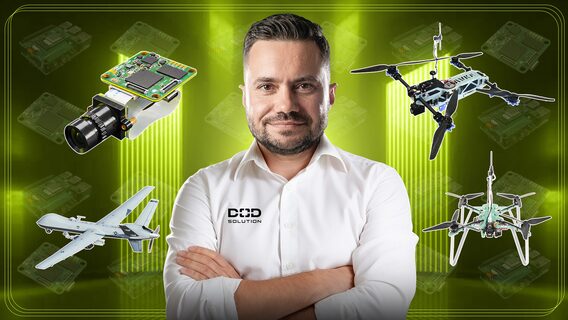
We develop single-board computers and software for them. For drone autonomy. Our product is called AURA. There are three versions: AURA Mini, AURA and AURA Pro. AURA Mini is already used on FPV drones. Then there are more complex stories: interceptors, deepstrike.
— What is the key idea?
Today, one pilot controls one drone. But we don’t have parity in people. Therefore, our task is for one pilot to be able to send several drones to the affected area. They fly in on their own, find the target themselves, recognize it and strike. I like to put it simply: one pilot should control not one, but send 10-15 drones to the affected area.
«NVIDIA didn’t make computers for war»
— Who is your client? The military?
No, we are B2B. These are drone manufacturers and software companies. The military is our end-user. They test, give feedback. There are three main platforms on the market: Raspberry Pi, NVIDIA Jetson Orin, Orange Pi. But they were not created for war. These are universal solutions.
We make computers for specific tasks: power consumption, size, calculations. And importantly, we make both hardware and software. That is, we understand what exactly should work on this computer.
— How are such decisions implemented?
There is an important nuance — codification. In Ukraine, you can’t just sell a separate component. Everything happens as a complex: drone + autonomy module. That is, our solution needs to be adapted for each drone. We get a specific drone, calibrate it, check that everything works, and only after that can we scale — dozens, hundreds, thousands of boards.
— Which well-known drone manufacturers are you already working with?
Our platform is drone-agnostic — meaning it is not tied to a specific manufacturer or type of drone and can integrate into various unmanned systems. We are currently focused on a few priority integrations that we are bringing to codification in order to then scale the technology.
«We’re raising €1 million and going to California»
— What are the current plans for the company’s development?
We have opened a pre-seed round and are raising €1 million. We plan to close it by the end of May. We already have several commitments from investors and funds. We have also been selected for an acceleration program in California, where we will work with venture funds. The team currently consists of about 25 people. After the round, we plan to grow to 35. The main focus is hardware, ML/AI and embedded engineers.
— Do you plan to produce your own drones?
We started with this in 2023 — we collected about 100 drones. But we decided to focus on autonomy. We see ourselves as a «computer in every drone». We are already working on software for different scenarios — from FPV to more complex systems. For example, solutions that can autonomously perform a mission, wait for a trigger and activate.
«In defense, it’s not just seniors who are important»
— Do you feel a difference in the approach to hiring specialists?
In the service business, everything is dictated by the client. Here, speed is key. I would say that 30% of our team today is strong experts, and 70% is people with potential. It is important for us that a person understands why they are here. That they have «eyes», that they are on fire. There is a lot of mathematics in defense, so the base is important. But no less important is thinking and motivation.
— So the Juns have a chance?
Yes. We already have a junior engineer. If a person comes and says: «I’ll do it» — and you see that he is really ready to learn — we take him. In defense, potential is often more important than experience.
— How does using AI help your engineers’ productivity?
Honestly, we’re not cutting edge. We push engineers to use Copilot and similar tools, but this is something we want to improve a lot. And here’s the important news — this week we hired a CTO. I’m not ready to reveal his name yet, but he’s a pretty good professional. And I expect that with his arrival, the team’s productivity will increase significantly.
— What about salaries and benefits?
This is not the IT that has all the classic goodies. But we pay at market rates and give something else: meaning, influence, and the opportunity to work on really important things. Plus, we are a critical enterprise, so we can give reservations.
— What is your «signature» question to candidates now?
«Why do you want to work in defense?» Because this is key. You can’t work here just «for a salary.» There must be an understanding of why you do it. We are working on technologies that can change the course of war. And here everything is very simple: if we are not more effective, we will lose. And if we are, we have a chance to win.
About «Banderomobile» and humor on pause
— Do you have time left for other projects — «Banderomobile,» «Ours without rushes»?
«Banderomobile» already lives on its own. We have built a system in four years: there is a team, managers, processes. My role is more ideological. To see that everything works and that we consistently send 5–7 cars a week.
But with humor it’s more difficult. The show «Nashi bez rashi» will most likely be on hiatus. At least for six months. Because now I need to completely immerse myself in DoD Solution — understand the processes, focus, stabilize everything. Maybe we’ll upload something from the archives sometimes. But new content is questionable.
Intellias top manager Roman Gapachilo launched a new initiative — «Banderodrones.» What can the «birds» that have been developed over the past 15 months do?