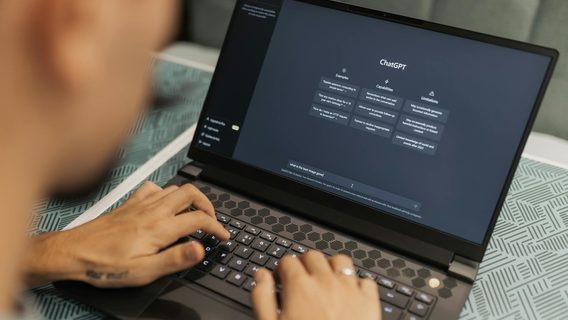
“Soon, offers will be given to those who made more mistakes and did not answer perfectly.” Aitivets complained that he “burned” a candidate using ChatGPT during an interview and asked what to do about it. The community offers options
Chief Analytics Officer Andriy Luzan talked about an unusual interview experience. The IT community is lively discussing the case.
Chief Analytics Officer Andriy Luzan talked about an unusual interview experience. The IT community is lively discussing the case.
«I’m conducting an online interview with a candidate and hear in the background: 'How else can I help you?' And then I realize that the ChatGPT voice agent hears my questions, answers in the candidate’s ear, and he broadcasts them to me,» the specialist said .
Andriy asked the LinkedIn community what to do with deepfakes and AI in interviews. Here are the most interesting answers from IT professionals.
«Ask them to explain a term in detail, then interrupt and ask them to clarify some nuance. Enjoy the panic,» advises Dmytro Gavrilyuk, COO at Yieldy.
Machine Learning Consultant & Educator Hanna Pyleva suggests asking the candidate to solve a case online, where part of it is described in the document, and first ask them to share the candidate’s entire screen. «It would be cool to also limit copying the text from where it is written (you can send it as a picture or in PDF). And ask the candidate to read the task about themselves. And another option: at the beginning of the interview, ask the candidate to say „I do not use any auxiliary AI tools in the interview and I understand that if I use them, I will never be able to interview with this company again.“ It won’t work for everyone, but it might for someone,» the specialist advises.
Stanislav Nikitenko, Python Developer and AI Engineer, believes that if a person is able to process the AI response quickly enough and give his answer, then the employer will bite his elbows by refusing such a candidate. «Since I very much doubt that today there are developers who do not use AI to perform tasks. If this is a bad answer, then the question is about your competence, and whether these questions were generated by AI. What prevents you from asking additional questions, the senseless copying is immediately visible and audible, and not the ability to navigate in what is being said, and in the fact that everything lies on the surface?» he asks.
«Google Cloud Certification has long had strict control over the online exam: the examiner is constantly watching you, you first show the place where you are, prove that there are no gadgets nearby (an empty table), you don’t say anything out loud, you don’t look around, everything happens in your head. This is an honest and fair approach. To cheer you up: soon offers will be given to those who made more mistakes and didn’t answer perfectly,» shares Java Developer Roman Manzhula .
Ivan Branets, Staff Engineer, shared his own experience: «Well, at least you guessed to use voice recognition. I have one candidate, after I asked a question, just pounded on the mechanical keyboard. In general, it is quite difficult to maintain a lively conversation when you are simultaneously listening to or reading answers from AI. Once, you could see „let me finish reading“ on the candidate’s face and his gaze was very focused on the monitor to the side after I asked a question that required a long answer, and then I started throwing out additional questions that should have prompted him to answer, because the candidate was silent for a long time.» In his opinion, it is good practice to ask questions in the context of previous experience. «For example, how would you use ABC when you worked at XYZ. It is unlikely that the candidate will ask any context about himself and previous places of work for AI, so you will have to answer yourself. It is also quite difficult to cheat when you ask a candidate to open an online text file with a part of the questions and have him or her scan the screen. Then you can monitor where the mouse cursor is and whether the current window is in focus, as well as whether the candidate continues to look at the same monitor. A red flag can be when the candidate starts reading each question loudly and clearly so that the assistant can hear it,» the IT specialist is convinced.