Редакція dev.uaHot News
14 July 2026, 15:15
2026-07-14
The evolution of voice calls: how Kyivstar made HD Voice available to millions of subscribers
The era when a mobile phone had to "drop" its speed and switch from 4G to good old 3G or even 2G to make a phone call is officially coming to an end. While couch analysts were predicting the death of classic calls under the onslaught of instant messaging, a quiet technological revolution has taken place in the bowels of telecom networks.
Voice has not disappeared. It has simply become fully digital and learned to live inside high-speed networks. Without unnecessary pathos and boring engineering terms, let's figure out why traditional switching is becoming a thing of the past and how VoLTE and VoWiFi technologies have become game changers.
The era when a mobile phone had to "drop" its speed and switch from 4G to good old 3G or even 2G to make a phone call is officially coming to an end. While couch analysts were predicting the death of classic calls under the onslaught of instant messaging, a quiet technological revolution has taken place in the bowels of telecom networks.
Voice has not disappeared. It has simply become fully digital and learned to live inside high-speed networks. Without unnecessary pathos and boring engineering terms, let's figure out why traditional switching is becoming a thing of the past and how VoLTE and VoWiFi technologies have become game changers.
Impressive numbers: megacities dictate trends
If you thought that new technologies were a game for a few percent of geeks, then the latest data from the national regulator NKEK and the operator Kyivstar for 2026 say the opposite. For example, today VoLTE and VoWiFi technologies generate more than 50% of all voice traffic in the network of the largest mobile operator in Ukraine.
In large cities, digital voice penetration is even higher. Here are the latest data from Kyivstar:
Kyiv and Odessa — 64–65% of all calls are made via data packages.
Lviv is the absolute leader, where the digital voice penetration rate reaches 67%.
But how did we get here?
Stage 1. VoLTE: when conversations don't interfere with the internet
Kyivstar was the first among Ukrainian operators to launch VoLTE (Voice over LTE) technology back in December 2020. The main feature is simple: 4G (LTE) networks were developed from the very beginning as fully packet-based. They do not have a separate “voice” subsystem, like in 2G/3G. VoLTE was created to provide calls directly within high-speed Internet.
Why this is cool for the user:
Crystal clear sound: The voice sounds as if the other person is standing next to you. Kyivstar uses top codecs — AMR-WB and the most modern EVS, which has the highest priority during connection and provides maximum HD quality.
Instant Connection: The call starts in less than a few seconds. In 3G networks, this took 5 to 10 seconds due to the CSFB (Circuit Switched Fallback) procedure, where the phone had to jump between standards back in the past.
Multitasking: You can simultaneously talk on the phone and scroll through the news feed, download files, or use a navigator in 4G.
Carrier Capacity: The network breathes more freely. The VoLTE funnel delivers three times the voice capacity compared to 3G and up to six times the capacity compared to 2G.
Only at Kyivstar the number of active VoLTE users has increased almost 2.5 times and exceeded 9.5 million in the last two years. The operator has expanded the list of compatible devices to over 1000 smartphone models, taking into account all modifications of different models. About 90% of surveyed users are completely satisfied with the service.
How to enable? Check if your SIM card supports 4G (USSD request *245*4#), make sure you are in a 4G zone (and Kyivstar, according to NKEK, has the largest number of 4G base stations in Ukraine), install the latest software update and simply turn on the VoLTE toggle in the settings. Kyivstar automatically connects the technology by number, almost everyone who is ready ꟷ has an appropriate device and USIM already has VoLTE, or will have it by the end of 2026.
Stage 2. VoWiFi: More ways to stay connected
In December 2024, Kyivstar launched VoWiFi (Voice over Wi-Fi) technology. And this became a real salvation for residents of large cities.
Probably everyone has someone they know who lives on the basement floor, works in a semi-basement office or parking lot, where thick reinforced concrete walls significantly weaken the mobile network signal. VoWiFi solves this problem conceptually. The smartphone uses any available Wi-Fi network as the operator's home base station. You get a stable call with high-quality sound even in a bomb shelter, at regular rates (unlike OTT calls in messengers).
Additional tool for resilience during war
While in the world VoWiFi is considered as a means to improve coverage inside business centers, Ukraine has formed a unique experience. In conditions of frequent power outages, VoWiFi has become a backup channel. Thanks to the mass distribution of optical networks, if you have Internet at home and a Wi-Fi router powered by a power bank, you remain on a full-fledged mobile connection even in conditions of weak signal, for example, during a blackout. Currently, Kyivstar has more than 2.2 million subscribers using VoWiFi technology.
The perfect combo: how do they work together?
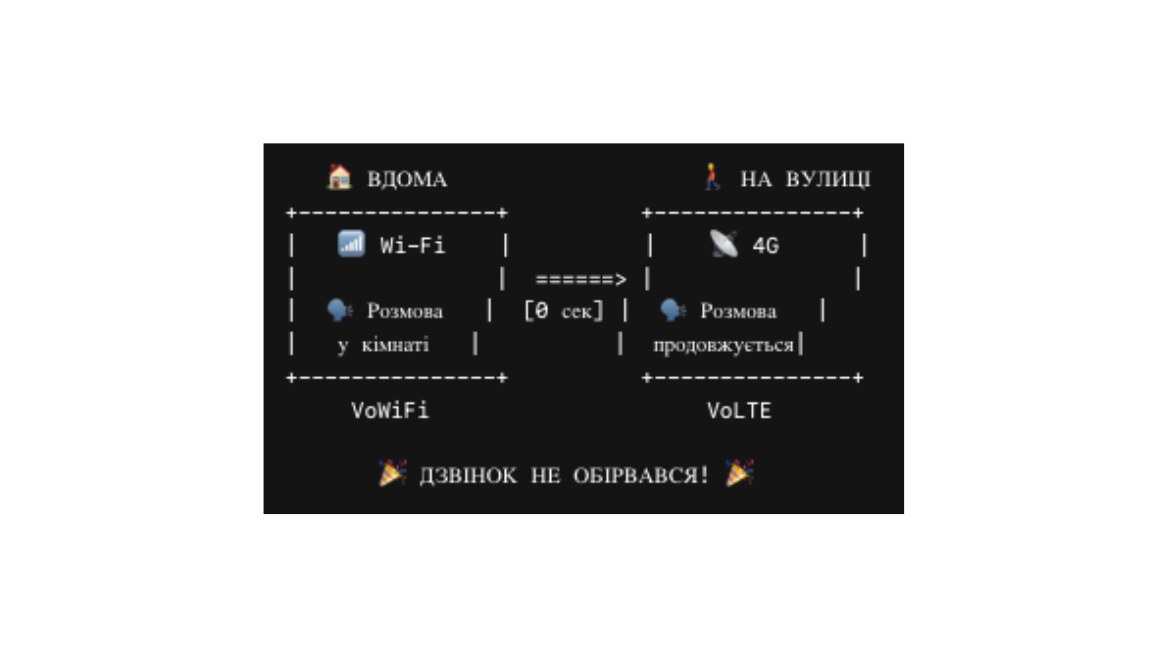
Voice chips work in a seamless tandem. Kyivstar recommends keeping both technologies enabled at the same time.
If you started a conversation in your apartment via Wi-Fi, and then went outside, where the router stopped receiving, the conversation will not be interrupted. The smartphone will imperceptibly bridge to mobile 4G (VoLTE) without delay.
World experience
The US, South Korea, Japan and Germany have already completely shut down their legacy 3G networks. According to the GSMA, 375 operators worldwide have already invested in VoLTE.
Europe is actively getting rid of outdated networks for the Digital Decade 2030 program (freeing up spectrum for LTE and 5G, energy efficiency). The Netherlands, Switzerland and Sweden have completely turned off 3G. France and Spain plan to phase out 2G by the end of 2026.
National specifics: why Ukraine does NOT turn off 2G
In Ukraine, the situation is developing according to a special scenario. Our operators have already begun a phased decommissioning of 3G networks in order to release this frequency spectrum for expanding 4G capacity and speed.
However, as the regulator N KEK notes, the shutdown of 2G in Ukraine is not even being considered at the moment. The state's position is unwavering due to three factors:
The ongoing full-scale Russian invasion.
The need to provide coverage for absolutely all categories of the population (including owners of old push-button phones).
Guaranteed access to emergency services under any conditions.
Second-generation networks in Ukraine remain the most reliable and resilient reserve in the event of large-scale infrastructure damage.
What's Next: The Future Behind VoNR and 5G
While Ukrainian operators are at the stage of pilot testing 5G, the next step in evolution is already taking shape in the world - VoNR (Voice over New Radio) technology. This is voice communication in 5G Standalone networks. The first commercial launches took place in Bell Canada (August 2025) and Belgian Proximus (early 2026).
VoNR will provide ultra-low latency and even higher sound quality over 5G radio. However, the current deployment of VoLTE and VoWiFi in Ukraine is not a temporary solution, but a mandatory technological foundation, without which it will be simply impossible to launch voice in the 5G of the future.
Today, NKEK and operators are actively working to overcome the "activation barrier" (when the phone supports 4G, but the subscriber habitually sits in the outdated calling mode). So check your settings, turn on VoLTE/VoWiFi and experience the technologies of the future today.