Changing jobs no longer means earning more. Research shows who still gets a significant salary increase when moving to another company
Working for a new company no longer guarantees a significant salary increase. While for Generation Z, changing employers is still the shortest path to higher income, for experienced professionals the situation has changed: it is often more profitable for them to stay in their current company. Such conclusions were reached byBank of America Institute, analyzing the dynamics of salaries of American workers.
Young professionals earn more after changing jobs
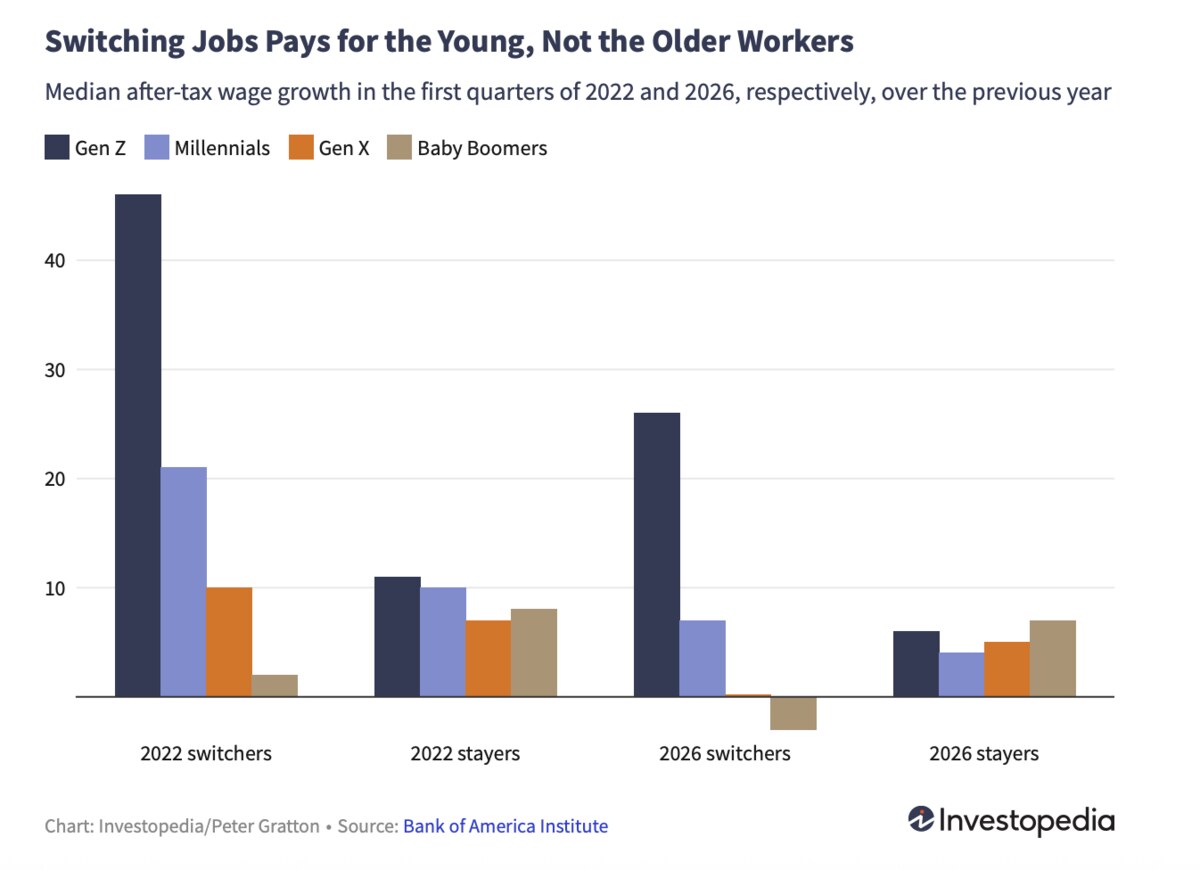
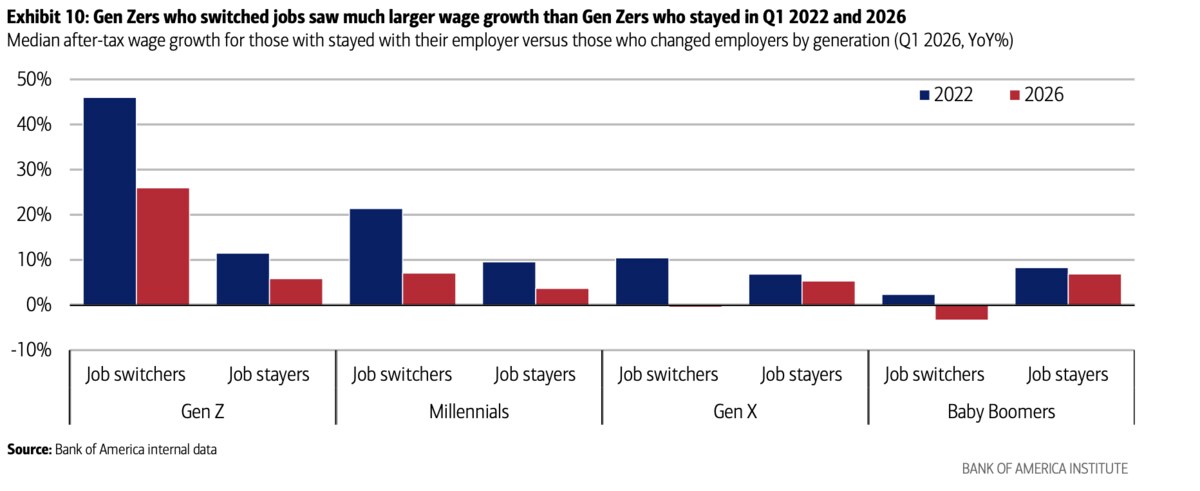
Analysts compared median employee salaries in the first quarter of 2026 with the same period a year earlier. The Gen Z generation was the most affected by the change of employer. Young workers who moved to another company showed about four times the salary increase than their peers who stayed in their previous place of work.
For millennials, changing companies also remains beneficial: they received about twice the income growth as those who did not change employers.
For experienced workers, the situation is the opposite.
However, among Generation X and Baby Boomers, the job-changing bonus has all but disappeared. According to the Bank of America Institute, employees in these generations would often receive a larger pay raise if they stayed with their company rather than moving to another employer.
Bank of America Institute economist Joe Wedford explains this by saying that young professionals tend to start their careers in lower positions and have more opportunities for rapid professional and financial growth. They are also more likely to move from part-time to full-time employment or to get jobs that better match the skills they learned during their studies.
Older workers, on the other hand, are already occupying higher-paying positions, where employers value their experience and are willing to reward loyalty.
Younger workers are more in need of higher wages
According to Wedford, financial needs also vary by age. Young people are more likely to face large expenses — buying a home or car, starting a family — and are therefore more actively looking for opportunities to increase their income.
In contrast, older workers, especially homeowners, are less sensitive to inflation and may prefer other job benefits over salary—such as the ability to work remotely or have a flexible schedule.
The job market is not so hot anymore
Bank of America also notes that the labor market has changed. Companies are hiring less frequently, so they are no longer forced to compete as aggressively for candidates as they were a few years ago. As a result, the difference in salaries between those who changed jobs and those who stayed has becomethe lowest in the last seven years.
This is especially noticeable among the youngest workers: compared to 2022, the average salary increase for Gen Z representatives after changing companies decreased by about 20 percentage points.
Half of workers did not experience any income growth at all
The study also showed that the slowdown in the labor market affected almost all categories of workers.
More than 50% of people who stayed with their company did not receive a salary increase or even started earning less — in particular due to the increase in the cost of social packages and insurance. Among those who switched to a new employer, 44% also did not see an increase in income or even lost their salary. However, analysts also see positive signals. The share of employees who changed employers increased from 12,9% at the beginning of 2025 to 13,5% in the first quarter of 2026, which may indicate a gradual recovery in the labor market.
«We are already seeing signs that the market is coming back to life,» noted Joe Wedford.