Марія БровінськаІсторії
9 October 2026, 16:23
2026-10-09
Margaret Hamilton, who invented "software engineering" and proved that code can fly to the moon, dies at 90
The author of the on-board software for Apollo has passed away at the age of 90. Her code helped land on the moon, and her approach to reliability still underlies mission-critical software.
The author of the on-board software for Apollo has passed away at the age of 90. Her code helped land on the moon, and her approach to reliability still underlies mission-critical software.
Margaret Hamilton, who led the development of onboard software for NASA’s Apollo missions, died on September 30. She was 90, MIT announced on October 7. The cause of death was not given.
From the weather forecast to the moon
Hamilton was born in 1936 in Peyola, Indiana. She studied mathematics at the University of Michigan and graduated from Earlham College in 1958 with a minor in philosophy. She moved to Boston in 1959 with her husband, who was studying law. At MIT, she first got a temporary job in the meteorology department, writing weather forecasting software with Professor Edward Lorenz. According to MIT, this work influenced his later publications on chaos theory.
In 1961, Hamilton moved to MIT’s Lincoln Laboratory, where she worked on SAGE, the first U.S. air defense system. The project cost more than the Manhattan Project. There, she became interested in a topic that would define her entire career: program reliability, which was largely unexplored at the time.
In 1965, Hamilton was preparing for graduate school when her husband saw an ad in the newspaper: MIT’s Instrumentation Lab was looking for people to work on software that would “put a man on the moon.” The lab had a NASA contract signed on August 9, 1961, just 10 weeks after John F. Kennedy announced the moon landing. Hamilton was hired as the first programmer on the project at MIT. She first worked on software for unmanned missions, then headed the manned software team. By 1968, she was deputy director, and more than 400 people were working on the Apollo software.
Hamilton later said that they didn’t have a second chance and they understood that, and many started in their 20s. The management, she said, didn’t understand software and gave the team complete freedom and trust.
"The Lauren Mistake" and Apollo 8
One day, Hamilton’s four-year-old daughter Lauren was playing with the command module simulator and accidentally launched the P01 prelaunch program in the middle of the “flight.” The simulator crashed. Hamilton added a warning to the documentation and suggested a safeguard against such a failure, but she was refused: trained astronauts would not make such a mistake. During Apollo 8 in 1968, Jim Lovell did launch P01 in flight, and the navigation data disappeared.
Hamilton’s team was quickly brought in to fix the problem, and the changes she suggested were incorporated into the program. It was an early example of defensive programming: software that anticipates errors and corrects them itself.
1202 on Apollo 11
The most famous episode occurred in July 1969. Before the landing of the Orel module, the on-board computer issued error 1202: it was overloaded by a hardware switch failure, and the system could not cope with the landing. But the Hamilton team created software with priorities that turns off secondary background tasks to leave resources for critical ones. In Houston, they trusted the software and allowed the landing to continue.
After NASA
In 1973, the Instrumentation Lab was spun off from MIT and became the independent Draper Laboratory. Hamilton also consulted for NASA on Skylab and the Space Shuttle, before going into business. In 1976, she founded Higher Order Software, which was built on the idea of error prevention and fault tolerance. A decade later, Hamilton Technologies emerged, whose flagship product, the Universal Systems Language, is a language and methodology for modeling complex systems with a focus on error prevention.
Hamilton, the author of more than 130 publications and one of the people who helped the term “software engineering” become accepted as a separate engineering discipline, said that at first the term was considered a joke, and colleagues liked to mock her radical ideas.
Awards and cultural impact
Hamilton has received the NASA Exceptional Space Act Award (2003), the Presidential Medal of Freedom from Barack Obama (2016), the Fellow Award from the Computer History Museum (2017), the Intrepid Lifetime Achievement Award (2019), and was inducted into the National Aviation Hall of Fame (2022). She was given the medal, among other things, for her contributions to the concepts of asynchronous software, priority scheduling, and the human in the decision-making loop. Obama called her a symbol of a generation of unseen women who helped send humanity into space.
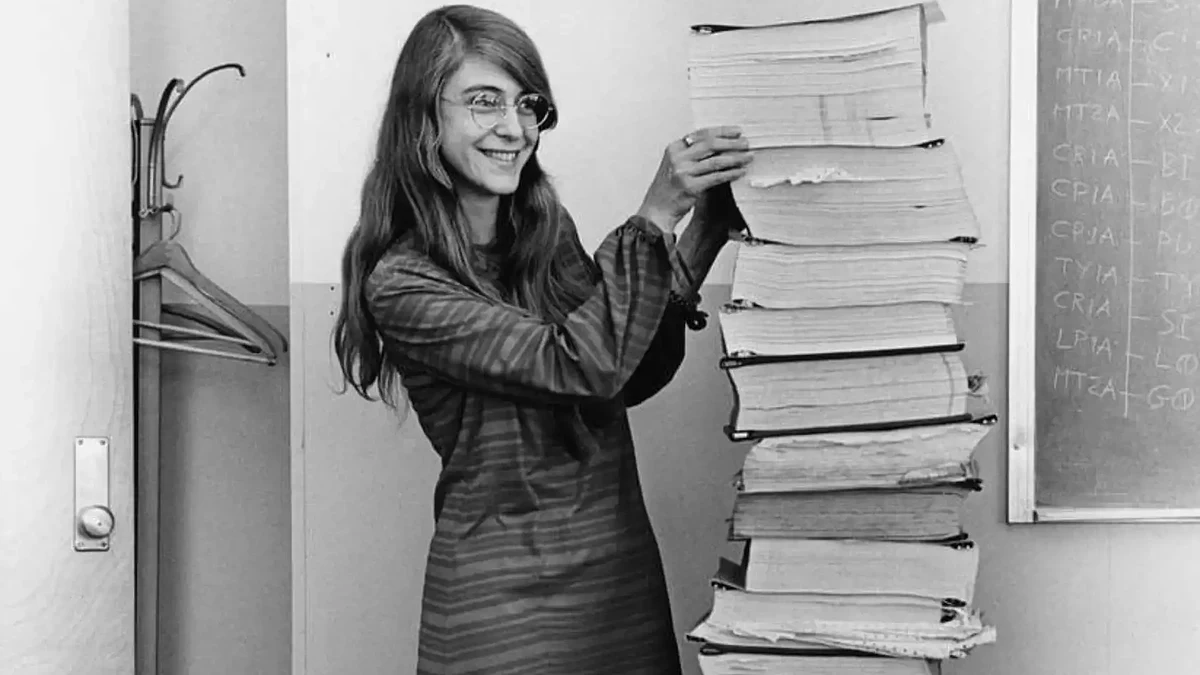
A photo of her standing next to a stack of Apollo code printouts has become an internet icon. In 2015, the mission code was posted in its entirety on GitHub, and the first line still reads: Margaret Hamilton, Colossus Programming Lead, March 28, 1969. In 2017, a Lego set called “Women of NASA” was released with her minifigure.
What colleagues say
Olivier de Weck, acting chair of MIT’s Department of Aeronautics and Astronautics, called Hamilton a pioneer who not only wrote cutting-edge code herself but also led a team that built one of the most complex systems in history. Draper President Jerry Woletz said she left an unforgettable mark on the lab.
Hamilton is survived by his daughter Lauren, son-in-law Richard Selesnik, two grandchildren, four great-grandchildren, brothers John and David, and sister Catherine. A memorial service will be held in the spring in Cambridge, Massachusetts.