Education that works: how Hillel IT School is building an EdTech business in a billion-dollar niche
He estimates the IT education market in Ukraine at 2.5–5 billion hryvnias. And although the niche is clearly saturated with competition, he calls it a clearly profitable and promising business.
He estimates the IT education market in Ukraine at 2.5–5 billion hryvnias. And although the niche is clearly saturated with competition, he calls it a clearly profitable and promising business.
Every year, new players emerge, from private tutors to hype bloggers promising «golden IT» salaries after three video lessons. How, amidst all this, does Hillel IT School continue to grow, educating over 11,000 students a year, not raising prices for years, and building a business on automation, not marketing hype?
We spoke with Vadim Drumov, CEO and co-founder of the school, about how to build an educational product that really works, about accessibility as a strategy, why they pay their students, and about «IT monsters.»
— Do you remember what was popular in IT education ten years ago, where it all started?
— I remember that somewhere in 2014 there were about 80,000 IT specialists in Ukraine. And at the time when we were just starting out, the most popular areas were: QA, Frontend, Java — at the same time, Frontend was constantly evolving.
At first, people were hired for Frontend if they only knew how to machine tools. But over time, the requirements grew, and it was necessary to know not only HTML and CSS, but also JavaScript. And the pace of market demands, of course, grew. Waves began: Python began to squeeze out territory from Java, the market began to want more Fullstack developers of universals.
Python has taken off due to the rapid development of machine learning and artificial intelligence, as well as because it was actively used by scientists and researchers at US universities. They were among the first to start using Python on a large scale for data analysis and creating AI solutions.
People want to be more versatile, so they are not only improving their level of education in their field, but also taking on related areas — learning other programming languages, automation, cybersecurity, and developing skills in management, business analysis, and product management. All of this has significantly increased interest in corporate training — and companies are willing to invest in their people to have strong teams for the future.
I see this in the business training at Hillel IT School — dozens of businesses, NGOs, and foundations continue to choose us with this request. Last year, this direction grew almost 5 times compared to 2023.
Regarding the popularity of directions and how to live with it. Look, it has always been interesting to observe «who, where and what» popularity is sought. For us, for example, it was dictated by market analysis — we constantly observe the world market, monitor all current trends and try to predict/forecast «what exactly will be needed for all these needs of change, development of the world — and from there, what exactly will be the skills and knowledge a person needs to realize himself in this world.
For us, this is embedded in the word «popularity». And when we really had a queue for training «according to QA-manual», because in those years it was a very popular direction — we fundamentally did not increase our flow of training experts, and the queue reached 6 months of waiting. Although from a business point of view — we could definitely use this, but it would go against the «logical and strict truth of the market».
— What about competition with universities? All these years there have been universities that trained people and courses. What was the competition like at first and now?
— First of all, all the platforms for courses arose precisely because the IT sphere is one of the most dynamic, it requires «here and now» solutions, knowledge and skills. And, unfortunately, most universities could not provide this, and the issue was not only in speed, but often in the approaches themselves. They taught according to old textbooks, could stretch the program for several years, just because «some statute requires it.»
Our concept was to focus on practice: 30% theory / 70% practice. People immediately work with real tasks. And what is important is that they are taught by IT professionals who work on real projects. For us, it is fundamental that our teachers have relevant knowledge and skills from the real world of IT here and now. So that they can share all this with students here and now, and not read a 10-year-old manual. The average work experience of our experts is 6 years.
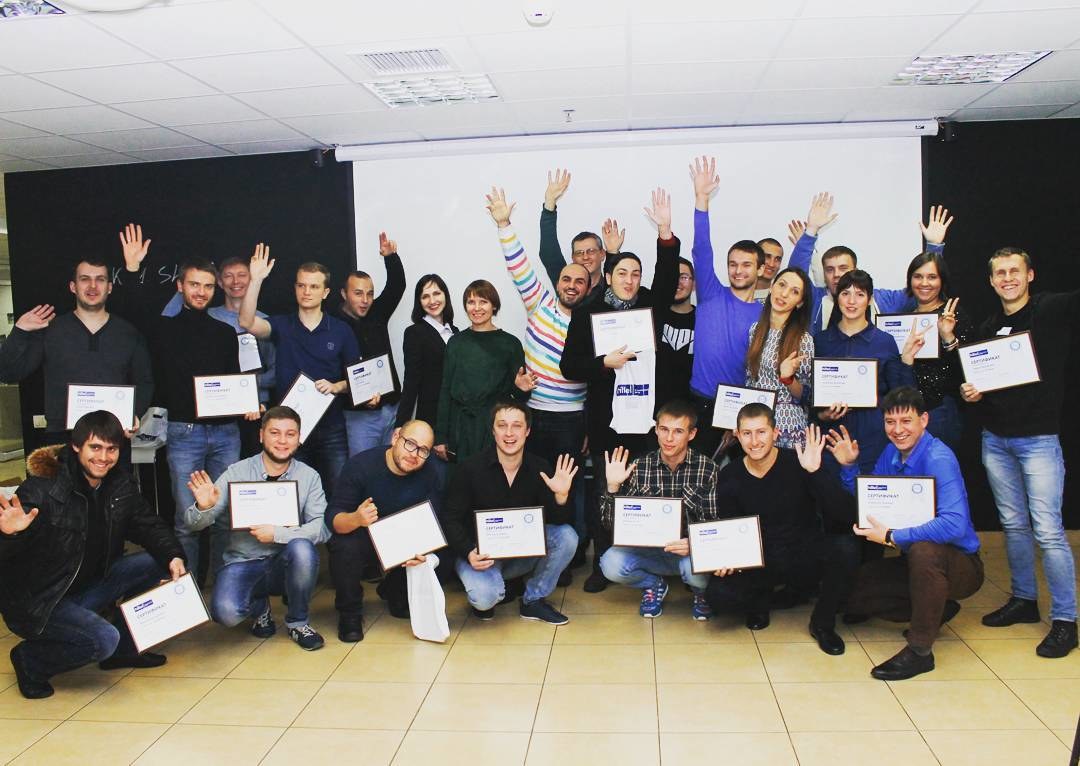
First-year school graduates
We didn’t feel any competition with universities at that time, because they didn’t take us seriously. Now, however, the competition between universities and IT schools has increased, especially from the universities. But I’m honestly very happy about it. After all, they are a very important institution for the country. And the fact that they are now taking the necessary steps for their progress, important changes, is definitely the right move.
Well, competition is always about improving the quality of services of all players in the market (honest players).
And besides competition with universities, I see another side — as complementing each other. For example, we are currently actively developing our IT school for children and teenagers Bookford, so that young people can try different areas in IT, and then, when they are 17, they will consciously choose their specialization (possibly at university). It is great when students who take courses then go to universities and already understand what they need to achieve success. On the other hand, university students can come to us to improve their practical skills. And already during their studies at university, they can start working on their IT specialty.
— There were different opinions, including from well-known IT people, one of them was that if you study at a university, it means you can become a programmer. And if you only take courses, you will be a coder and you will not have a general vision of the profession. To what extent is it possible to make a profession no worse than graduating from a university by taking courses?
— It all depends on the university and the profession. There is a stereotype in society that all developers should know math well.
— Yes, 100%.
— But this is an illusion. Any developer will tell you that in many specialties, 10th-11th grade mathematics is absolutely enough to understand everything. But if you are doing complex things — conventionally rocket science, artificial intelligence, working with large amounts of data or developing complex algorithms — then mathematics is really important. It gives you an advantage and helps you become a strong engineer.
But there are specialties that do not require this.
We advise our students: look at the specialty that interests you, look at the requirements for this candidate and prepare for these requirements. A person can use the courses to make a plan for what he wants to study, and whether he really needs to know all these technologies to start working in order to get his first profession.
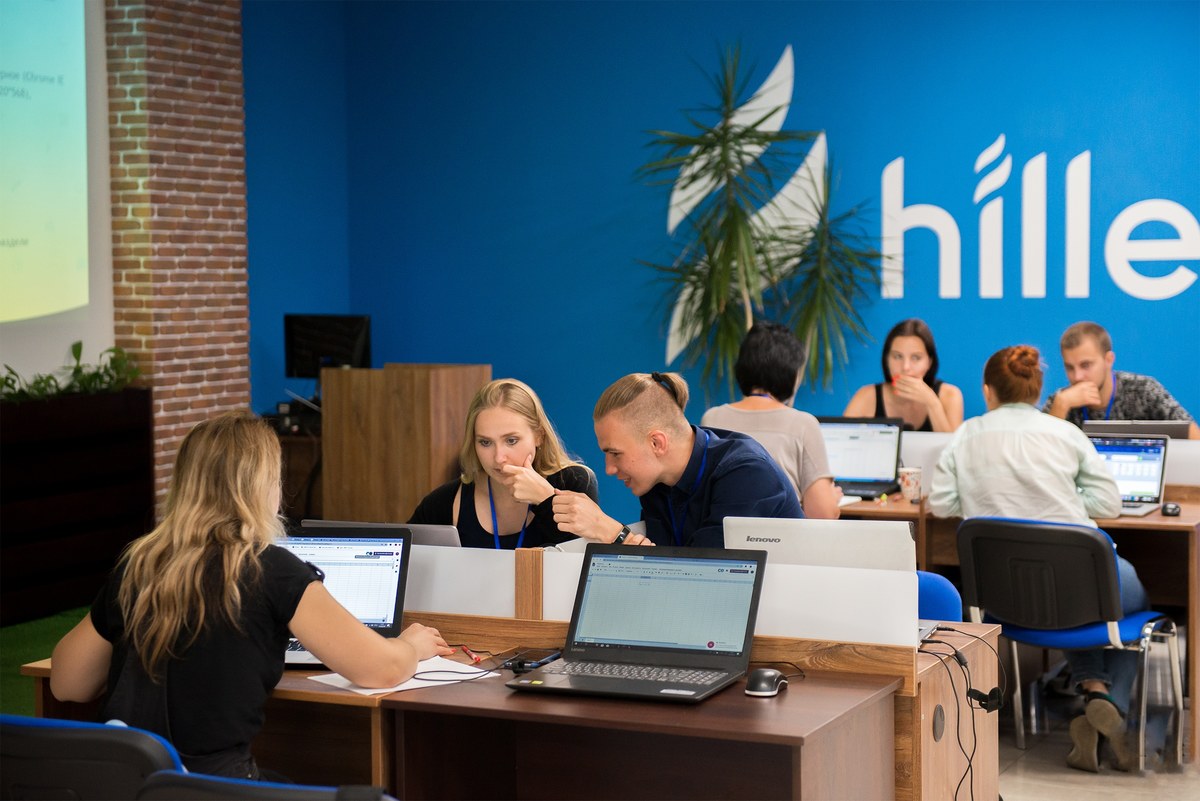
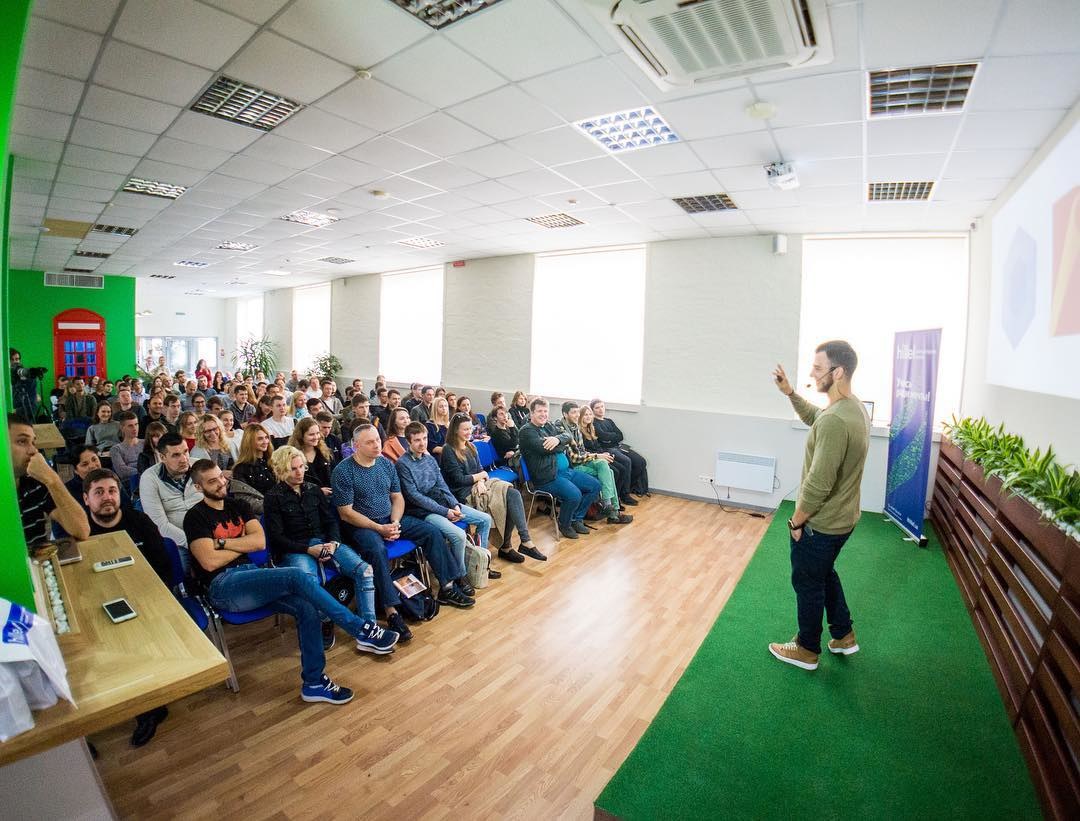
Offline learning until 2022
And in the process of work, you can constantly learn. Because all great IT specialists are constantly learning. I am sure that if you conduct a survey: the majority read articles, buy additional courses, etc.
— So, you can still make a profession and career in IT by simply completing various courses that you plan for yourself as needed?
— I am convinced that it is not a diploma that gives a person success in their professional activities and career. The real result is given by internal motivation, systematic work on oneself, and the ability to apply knowledge in real conditions. We live in a time when the ability to learn quickly and adapt is valued more than formal education. And this is confirmed by the stories of our graduates.
For example, Olga Divushchak, who has a higher education in logistics, completed courses in Internet marketing, worked as a freelance designer, and now runs her own digital agency, Digital Paint, and has long been a successful marketer and teaches at our school.
Oleksandr Fesyura manages the project of receiving international transfers to Monobank cards.
Victoria Tereshchenko, who held the position of Software QA Engineer at Tesla and now works at TikTok.
Victoria Tereshchenko
Diana Raynova also took a course in UI/UX design after graduating from university and has been successfully developing this direction for over 5 years in one of the largest Ukrainian technology retailers, Citrus.
And these are just a few examples, you must admit, it is impossible to list all the graduates. Of course, their success is a personal achievement, we do not directly associate it with studying with us, but we are very happy for everyone who realizes themselves in the world of IT.
— How was Hillel IT School created and where did it start?
— The first presentation of the school took place in November 2012, and the first class was held on February 22, 2013. It was an 80-square-meter room in one of the business centers, where there was both a reception and a classroom. And without windows. I remember that we only found out what the weather was like there: whether it was snowing or raining when we went outside. It was the start in Odessa.
Then the space of this offline school increased tenfold, and huge branches appeared in Dnipro, Kyiv, and Kharkiv. By 2022, we had a 50/50 combination of offline and online.
— What did you do at school? What background did you come with?
— I once worked as a Project Manager at the Netpeak agency. I have management experience in the production sector, at that time I managed an enterprise with about 100 people.
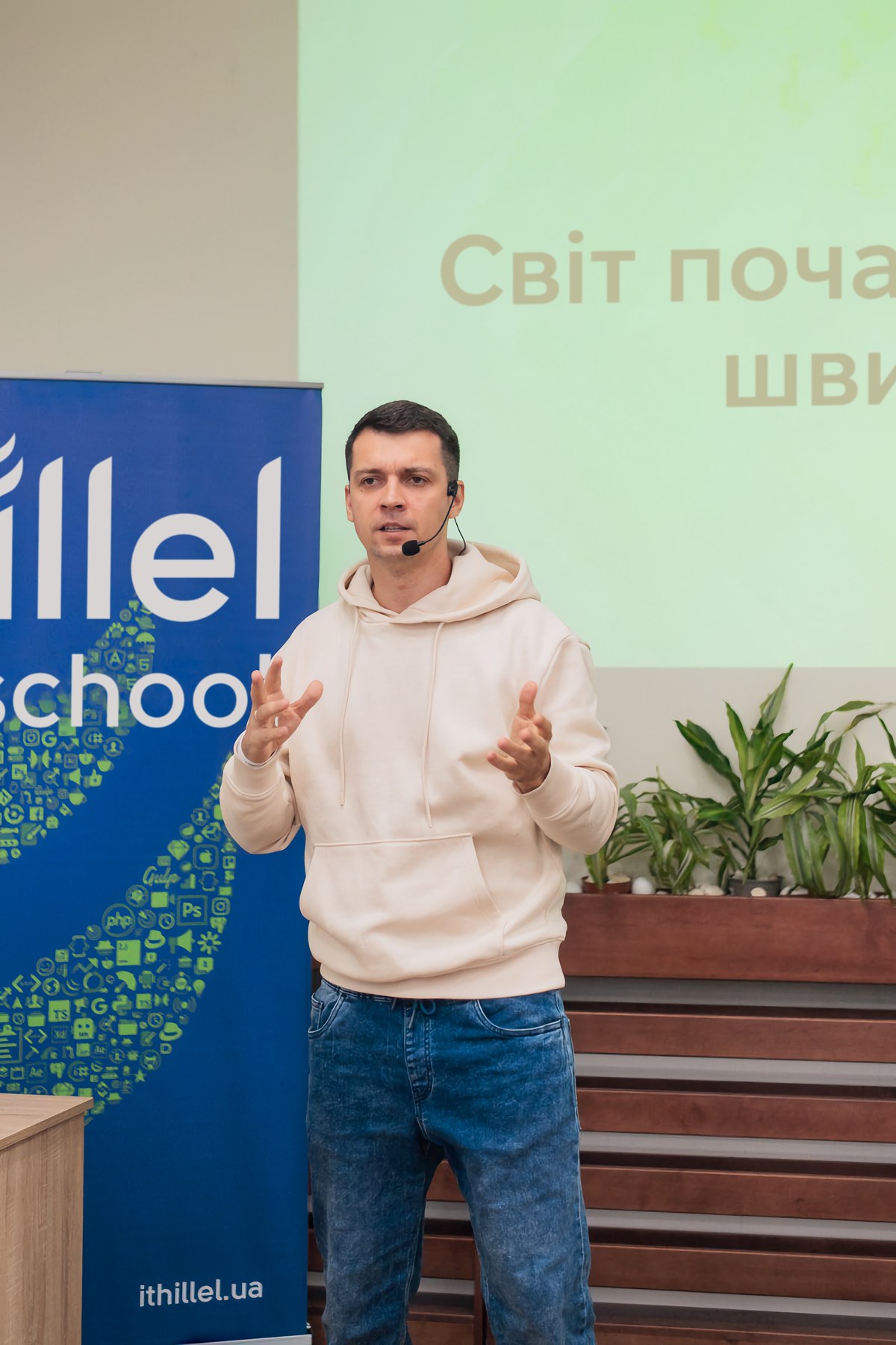
Vadim Drumov
— And you thought you should start your own business?
There were six months of discussions about me joining this project. I was sure that digitalization of various sectors of the economy would take place. And this means that the IT industry would grow, and there would be an increasing need for people to work on all this.
— How did you search for the first teachers?
— It was very important that people had at least 3 years of experience in the industry. We also looked for company executives we knew to recommend good specialists.
— And how much did the course cost then?
— The tester training course cost 12,600 hryvnias in 2014. And what’s most interesting: by 2022 the price was 13,500 hryvnias. That is, in 9 years the price has changed by literally 7%, and this is not even indexed to the annual inflation rate.
Keeping the cost level affordable is what our position dictates to us — to make education as effective as possible, but also accessible to people, because education can change lives for the better.
We have both beginners and IT specialists at the Middle, Senior, and Lead levels — about 30–40%. They want to change their profession, get a promotion, or simply improve the necessary skill — this is what we consider our influence.
Now, during the war, of course, the situation has changed, and the dollar exchange rate has affected many factors, but we still try to keep prices stable and much lower than most of our colleagues on the market.
— Was there an opportunity to raise prices?
So, for example, in September 2021, people were signing up for March 2022. Of course, there was a long queue, and it was possible to safely raise prices, since demand was high. But I repeat, we have a different strategy. We understand that even a slight price increase can be serious for someone.
— How do you manage to keep prices down and not lose quality?
Much depends on process automation. We are actively implementing technologies to optimize both the educational process and administrative functions. For example, our system already has a student feedback monitoring function, where artificial intelligence automatically evaluates and responds to feedback. This saves our managers time and reduces the human factor that affects the quality of work.
We used to listen to some of the sales department’s phone calls to improve customer focus. Now, artificial intelligence does this, which saves a lot of time and relieves managers of routine.
Right from the start, we developed our own ERP system (we call it TT), which integrates all aspects of the school’s work: from teaching to student employment. This allows us to control all processes, automate tasks, and provide convenience for both students and our employees.
In 2024, the school was recognized as the best for teaching programming and training QA engineers
We are constantly improving the Hillel LMS learning platform. Among the new features: after the lesson, a convenient and important Samari is automatically created. It includes a summary of the lesson with key topics, automatic timecodes on the recorded video lesson. This would be extremely difficult to do manually, because there is a lot of material.
— How would you assess the overall IT training market in Ukraine?
— I estimate its volume at 2.5–5 billion hryvnias. And the global market is tens of billions of dollars. This is based on my internal calculations, taking into account that there are both large companies and individual teachers who conduct courses on the market.
— There are cases when people organize courses, but at the same time do not actually offer quality training. How can you determine whether you are dealing with such a «pseudo-course»?
— First, you should pay attention to the history of the company. If it has been operating for a long time, this is already a good signal. In addition, it is worth looking at what exactly these courses promise. If they promise «mountains of gold, millions in starting salaries, and a carefree life as an IT professional» — and all this in a few weeks, this should be alarming.
Secondly, no one can guarantee 100% employment. Success in this matter consists of three components: your efforts, the quality of the school and the decision of the company that takes you. Therefore, if someone promises such a figure, it should be a bad signal. Instead of promising employment, it is better to focus on the quality of education.
— How are you looking for teachers now?
— Connections. Constant checks and a detector. I’m kidding, at least about that last point.
In addition to the relevant soft and hard skills, our teachers have active professional activity in companies and work experience of at least 4 years, are able to explain complex things in simple words to a large audience, etc. Therefore, recommendations from others are of great importance. A person’s professional reputation is again worth its weight in gold here.
And we have a system that tracks teaching effectiveness so that we can quickly adjust the process.
— What about teachers' salaries?
— I won’t disclose exact numbers. I will say that it depends on the direction, experience, and qualifications of the teachers.
This differentiation explains both the complexity of the directions, the profile of the teacher and his expertise, and also serves as motivation, because we have their assessment, which directly depends on the success of students. In the most complex long directions, a teacher can earn ± his average salary in the company or even more for one course.
In total, we employ between 200 and 300 teachers.
— How many courses do you have now?
— We have about 48 courses. Last year, we had about 11,000 students. About 30–40% of them are IT professionals who are taking advanced training courses. We also have corporate clients, companies that send their employees for training. In total, over the entire time of our activity, more than 70,000 students have studied at the school. And, by the way, we really still pay our students for their studies.
To do this, we have created the only educational banking of bonuses in Ukraine, where they can earn thousands of UAH. Students receive bonuses for academic success, recommendations to friends, etc. — and can spend them on discounts, transfer them to others, or even withdraw them to their bank account. In total, we have already invested more than 70 million UAH in this program. There are no analogues to such banking in IT education.
— What do you see as the professions of the future?
— Now we see that data is the new oil. There is a shortage of data analysis specialists, and the competition for these vacancies is lower than in other areas. Therefore, if you want to work in IT or another technical field, it is important to pay attention to data analytics as a promising direction.
AI and other tools that automate routine tasks will change every field: software, data analysis, video content creation, etc. If before it could take us two weeks to implement one video, now thanks to AI we can produce up to four videos per week. Productivity has increased significantly thanks to the use of such tools.
It is logical that this is beneficial for companies, and it is obvious that AI is a must-have tool for specialists to remain competitive in the market.
It seems to me that the specialist of the future is a person who successfully creates and manages AI assistants. Undoubtedly, this process of transformation and implementation of AI in all processes will be hampered by the «human factor». This is typical: at first people have difficulty accepting changes, but then they cannot give up what has become convenient for them.
And again, such transformations do lead to something disappearing forever, but something new is bound to form. Just remember, Facebook appeared more than 20 years ago, and Google even earlier. They clearly changed both the surrounding space and professions in their time.
— But let’s get back to your experience. What were the most stressful moments in your company’s development?
— No matter how it sounds, it seems to me that 2020 gave us a specific vaccination «against total stress.» When a full-scale war began, we opened old documents describing crisis actions and saw that 70% of what we did during the pandemic, we had already started implementing since the beginning of the war.
It was an interesting coincidence. In 2019, we decided to open a branch in Lviv, but then I realized that we needed to prepare a platform for online training. And just at the time when we started active preparation, quarantine was announced. We started online training, as planned. It coincided so that we could immediately apply our plans for online training during quarantine. And this gave us an impetus to develop this platform. You can call it a coincidence or a clear catalyst, thanks to which we were able to train 3,000–4,000 people at the same time.
When a full-scale war began, we resumed training very quickly because we understood that it was important for many people to gain new knowledge in order to find a job faster.
I don’t know if I should write this, but I’ll tell you. People pay us in advance. And when the war started, most of them started asking for a refund. We didn’t say that it was a force majeure situation, but we returned everything to everyone. And the problem was that today you give one amount, and tomorrow you have to double it, because there were already more people willing to pay.
And we refunded the money to everyone who applied. After all, we understood that these 5,000, 10,000, 15,000 hryvnias that the client paid for training could have influenced, for example, a mother with a child to leave a dangerous place. And these funds could have become a decisive factor in making this decision.
— Every businessman is ready to sell his company if he receives an offer that suits him. Do you have this approach? Do you consider your company to be your life’s work?
— I love my IT school very much, of course, I feel sentimental about it. But this is a business. Yes, if there is an offer, then, of course, it all depends on the price. I feel absolutely normal about this.
— Could this happen: a strong company will emerge that will buy up various IT education companies in Ukraine. What do you think?
— The full-scale war objectively influenced this. If it hadn’t started, this consolidation would have happened. For example, before the war we were talking to a private school to buy it. We would like to educate young people from elementary school to graduation. It would be a very cool story, because after school they would come out as «IT monsters.»
That is, by the age of 17, they would already have a fundamental base and clearly developed skills, and this would be a way not only to successfully enter the world of IT, but specifically to break through it — from all templates, frameworks and with the necessary advantages. That is why this year we opened the Bookford IT school for children and teenagers. This was a logical step in scaling our children’s direction, which had been based on Hillel IT School for over 7 years.
— If it suddenly happened that you were selling your business, what would you do then? Do you have any alternative scenarios?
— I would go into construction. I always liked it, and we were always building something. Every year we renovated and remodeled something in our branch schools. Also, I am interested in the banking sector, especially from a technology perspective.