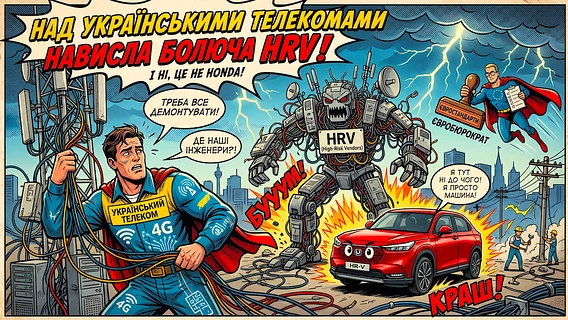
A painful HRV looms over Ukrainian telecoms. And no, it's not a Honda
European digitalization can sometimes be not only beneficial but also quite harmful. Or rather, the intentions of European politicians almost always have good ones, but the implementation of these intentions in life can be threatening for business (and not only). Recently, this applies not only to European countries, but also to Ukraine.
European digitalization can sometimes be not only beneficial but also quite harmful. Or rather, the intentions of European politicians almost always have good ones, but the implementation of these intentions in life can be threatening for business (and not only). Recently, this applies not only to European countries, but also to Ukraine.
I understand that I started this post, and I’m immediately writing in riddles :) Now I’ll explain in more detail what I’m talking about. There is news that has swept through the information space quite imperceptibly, against the background of Trump’s loud statements, which constantly distract our attention from really important things.
One step closer to the EU, but there is a nuance
So, what happened: On October 13, the 4th Intergovernmental Conference on Ukraine’s Accession to the EU was held in Luxembourg. The result was an official agreement by all 27 member states to open negotiations immediately in two key areas: Cluster 2 (Internal Market); Cluster 3 (Competitiveness and Inclusive Growth).
Let me remind you that we opened Cluster 1 (Fundamentals) with the EU back in June 2025, and Cluster 6 (Foreign Relations) in July 2025.
That is, we are one step closer to joining the EU, which is good news globally. I will not go into the details of this event. Instead, I will focus on digitalization, the topic that I am following.
Why is the Luxembourg event so important for our telecom market? It turns out that the EU’s decision to open Cluster 3 for Ukraine in the process of European integration requires us to harmonize our legislation with European cybersecurity standards. Among other things, it provides for the implementation of the EU 5G Security Toolbox.
And here’s where the fun begins. 5G Toolbox includes a recommendation for mandatory dismantling and replacement of equipment from High-Risk Vendors (HRV). Remember these three letters. Translated into ordinary human language, this means mandatory dismantling of equipment from Chinese manufacturers.
Specific steps and specific problems
Telecom operators will be required to completely remove HRV equipment from mobile networks. And these restrictions are planned to be extended not only to mobile networks (core and radio access RAN), but also to fixed and satellite communications.
A report by research company Assembly (commissioned by the Connect Europe association) shows that instead of improving safety, the new Act risks causing a cascade of operational, financial and environmental problems.
First, there is an "acute shortage" of telecom engineers in the EU. The massive dismantling of equipment at hundreds of thousands of sites will simultaneously lead to a shortage of crews and skyrocketing prices for contractor services. Moreover, the procedures for obtaining construction permits and replacing antennas in countries such as Germany can take up to 2 years.
Secondly, the exclusion of Chinese suppliers (who together account for about 32% of the European market) leaves operators with effectively only two major players — Sweden’s Ericsson and Finland’s Nokia. Narrowing the market to a duopoly will inevitably lead to rising equipment prices and a slowdown in R&D.
And thirdly (and this is probably the most important point), the direct costs of European operators to replace mobile equipment are estimated by the Chinese Chamber of Commerce in the European Union at €56 billion, which they will also have to cover out of their own pockets (no compensation from the EC is provided).
Experience of other countries
Great Britain
The experience of the UK, which started its HRV replacement earlier, is a warning sign. The schedule called for a cleanup of the core by the end of 2023, a 35% RAN share cap by July 2023, and a complete removal from all 5G networks by December 31, 2027.
During this time, the UK has fallen to the bottom of the EU in terms of mobile network quality, according to Assembly data (only 80% of “stable quality” signal on the network compared to 88,1% on average for the EU). 5G coverage in the UK is 65%, while in the EU it is 85,7%.
USA
The US introduced a mandatory Chinese equipment replacement program in 2020. It is the only country to have allocated direct government funding (approximately $5 billion) to compensate operators. However, even with the money available, the program has been running for more than five years, and its implementation rate is still below 50%.
Germany
Germany has mandated the removal of critical components from the 5G core by the end of 2026, and control systems in access and transport networks by the end of 2029.
By the way, some countries, such as Sweden, Lithuania and Estonia, have almost completely completed the dismantling and replacement process in their networks. But not everywhere the process went so smoothly. After all, the cost of removal is billions of euros. And the EU does not provide for a centralized compensation fund. Therefore, European operators are forced to sue governments. For example, in Denmark, a court recognized the right of the operator TDC NET to compensation.
What the new regulation means for us
For Ukrainian telecoms, such a “major replacement” could turn into a real headache. “Some mobile operators may have about 70%, or even more, of their equipment from Chinese suppliers,” a representative of the Ministry of Digital Affairs told me back in 2023. According to his estimates, replacing HRV could cost more than a billion dollars, if not several billion.
Yes, network cybersecurity is a truly pressing national issue. But imagine yourself in the shoes of telecommunications operators: you are forced to dismantle and throw away equipment that works perfectly at your own expense, and urgently look for a replacement. And this is in a country where the network literally has to be pulled out of the other world every day after another rocket attack, blackouts, and cyberattacks. If, in such conditions, you also load already exhausted engineering teams with artificial dismantling work, this will create a direct threat to the stability of our entire critical infrastructure.
Moreover, it is not easy for anyone to do this. Due to mobilization and an acute shortage of personnel in the labor market, operators will not be able to physically recruit so many specialists. As a result, instead of development, we will get a slowdown: all money and resources will go to modifying old stations, and the full launch of 5G and expanding coverage in the regions will again be postponed. In the end, you and I will have to pay for all this through tariff increases.
What to do?
That is why, during negotiations with the European Commission, the Ukrainian government should not simply silently agree to all of Brussels' demands, but rather fiercely fight for special conditions for our market.