Редакція dev.ua
16 November 2026, 17:25
2026-11-16
Certification and Laboratory Testing: Huawei Shared Details on Network Cybersecurity Control
Maintaining the resilience of telecommunications networks and protecting critical infrastructure from cyber threats were the topics of the third conference of the Ukrainian community of network operators NOGUA 3, which took place in Lviv on November 12–15. The event brought together engineers, heads of international and Ukrainian technology companies, representatives of the Ministry of Digital Affairs, the State Service for Special Communications, and other state institutions and regulators in the field of telecom and cybersecurity to discuss the challenges faced by Ukrainian telecom in the context of a full-scale war and missile strikes on the energy sector.
Maintaining the resilience of telecommunications networks and protecting critical infrastructure from cyber threats were the topics of the third conference of the Ukrainian community of network operators NOGUA 3, which took place in Lviv on November 12–15. The event brought together engineers, heads of international and Ukrainian technology companies, representatives of the Ministry of Digital Affairs, the State Service for Special Communications, and other state institutions and regulators in the field of telecom and cybersecurity to discuss the challenges facing Ukrainian telecom in the context of a full-scale war and missile strikes on the energy sector.
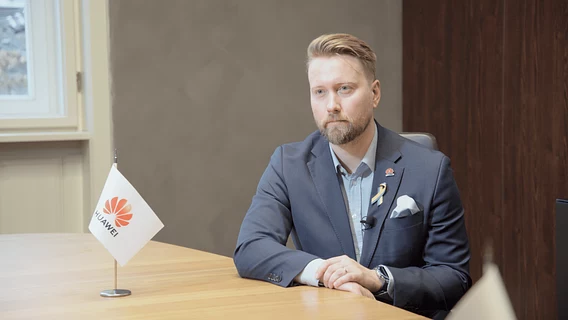
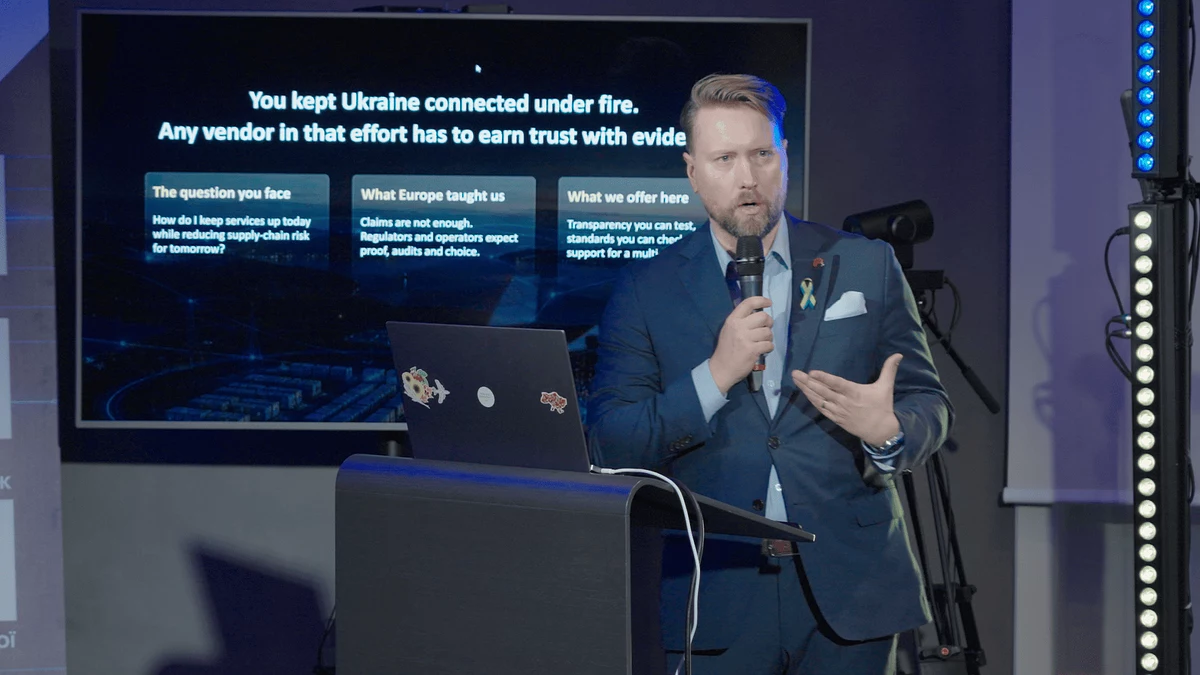
Niklas Mannfolk, Vice President of Business Development at Huawei Finland, focused his presentation on building trust in telecommunications equipment through transparency, independent audits, and adherence to international technical standards. He emphasized that in times of war, communications are a critical element of a country's survival, so any technology provider must prove the safety of its products with real facts, not declarations.
"You have maintained connectivity in Ukraine under fire. Any provider participating in this effort must earn trust with evidence. Claims alone are not enough, as regulators and operators expect evidence, audits and choice," stressed Niklas Mannfolk.
The company representative spoke about the experience of working in the European market, which has high requirements for cybersecurity. In particular, in Finland, the national regulator Traficom has conducted a risk assessment of 5G networks three times in recent years. According to the results of these inspections, the regulator found no grounds for removing the supplier's equipment, confirming its compliance with security standards. At the same time, against the backdrop of discussions in the European Union on mandatory restrictions on certain vendors, the heads of 17 leading European telecom operators have already warned of possible losses for the industry of 40 billion euros in the event of the introduction of strict bans.
Niklas Mannfolk, Vice President of Business Development, Huawei Finland
Niklas Mannfolk noted that the assessment of suppliers should be based on transparent criteria and independent control, covering the entire life cycle of the equipment: from project development to decommissioning. The company's key products are regularly audited according to the international standards Common Criteria and GSMA NESAS, and the results of these audits are published in the public domain. At the same time, the expert noted that certificates alone do not solve all security problems, so it is important for operators to conduct their own monitoring and testing of configurations in their own laboratories.
“We fully comply with every rule and legislation. We ask that suppliers be evaluated based on evidence and technical standards, not country of origin. Our approach involves transparency that can be verified,” said Huawei Finland’s Vice President of Business Environment Development.
During his speech, he paid special attention to the issue of ensuring the stability of networks in conditions of regular power outages and attacks on the power system. Modern telecom solutions allow for early detection of elements that may fail, adapt the operation of base stations to optimize battery consumption, and automatically direct repair crews to the most critical facilities.
The speaker also emphasized the importance of developing a multi-vendor ecosystem. Using open standards and ensuring compatibility of equipment from different manufacturers allows operators to flexibly manage risks and avoid dependence on a single supplier.
“We provide operators with tools for their own control: testing, monitoring and validation of configurations in their laboratories, as well as access to the results of independent audits according to international standards,” concluded Niklas Mannfolk.
Кіберспорт — це вам не іграшки, а безсонні ночі, стрес, суперництво і робота, робота, робота…
Поспілкувалися з трьома гравцями про професію, рутину, техніку і будні кіберспортсменів.