Промо на dev.uaWork
27 November 2025, 10:09
2025-11-27
HURMA launches 360 assessment tool that automatically collects and analyzes employee feedback
HURMA System introduced a new 360-assessment functionality in the "Effectiveness" section, which automates the full cycle of collecting and analyzing feedback in teams: from planning to development.
HURMA System introduced a new 360-assessment functionality in the "Effectiveness" section, which automates the full cycle of collecting and analyzing feedback in teams: from planning to development.
The launch was a response to a business request — companies want to measure performance through data. However, most HR departments still do it manually: in spreadsheets, forms, and letters.
360 feedback has long been considered one of the most effective tools for employee development, but in practice it often falters due to complex organization, fragmented data, and lack of consistency. The HURMA update removes these barriers by unifying the process, analytics, and feedback history in a single interface.
What does performance evaluation look like in most companies?
Even in companies with strong feedback cultures, the process often looks the same: spreadsheets, letters, copies of questionnaires, endless reminders in work chats. HR teams spend weeks getting organized, but the results remain fragmented.
And even with this level of training, only 26% of organizations believe that their managers effectively support team development, according to a Deloitte study.
In turn, HR cannot generalize the development trend through 360, and employees do not understand what to do with the results.
And so, the assessment, which was supposed to motivate, turns into an administrative burden.
Why it's hard for companies to move without a centralized system
Modern business relies on data. But when it comes to people development, numbers are often lacking:
when reviewing compensation, executives rely on intuition;
When the question arises of who to promote, HR is forced to gather evidence from dozens of sources;
If the company grows, manual evaluation simply does not scale.
All this is not due to a lack of desire, but due to a lack of a convenient tool.
And this is exactly what HURMA decided to change.
How HURMA made the 360 method part of systemic development
The new “Effectiveness” section in HURMA is where the entire 360 process runs automatically: from launch to results.
And, of course, all this without Excel, forms, and endless manual reminders:
A built-in cycle, not a one-time survey. Assessment in HURMA takes place in a cycle format: HR sets the frequency, participants, and goals. The system launches the process, sends invitations, reminders, and records the results. This way, the assessment is not conducted on a case-by-case basis, but regularly — in line with the company's development.
Analytics that shows dynamics, not just scores. Each cycle automatically generates data that accumulates from period to period. HR sees how the team's competencies change, who is developing faster, who needs support. Managers can compare results across departments and make decisions based on facts.
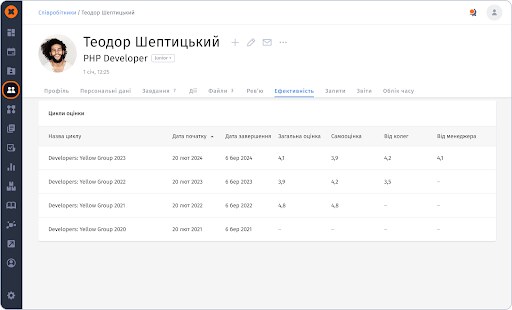
Development history in one tab. The employee profile contains a “Performance” tab — a personal analytics of all previous assessments. Thus, each employee has their own “growth map” — with specific benchmarks.
Transparency and a culture of feedback. HURMA allows you to fine-tune levels of openness — from anonymous feedback to full visibility. Companies choose how to build trust: through confidentiality or through openness.
From feedback to action. 360 results don’t disappear after the summary. They can be used immediately for PDP plans and 1:1 meetings. The assessment becomes not the end point, but the start of the next stage of development.
That is, instead of one-time launches, the company gets a continuous process that forms a culture of thoughtful feedback with real results. But systematicity is not only about analytics, but also about a responsible attitude to data. That is why HURMA paid special attention to security architecture
“Companies that work with sensitive information often come to us, because we have a Single-Tenant architecture. Each company's data is isolated, while in all other products, data is stored together with data from other companies, sometimes competitors... This is the best model and it is the only one on the market.” — Volodymyr Fedak, CEO of HURMA.
That is why HURMA is often chosen by companies that value not only functionality, but also complete security of their HR data - from personal information to assessment results.
How 360 at HURMA will change the daily work of HR
When performance appraisal ceases to be a manual process, HR has time and space for strategic work.
According to a SHRM study, 85% of companies that have implemented automation or artificial intelligence into HR processes have seen significant time savings and increased team productivity.
This means that assessment automation is not about technology for technology's sake, but about truly freeing up resources that can be directed toward people development, corporate culture, and analytics.
HURMA turns 360° into a source of management decisions, not reports.
After launching the "Efficiency" functionality, data from each cycle is automatically converted into indicators: by company, department, and each employee.
HR sees the dynamics of competency development, and managers see ready-made analytical snapshots for decisions about promotions, training, or changes in the structure.
McKinsey research is very suitable to support this idea - companies with a systematic approach to performance assessment are 4.2 times more productive than those where processes remain fragmented.
It is this scaling effect that HURMA provides: each evaluation cycle accumulates data that forms the analytical basis for development.
As a result, HR has:
Less routine. Preparing for a cycle takes hours, not weeks.
Analytics in a few clicks. No spreadsheets or manual calculations.
Objective data on results and dynamics replace subjective impressions.
HURMA gives HR departments the opportunity to focus on what's important - employee development and company culture.
Time to test
The 360 Performance module is now available to all users. Companies can test the functionality in a free demo, run their own cycle, and see how automation reduces weeks of routine work to a few hours.
If you've ever done spreadsheets, reminded colleagues in chats, and manually tallied results, you know exactly how much time and effort it takes. Now you can do it differently!
Try out what an automated 360 assessment looks like — order a free demo today!