Scientists have designed a spaceship that can carry 2,400 colonists to the closest star to the Sun
A team of engineers has designed a 57 km long Chrysalis spacecraft capable of carrying up to 2,400 passengers to Alpha Centauri.


A team of engineers has designed a 57 km long Chrysalis spacecraft capable of carrying up to 2,400 passengers to Alpha Centauri.
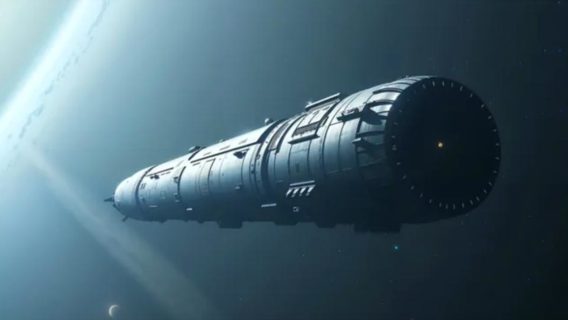
A team of engineers has designed a 57 km long Chrysalis spacecraft capable of carrying up to 2,400 passengers to Alpha Centauri.
As Futurism reports, for this project, the scientists received the top prize at the Project Hyperion Design Competition, which was launched last year by an international consortium of scientists, engineers, and urban planners.
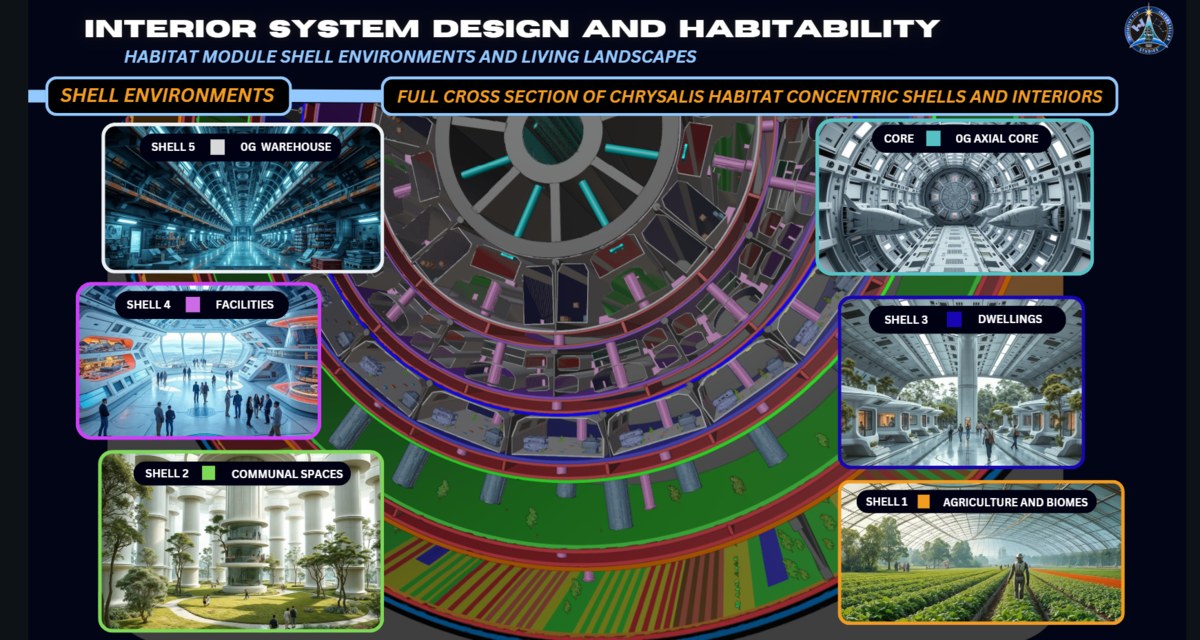
The hypothetical ship creates Earth-like gravity by constantly rotating on its axis. It has multiple layers with living quarters, gardens, storage, food production and ecosystems, and communal areas. Each of these shells is powered by nuclear fusion reactors, although this technology is still under development.
Chrysalis consists of several levels, each of which is a «fully self-contained and complete» habitat. The level closest to the core was designed to provide space for plants, microorganisms, livestock, and other food-producing mechanisms. The diverse environments allow for the preservation of biodiversity, including tropical and boreal forests.
The second layer contains common areas, and the third contains «printed living modules». The outer layer serves as a warehouse for machines, equipment, and other types of resources.
The 130-meter-high, 359-meter-diameter «Space Dome» provides a controlled zero-gravity environment, as well as thermal insulation and protection from cosmic radiation. It is also the only place where residents can contemplate outer space while floating freely and safely in weightlessness.
«Through the dome’s transparent panels, residents will be able to observe space behind the spacecraft,» the description says.
Since Chrysalis is a generational ship, the goal is to give both male and female residents a three-year window between the ages of 28 and 31 to reproduce. According to the description, each resident is limited to two children, «not necessarily with the same partner.»
The goal is to maintain a «stable population» of approximately 1,500 individuals for three generations.
Artificial intelligence will ensure «the sustainability of the entire social system, better knowledge sharing between different generations of residents, and a deeper understanding of the overall dynamics of the Chrysalis spacecraft,» the presentation says.
Unfortunately, a ship of this scale and technology is still closer to science fiction than reality.
Aside from the problem of nuclear fusion, the manufacturing processes required to build a structure tens of kilometers long in zero gravity are far beyond anything humanity has achieved so far. In addition, scientists have not yet fully explored the concept of artificial gravity using a centrifuge.
However, researching such concepts is important, given the various potential catastrophes that could threaten the future of humanity on Earth.
Recall that earlier, the owner of the space company SpaceX, Elon Musk, confirmed that he plans to deliver Tesla Optimus robots to Mars in 2026 and said when people could land on the «red planet».