Хочете будувати кар’єру в Data Science та AI? Vodafone Big Data Lab відкриває новий набір —>
Марія Бровінська
1 October 2026, 10:00
2026-10-01
“The Illusion of Coverage”: Why Choosing an Internet Provider in Ukraine Isn’t About Speed, But Luck with the Address
When the Internet does not work in an office or apartment, it seems that the problem is with the provider. But a large-scale study of the Ukrainian fixed Internet access market (2024 — June 2026), conducted by the Telecomsvit platform based on more than 11,000 commercial interactions between customers and operators, shows a different picture: the main problem of the market is not the lack of speed, but the gap between what the customer considers "optics" and what the provider can physically connect to a specific address.
dev.ua took a look at the key findings of the study — and what they mean for businesses choosing a provider for their office.
PON has become synonymous with "normal internet" — for both home and business
Analysis of search queries shows an almost unanimous market demand for PON technology (passive optical network): 86% of queries in the home Internet segment and 87,77% in B2B. For business, optics is no longer a premium option, but a basic requirement for process continuity: 9,35% of B2B queries fall into the "any technology" category — these are customers in locations with an acute coverage deficit, ready for any technical option to get a connection.
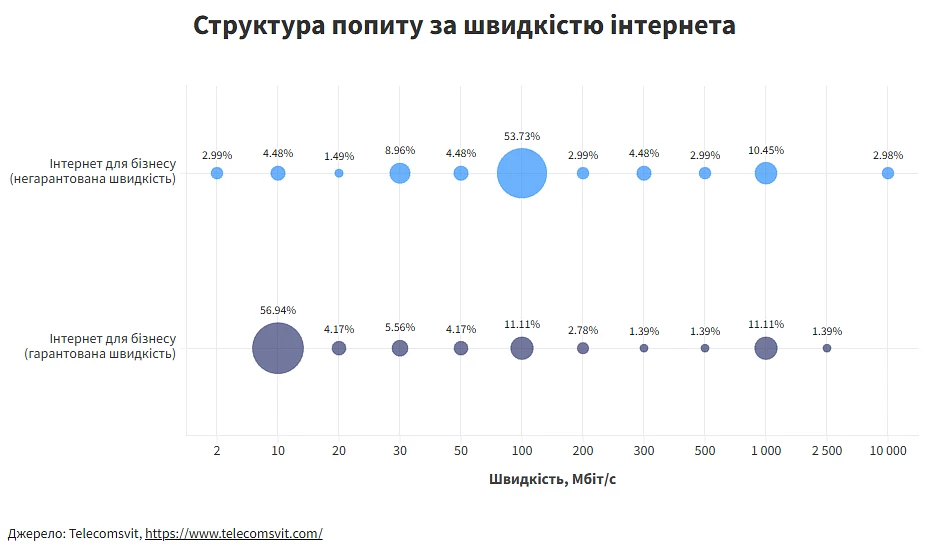
Interestingly, for the corporate segment, it is not the nominal speed that is more important, but its guaranteed speed: 56,94% of requests for dedicated lines with SLA fall on a speed of only 10 Mbps — this is enough for POS terminals, ERP systems, fiscal devices and security systems, where the continuity and symmetry of the channel are critical, not the "reserve" of bandwidth.
4 out of 5 customers get what they want. The rest don’t
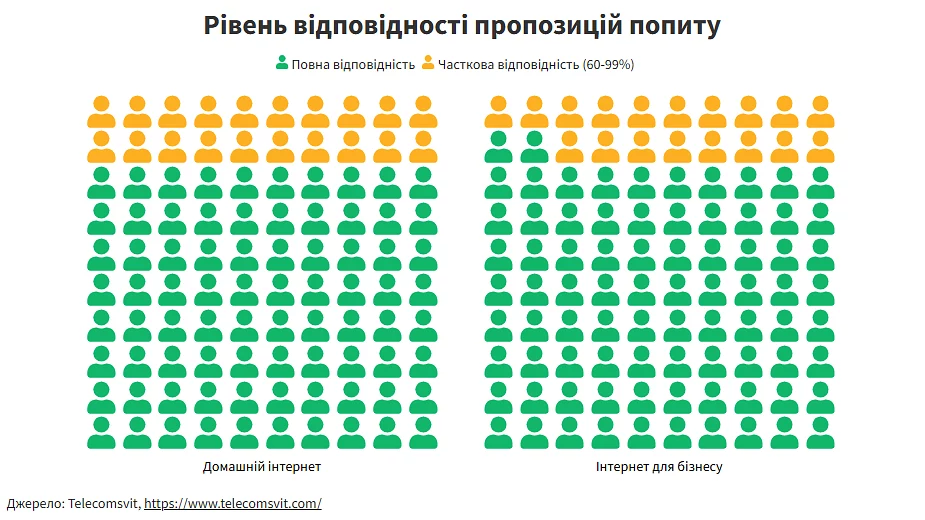
The researchers introduced a “matching index” — an indicator of how well the provider’s offer matches all the customer’s requirements. In B2B, 81,62% of customers receive a 100% relevant offer, in B2C — 79,95%. But it is the remaining ~20% that reveal the structural difference between the segments.
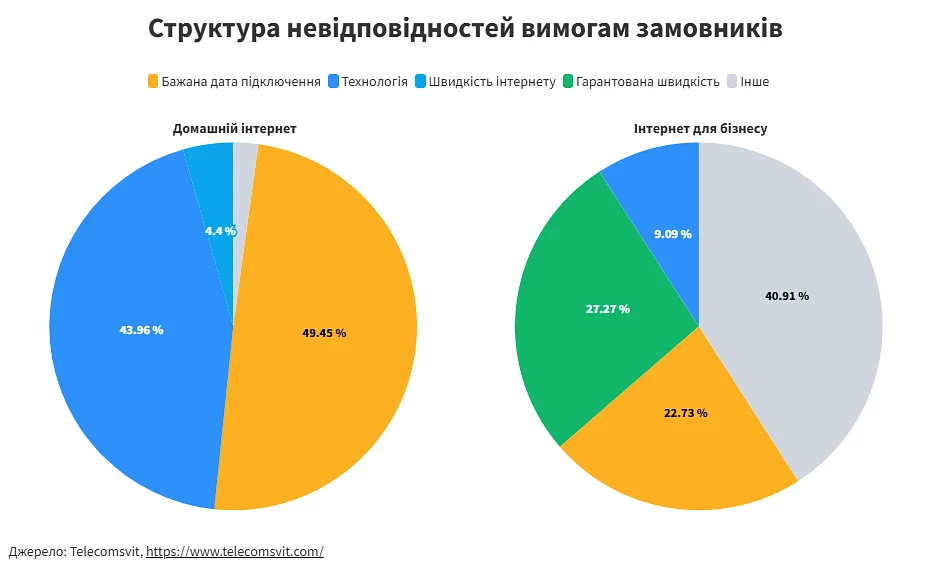
In business, the main reasons for incomplete compliance are service-related: 27,27% of cases are related to the provider’s inability to guarantee bandwidth (instead, they offer massive Best Effort), another 22,73% — to the inability to complete the connection within the desired time frame. Technology as a barrier — only 9,09% of cases.
For private customers, the opposite is true: almost half of the failures (49.45%) are due to the workload of installation crews and the desired connection date, and 43,96% are due to the requirement of a specific technology. The reason is simple: the mass consumer wants a non-volatile PON, and the operator did not have time to physically deliver the optics to a specific house.
Paradox: providers themselves are abandoning Ethernet
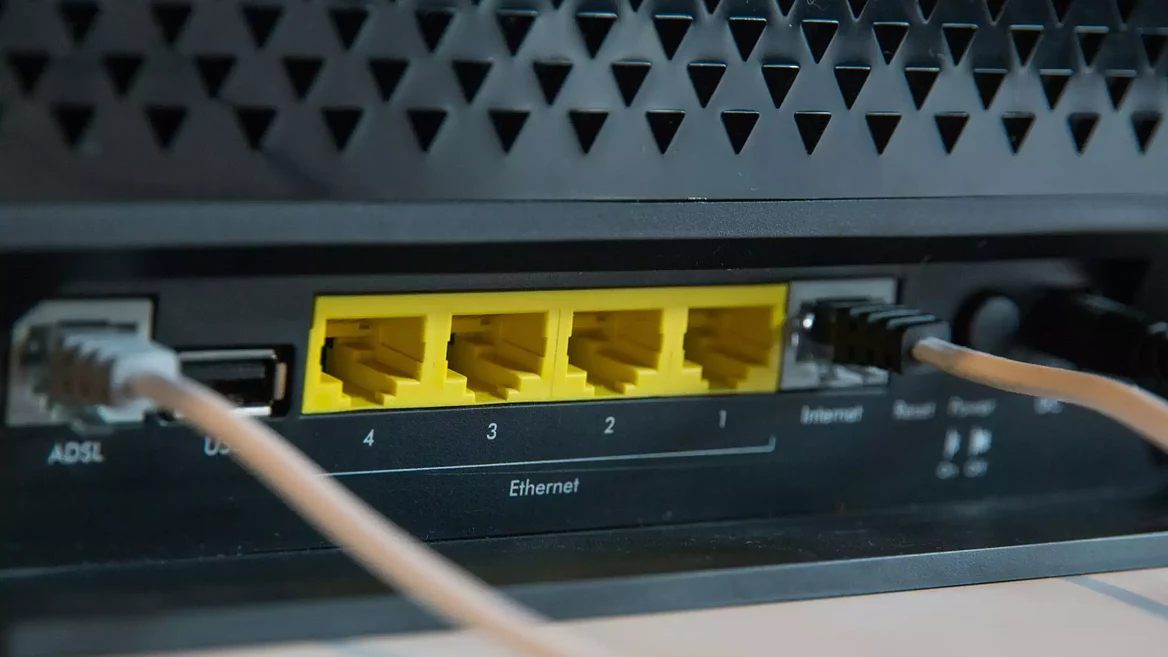
An interesting and counterintuitive fact is that 12,82% of B2C technology failures are not due to a lack of new technology, but to customers’ requests for “good old” Ethernet (copper twisted pair), which operators themselves find unprofitable to support. Customers often consider Ethernet to be the cheaper default option, while providers are deliberately decommissioning copper networks and switching everyone to fiber.
Terminological trap: "optics" does not mean "there will be no internet without light"
One of the most practical conclusions of the study is a warning about the substitution of concepts. In the consumer’s mind, the word "optics" has become synonymous with 100% energy independence of communication. But when the operator says that "optics are brought into the house" (this is FTTB, Fiber to the Building) technology, inside the building the wiring to the apartment or office can still go as a twisted copper pair through active equipment that requires power — and when the batteries in the entrance run down, the connection disappears, despite the "optics" at the input.
Researchers advise businesses to conduct an audit of the cable entry into the premises: if twisted pair is installed, the facility remains vulnerable during long blackouts, and the contract should separately specify the connection topology and the rules for replacing batteries or connecting a generator by the provider.
“Illusion of coverage”: provider “in the area” ≠ provider “at your place”
One of the most important practical conclusions is about real competition at the level of a specific address, and not the city as a whole. In the B2C segment, 75,56% of requests receive a confirmed technical connection possibility from only one provider. Only 24,44% of households overcome the threshold of real choice (two or more providers), and “high competition” (4+ operators) occurs in only 1,9% of cases.
In business, the situation is better, but not radically: 57,27% of requests receive two or more offers, and the share of "monopoly" responses is 42,73%.
A practical conclusion for companies with a network of branches: you should not rely on one "national" contract with a large operator — it is more rational to check the coverage of several operators for each specific address and switch to a multi-vendor model.
Who’s Really Powering Your Office: The Hidden Subcontracting Economy
One of the most interesting blocks of the study is about how national contracts of large operators actually work. Winning tenders for connecting an extensive network of branches (banks, gas stations, retail), large players rarely have their own cable at each specific point. Therefore, they massively involve local providers as subcontractors for the "last mile" — and the actual quality of communication in your specific branch technically depends on the capabilities of this small regional player, and not on the brand on the contract.
Researchers directly advise: when signing a "single national contract", it is worth understanding that this is a de facto service from dozens of regional subcontractors, and a direct agreement with a local provider of the same "last mile" can save 30–50% of the budget.
"Tax" from condominiums and management companies
Another structural barrier is not technical, but administrative. The study records a pattern when the technical possibility of connection is available, but the management company or condominium association does not provide access to other operators — in fact, fixing an exclusive provider in the building and forming a hidden "administrative surcharge" in the tariff. The authors of the study advise businesses to check for open access for several operators even at the stage of choosing a premises for rent.
Multi-gigabit tariffs: when speed is bought but there is no point in using it
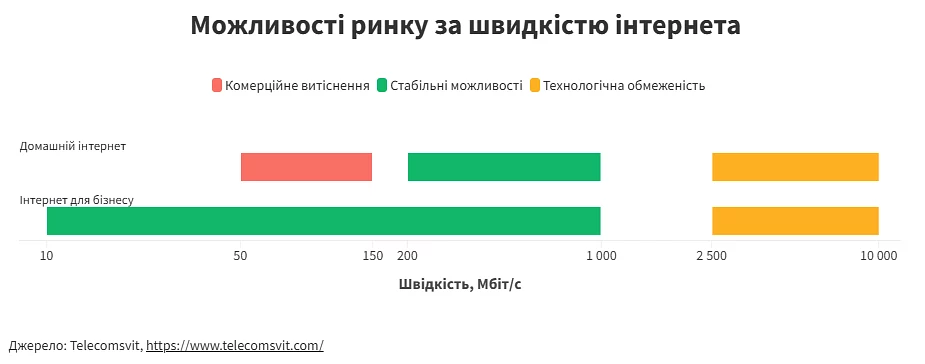
Researchers also draw attention to the growing demand for tariffs of 2.5–10 Gbps (about 3% of retail requests) — and warn that this is more a “technological overheating of expectations” than a real need. Most home PON networks in Ukraine are built on GPON with a ceiling of 1 Gbps, and home routers, cables in the walls and network cards of devices are mostly not physically ready to use even the available gigabit. Before paying for a multi-gigabit tariff, researchers advise conducting an audit of your own equipment — it is often more rational to update the router and cables than the channel.