Хочете будувати кар’єру в Data Science та AI? Vodafone Big Data Lab відкриває новий набір —>
Марія БровінськаWork
11 December 2025, 15:30
2025-12-11
“There is a shortage of engineers in the market who can build hardware solutions from scratch.” Why the increase in university applications is not translating into enough engineers for Defence Tech: study
Even an 82% increase in applications for certain technical specialties does not cover the market needs. Employers may not receive any response for certain engineering vacancies.
Even an 82% increase in applications for certain technical specialties does not cover the market needs. Employers may not receive any response for certain engineering vacancies.
IT recruitment agency ITExpert has presented the first comprehensive study on the personnel shortage in DefenceTech: from the analysis of university data to the comparison of curricula and comments of five MilTech companies. The study was attended by representatives of five DefenceTech companies, the largest technical universities — Igor Sikorsky Kyiv Polytechnic Institute and Lviv Polytechnic University, as well as the founders of one of the first online courses on Hardware in Ukraine — Beetroot Academy. The analysis covers the years 2021–2025.
About ITExpert
ITExpert is a Ukrainian IT recruitment agency that has been on the market since 2015. We have filled 1,300+ vacancies for companies including Deloitte, Bolt, Fozzy Group, Nova Poshta, Metinvest Digital and many others. We fill the needs for engineers and technical specialists for the following areas: FinTech, AI/ML, Ecommerce, MilTech and others. The team includes 32 IT recruiters and a CTO.
What the ITExpert study showed
DefenceTech is one of the most dynamic sectors of the Ukrainian economy. There are already over 500 companies on the market, and the demand for engineers is growing faster than the number of people willing to work with hardware technologies.
For individual engineering vacancies, employers receive 0–2 candidates, which directly affects the hiring approach and the speed of product development.
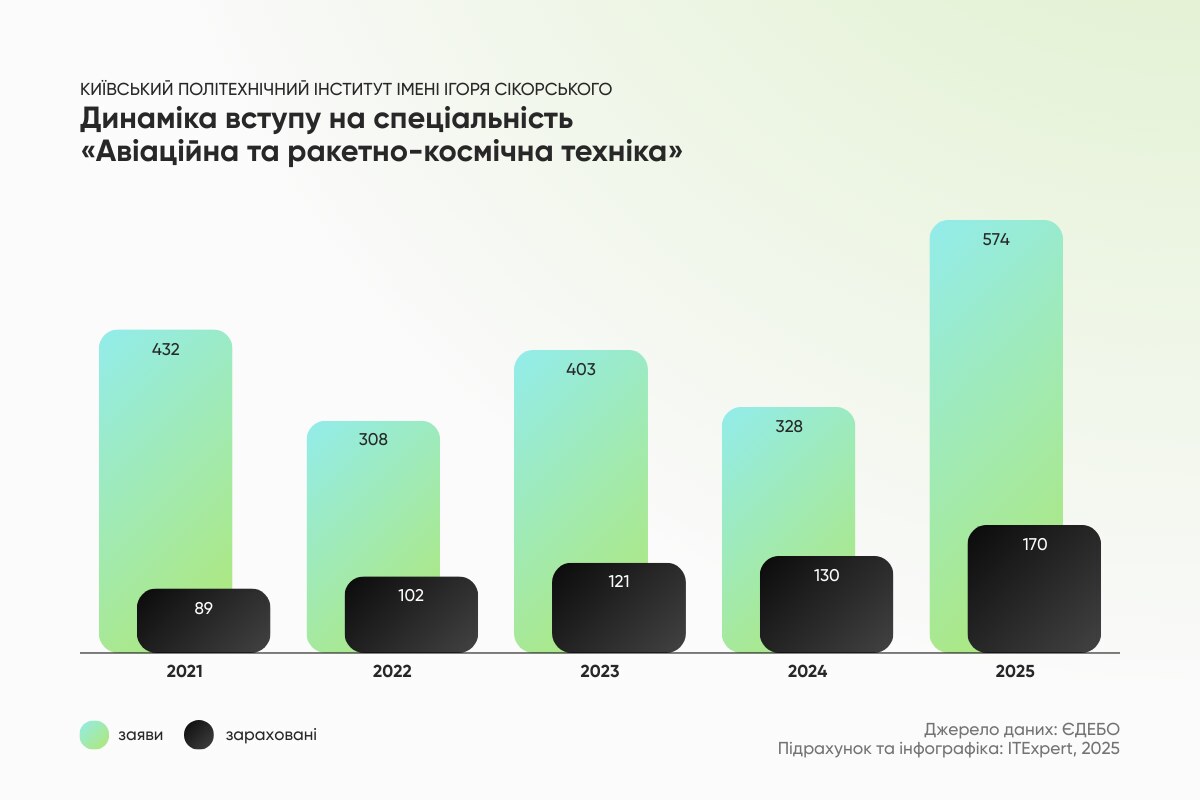
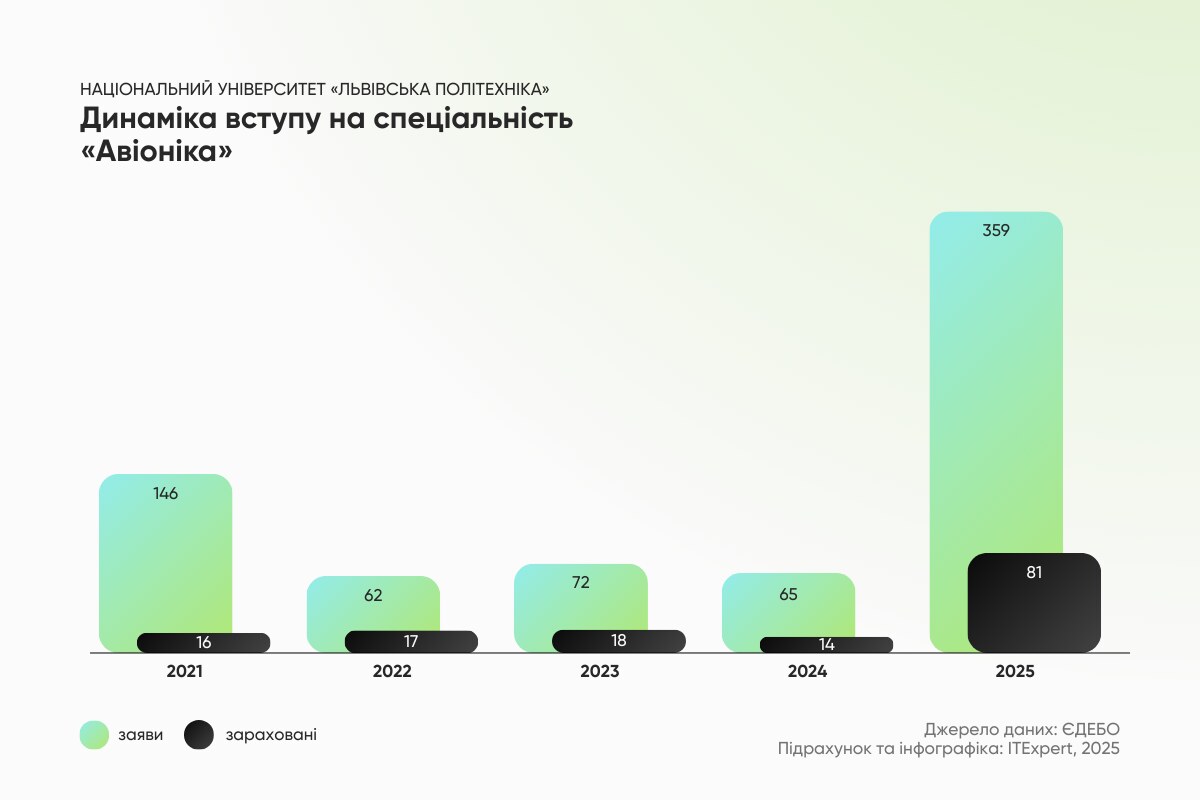
In 2025, the number of applications for key MilTech majors at Igor Sikorsky Kyiv Polytechnic Institute and Lviv Polytechnic University increased from +23% to +82%. The largest increases were seen in the Avionics major (Lviv Polytechnic University) and Aviation and Space Technology majors (KPI). Although the growth rates are noticeable, they have not returned to pre-war levels, when the market demand for niche specialists was not so high.
According to the Ukrainian State University of Applied Sciences, each year KPI admits about 3.8 thousand students to the relevant specialties — -12% per year on average. At Lviv Polytechnic, the number of enrolled students remains relatively stable (about 780 people), and in 2025 this figure increased to 880 — the highest value in five years.
Despite the growing interest of employers, some curricula still do not contain critical modules — electronic warfare, high-speed PCB design, Altium, soldering, etc.
Universities are more actively involving business in the development of technical education: companies open laboratories, update equipment and help form practical modules. Igor Sikorsky Kyiv Polytechnic Institute has laboratories from SQUAD, Ajax Systems, Skyfall, Datacom, Keysight, Melexis, EPAM and other partners, and Lviv Polytechnic has spaces from Infineon, Ajax, Lifecell, Kyivstar and Cisco. This gives students access to modern tools — from radio communications and embedded to microelectronics.
The role of fast-paced technical programs is also highlighted. For example, Embedded Development at Beetroot Academy already has about 50 students. Despite the speed of the course, it includes a practical part — six projects. Students receive individual kits by mail before the start of training, so that they can work with the hardware from the first module.
What the industry says
Mykola Klestov, CTO ITExpert
There is a shortage of engineers in the market who can create hardware solutions from scratch: chips, boards, communication modules, navigation systems. It takes years of training and access to laboratories, not crash courses.
Pavlo Chubka, Recruitment Manager at Twist Robotics .
The most noticeable shortage is PCB Design Engineer and RF Engineer: demand has increased sharply, while supply has hardly changed. Engineers who have already worked with FPV drones, communication systems, and take into account the impact of electronic warfare are especially valuable.
Alina Bogulska from Frontline Robotics
The hardest thing to find is engineers with knowledge of electronics and design: working with Altium, laying out boards, soldering components
How companies are closing the talent gap
Among the most effective market practices:
cooperation with universities: creation of laboratories, internships and allocation of additional scholarships.
cultivating engineers within the company.
the possibility of internal transitions. For example, from RF engineers to PCB design (Twist Robotics case).
support for veterans and their integration into R&D teams.
MilTech company Athlon Avia works not only with universities but also with schools. This year, the team launched a course «How Unmanned Systems Work» using their UAV «Fury» as an example for teachers of the subject «Defense of Ukraine» in partnership with the Kharkiv Department of Education.
Ukraine is moving in the right direction: universities are updating programs, online courses are adding practice, companies are creating laboratories and actively working with young people. But this is still not enough. The needs of DefenceTech are growing faster than the number of people choosing engineering professions. To bridge the gap, engineering must become a mass choice — not a «niche» direction. This is a common challenge for the state, universities, and business.