Наталя ХандусенкоStartup
22 July 2025, 10:30
2025-07-22
A Kharkiv resident launched an application to support interesting conversations on any topic. How AI helped a developer create iWonda in his free time from two jobs and save up to $100 on designers
Full Stack Developer Volodymyr Dehtiarev from Kharkiv, having experience in web development, decided to try to create his first mobile application. Artificial intelligence helped to implement the idea that was born over a cup of morning coffee, which significantly accelerated development and saved money. We tell you how iWonda was created (from the idea to the fight with the App Store for release), where all the content is generated by AI.
Full Stack Developer Volodymyr Dehtiarev from Kharkiv, having experience in web development, decided to try to create his first mobile application. Artificial intelligence helped to implement the idea that was born over a cup of morning coffee, which significantly accelerated development and saved money. We tell you how iWonda was created (from the idea to the fight with the App Store for release), where all the content is generated by AI.
Volodymyr has been in IT for 4 years. But you could say that his journey in technology began by accident — when his son took IT courses.
I sat in on the courses with my son and listened. I got hooked. I started watching videos on YouTube, learning Python on my own, and using its Django framework, I created my first website — a blog with problem analysis from Codewars. Then I took ten-month courses with Full Stack, and then got a second higher education in Software Engineering.
Currently, Volodymyr is combining two jobs: his main one is the head of the contracting department at a utility company and a Full Stack Developer at a foreign company.
«Due to the 10-hour time difference, it is possible to combine both without losing quality. It should be noted that I work under the „shadow dev“ system. This is when one person is officially employed and only attends meetings, and the other person, a developer, performs all the tasks. He is also present at meetings to prompt the first person with an answer if he is asked about something, like a shadow. Of course, with a part of the payment,» the developer explains.
An idea born over a cup of morning coffee
«I worked as a web developer all the time, and then I became interested in looking at another world — mobile development.»
After the desire to try his hand at mobile development arose, Volodymyr pondered which genre to start with. There were many options, including games and an information application.
«I chose the second option to start. It was easy to come up with content: I always wanted to have something interesting at hand for casual conversations — small talk, networking, dating. You press one button — and you have a topic for conversation.»
The idea for the name came quickly: I wonder. But since an app with that name was already on the App Store, the developer decided to play around with the name by using an abbreviation: «I am going — I gonna, I wonder — I wonda.»
The path from the birth of the idea in April to publication in the App Store in early July
«LLMs are increasingly entering our lives, and developers are probably the first to feel it. And since the development profession is a constant learning process, mastering LLM was only a matter of time.»
The idea for the application arose in April. Initially, Volodymyr considered two stacks: Swift and React-native. He chose the second one, since he already had experience with React. He used Nest.js for the backend.
«I worked in the evenings and on weekends, but it wasn’t sitting for hours. When you write something for yourself, without a deadline, it’s not burdensome at all,» says the developer.
Volodymyr used LLM to generate content. To do this, he needed to connect to the model via the API.
«For the text, I considered the following models: GPT‑4.1 mini, Grok 3 mini, and DeepSeek-R1-0528. The decisive argument when choosing a model for MVP was its cost. After numerous tests, DeepSeek rejected the prompts. It’s not that it’s bad or the answers are not correct, but some answers are not „human“. Although this may be my subjective perception. At first I worked with Grok, but at some point there was a failure on the part of xAI. They wrote a letter apologizing and still something else, but I switched to the model from OpenAI, hoping for reliability. Yes, I was naive. I tested image generation on DALL·E 3.»
Volodymyr also delegated design creation to AI.
«This was not an easy task, because Apple requires that the design adhere to the Apple Human Interface Guidelines (HIG). For my part, I selected the primary colors on the Itten circle that I wanted to see in the application and transferred them to the model. Then, during development, I checked the AI for compliance with the HIG documentation. At no time during development was Figma opened and the layout was developed „on the fly“. This saved me money on a designer. For example, a freelancer’s design layout for these pages costs $50-$100. Of course, AI does not replace a human’s creative approach. But at the MVP stage, it was very appropriate,» the developer shares.
The first version of the MVP was ready in May, and at the end of the month it was sent for testing .
«I kept an eye on the budget. No more than $5 per month was spent on testing models. More money was spent on purchasing access to publishing applications in the App Store — $99 per year,» Volodymyr explains.
Fighting Apple
Volodymyr set himself a goal — the application must be published in the App Store, regardless of what the MVP will look like at the time of release.
«I reviewed a lot of materials on preparing for publication and realized that you can’t do without rejections. So when Apple’s „guards“ wrote me „confusing UI“ pointing to the button design, I thought to myself: „Okay, it was AI that generated the design, and I didn’t check it.“ I fixed it and sent a new build for review. Again, a polite rejection — „your app presents an error message every time we clicked one of the categories.“ Here, AI is not to blame — the backend crashed. Again, correction, deployment, sending for testing, and after sending, I see 2 UI defects. I’m like, okay, if there’s a rejection, I’ll fix them. However, in the morning, an unexpected message arrives in the mail: „Review of your submission has been completed. It is now eligible for distribution.“,» says Volodymyr.
On July 2nd, iWonda was released on the App Store
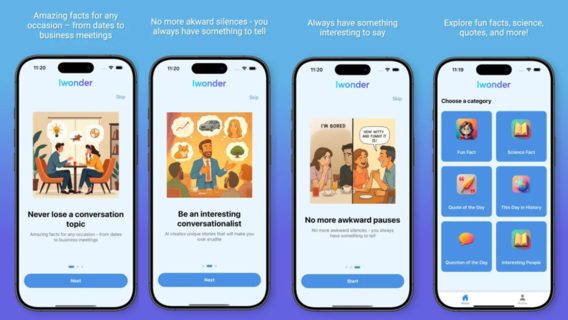
iWonda is a mobile application that helps you maintain a conversation with colleagues, acquaintances, or on a date. It provides interesting topics, quotes, and facts — everything to increase interest and respect for a person in any company.
The current version of MVP has six content categories: from quotes of the day to facts about the world around us, culture, and people.
According to the developer, iWonda’s advantage over its competitors is its simplicity. You just press one button and you already have a topic for conversation.
Regarding monetization of the application, there were two options: charging for connecting individual functions or subscription.
«For the first option, you need to implement authorization, storage, payment control, refunds, and much more. For the second option, which is less efficient, Apple takes care of the implementation. You only need to specify the cost of the download. The second option was chosen for the MVP,» the developer explains.
The application is available in 4 languages: English, Ukrainian, Spanish and Russian. When asked why the latter is present in iWonda, Volodymyr answered the following:
«I immediately wanted to cover as many countries as possible where publication was possible. But for the relevant publication of the application in the store, I used the most common languages in the world — English and Spanish. However, the main languages are English and Ukrainian. The others were added only to expand the audience. In addition, news content will be generated for the English-speaking audience on Fox News, and Ukrainian and Russian on Korrespondent. net. The goal is that if a Russian uses it, he will receive news from our sources. I can also add that I forbade LLM from generating interesting content about any historical, scientific, and other things related to „Russia“, „RF“ and similar tags.»
What are the plans for developing the application?
After the feedback, Volodymyr decided to add news content — it is already being prepared for publication.
He wants to add AI-generated illustrations to the generated content.
«For example, an interesting fact is how Fleming discovered penicillin thanks to the mess on his desk, and AI immediately generates an image of this desk as he sees it. That’s cool! It only requires a little funding, because image models are more expensive than text models,» says the developer.
There are also plans to add a feature where AI will generate interesting facts about a work of art. For example, an image of Michelangelo’s David opens, and a story about it: «David has gigantic proportions — on purpose. The sculpture is over 5 meters tall, but if you look closely — the head and hands are too big. This was done intentionally, because the statue was originally supposed to be installed high on the roof of the cathedral, where the distorted proportions would look perfect.»
Як нейромережі бачать вільну та незалежну Україну? Тест dev.ua
Нейронні мережі для генерації зображень бачать світ по-своєму, їхню логіку зрозуміти часом зовсім неможливо. Але таки хочеться. На честь Дня Незалежності України редакція dev.ua вирішила провести невеликий експеримент.
Ми задали чотирьом різним нейронним мережам п’ять однакових запитів: «прапор України», «День Незалежності України», «український Крим», «перемога України» та «українці». Отриманими результатами ми ділимося з вами нижче.
У TikTok тепер можна генерувати фон за допомогою нейромережі. Ми протестували її та ділимося результатами
У TikTok з’явилася нова функція «Розумний фон». З її допомогою як фон для тіктоків можна підставляти згенеровані нейромережею зображення. Редакція dev.ua протестувала цю технологію і ділиться своїми враженнями.