Оксана СтепураAI Eng
21 September 2026, 12:27
2026-09-21
Jev has become the fastest adopted model in the history of Vercel AI Gateway. Why are developers testing it en masse?
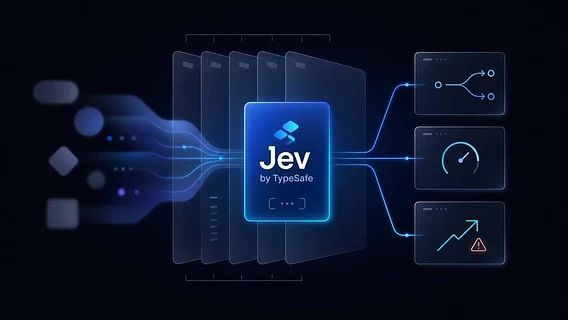
Nearly 13% of Vercel AI Gateway paid teams started using Jev in just 24 hours. It’s a specialized AI model that helps programs and AI agents make quick decisions — like which button to press, which tool to launch, or whether to perform a certain action at all.
Nearly 13% of Vercel AI Gateway paid teams started using Jev in just 24 hours. It’s a specialized AI model that helps programs and AI agents make quick decisions — like which button to press, which tool to launch, or whether to perform a certain action at all.
Vercel AI Gateway is a service through which developers can connect hundreds of AI models to their applications through a single API, without integrating each provider separately.
TypeSafe, the company that created Jev, was founded by former OpenAI researcher Diogo Almeida. He worked on the model training methods that later formed the basis of ChatGPT. After its launch on September 15, interest in Jev was so great that TypeSafe was unable to service all API requests for a while.
Unlike ChatGPT, Claude, or Gemini, Jev is not designed to write text, code, or respond to users. When given a task, the model is presented with several possible actions and quickly chooses one of them. For example, allow or block a command, press one of the buttons, or pass the task to another tool.
Along with the choice, Jev shows how confident she is in it. Therefore, the developer can set a rule: if the confidence is high, the action is performed automatically, if not, the decision is transferred to a human or a more powerful model.
This approach is already being tested on real-world tasks. Vercel engineer Pranit Sharma says he tested Jev on a system that checks whether certain commands are safe to execute. Previously, GPT-5.6 Luna was used for this. According to him, with Jev, the verification became 5-18 times faster, and the accuracy in this test also increased.
And Bryo AI CTO Nikhil Mudholkar instead had Jev sort the worksheets. Gemini was a little more accurate, but it cost 10–20 times less to use Jev. So Jev can do well in tasks where the agent has to make many small decisions in a row, and calling a large model like GPT or Gemini for each of them can be too slow and expensive.
TypeSafe claims that Jev responds in approximately 70–500 ms. Processing 1 million input tokens costs $0.042. And there is no need to pay for output tokens, since the model does not generate a regular text response.
In TypeSafe's own tests, Jev performed up to 193.6 times faster and up to 444.6 times cheaper than large language models on individual tasks. However, these are the maximum results in the company's own tests, and in real-world scenarios the difference may be smaller.
Previously, dev.ua wrote that AI agents that work with sites in the same way as humans, for example, clicking on interface elements and reading pages, can spend 45 times more tokens than when performing the same task through the API.
«Чи є у мене талант, якщо комп’ютер може імітувати мене?». Штучний інтелект пише книги авторам Amazon Kindle. The Verge поспілкувався з авторами та виявив багато цікавого
Письменники-романісти використовують штучний інтелект для створення своїх творів. Видання про технології The Verge поспілкувалося з письменницею Дженніфер Лепп, яка випускає нову книгу кожні дев’ять тижнів, й дізналося про те, як працює штучний інтелект для написання романів. Наводимо адаптований переклад статті.
Have important news to share? Message our Telegram bot
Key events and useful links in our Telegram channel