Хочете будувати кар’єру в Data Science та AI? Vodafone Big Data Lab відкриває новий набір —>
Марія БровінськаWeapon
20 October 2025, 13:30
2025-10-20
The Russians are hitting Ukraine with rocket-propelled grenades that travel up to 130 km at breakneck speed. What kind of weapon is this and is there a chance to intercept and neutralize it?
The Russians have stepped up the use of rocket-propelled grenades at the front. These bombs are a «miracle weapon» for the Russians, as they destroy buildings «like cards», creating craters 6–10 m in diameter. Air defense does not have time to react to such weapons — the bombs are low-emission, fast.
dev.ua tells what jet-guided bombs are and whether the Ukrainian military has a chance to counter them.
The Russians have stepped up the use of rocket-propelled grenades at the front. These bombs are a «miracle weapon» for the Russians, as they destroy buildings «like cards», creating craters 6–10 m in diameter. Air defense does not have time to react to such weapons — the bombs are low-emission, fast.
dev.ua tells what jet-guided bombs are and whether the Ukrainian military has a chance to counter them.
Where have jet fighter jets already flown?
It is known that on October 9, 2025, the Russian Federation struck the Dnieper River — probably with a Grom-E1 missile (a reactive missile based on the Kh-38 missile). Experts say that this is not a classic missile, but a hybrid with rocket acceleration.
On October 18, Russia launched its first strike with a guided aerial bomb (GAB) on the city of Lozova in the Kharkiv region, which is 120 km from the occupied territories. The prosecutor’s office reported that the city was hit by a guided aerial bomb (GAB) launched from the temporarily occupied territory of Ukraine. That is, the GAB flew 130 km. This is most likely an UMPB-5R, which was modernized in 2025. A low-impulse jet engine was added to the GAB, increasing its range by 20–30 km.
On October 19, 2025, the Russians struck Mykolaiv with two missile defense systems.
Today, for the first time, the Russians launched a KAB from Kharkiv region to Poltava region, the Air Force reported. According to monitoring channels, the KAB was reactive. The number of such strikes will probably increase.
What is a reactive CAB?
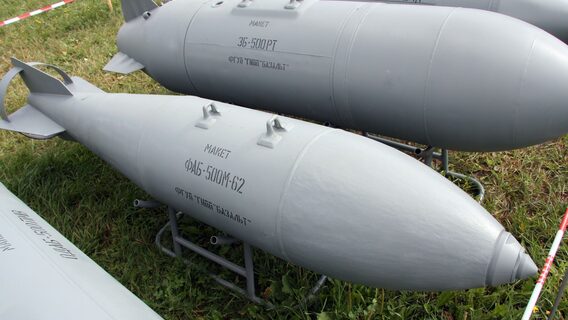
Jet-guided aerial bombs are a new modification of the Russian glide bombs that they have recently begun to use against Ukraine. Typically, KABs are Soviet high-explosive bombs (such as FAB-250 or FAB-500), to which the Russians attach glide modules (such as UMPK) so that they glide 40–70 km from the front line without risk to the carriers — Su-34 bombers. But the «jet» version of the KAB involves this improvement with a rocket engine, which allows it to cover greater distances — up to 130–150 km. Such a munition can reach speeds of over 500 km/h, which reduces the chances of interception by the air defense system.
The main model of such a CAB is the UMPB-5R, a universal planning and lateral movement module with reactive acceleration.
The main characteristics of the reactive CABs about which information is already available are similar. Two models of reactive bombs are currently known:
UMPB-5R (improved, 2025): weight — 300 kg, range 100–130 km, satellite guidance.
«Grom-E1» (hybrid): weight — 250 kg, range 100–120 km, based on the Kh-38, speed 500+ km/h, hybrid guidance.
The Russians produce thousands of these bombs every year. The plan for 2025 is to have over 40,000 KABs in total. It is not known how many of them will be equipped with jet engines. The fact is that KABs are relatively cheap and very destructive weapons. The cost of a bomb varies between $20–30,000 per piece, while the cost of a cruise missile starts at $1 million.
Is it possible to resist reactive CABs?
Reactive CABs rely on satellite (GLONASS) and inertial guidance, which is vulnerable to interference. Systems like Note or Quasar-A jam signals at frequencies of 1–2 GHz, forcing bombs to land with a deviation of 100–500 m.
But the Russians are adding Kometa-M antennas for stability, so electronic warfare needs to be constantly improved, in particular through artificial intelligence.
It can also be countered with air defense systems and interceptor drones. However, the speed of 500+ km/h makes interception difficult, but the Armed Forces of Ukraine are testing new systems.
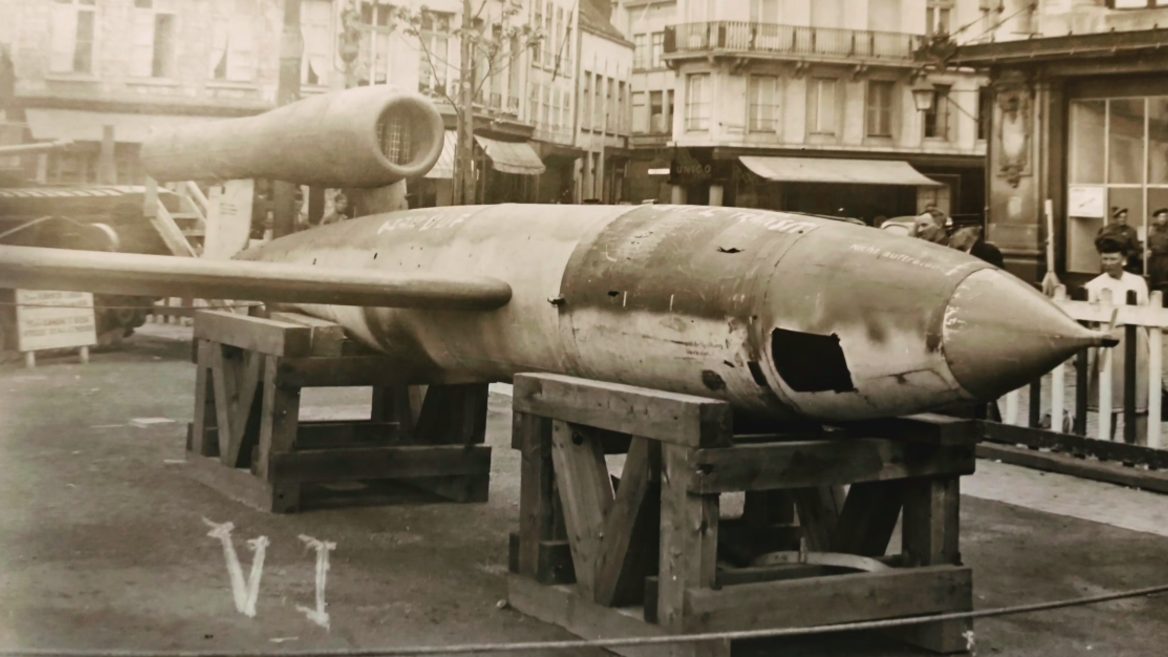
Weapon of retaliation. Ukrainian aerospace developers decided to revive and modernize the German V-1 «flying bomb» with which the Nazis bombed London in 1944