Хочете будувати кар’єру в Data Science та AI? Vodafone Big Data Lab відкриває новий набір —>
Марія БровінськаStartup
29 April 2026, 12:08
2026-04-29
"God was not foreseen in this system." Atheist programmer created an offline AI chaplain for the military on Flutter without servers
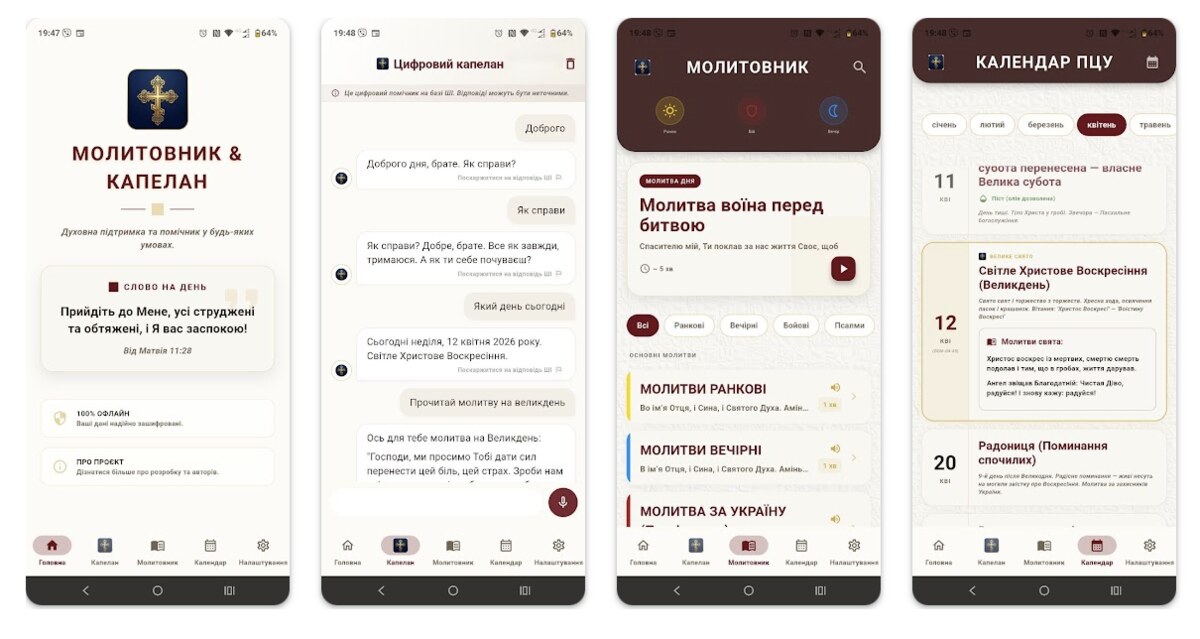
Ukrainian developer Yuriy Kucherenko created the mobile application «Digital Chaplain» — an offline AI assistant for the military that combines artificial intelligence and spiritual texts. The entire system works directly on the device — without servers, without the cloud, and without transferring data to the outside.
Ukrainian developer Yuriy Kucherenko created the mobile application «Digital Chaplain» — an offline AI assistant for the military that combines artificial intelligence and spiritual texts. The entire system works directly on the device — without servers, without the cloud, and without transferring data to the outside.
The story of this project began not with technology, but with a personal break. Until 2022, Kucherenko describes himself as a person for whom the world consisted of logic, rules and systems. «God was not foreseen in this system,» he says. The full-scale invasion changed this: IDP status, loss of support and the search for meaning became the starting point.
The first attempt to answer this request was a simple «Warrior’s Prayer Book.» But, according to the developer, the real turning point came when he saw the example of military chaplains — in particular, Abbot Makariy. «I realized that technology should not just provide text, but be there in the moment,» says Kucherenko. That’s how the idea for the «Digital Chaplain» came about.
Offline has become a fundamental decision
From the very beginning, the project had two strict limitations: no servers and one code base for two platforms, the author writes on the DOU forum. The first is a security issue. «No message should leave the device,» the developer notes. The second is a resource issue: the application is being created solo, without a budget.
That’s why Yuriy chose Flutter as the basis — to support iOS and Android simultaneously. And he transferred all the logic of artificial intelligence directly to the smartphone.
At the heart of the solution is the local language model Gemma, which runs directly on the device. It is supplemented by the RAG (retrieval-augmented generation) approach: before each answer, the system searches for relevant fragments in the local text database and passes them into the context of the model.
This database includes the full text of the Bible, prayers, psalms, and psychological support materials. As a result, the application does not simply «generate» answers, but selects specific texts for the situation.
How a «digital chaplain» works
The user can interact with the app using both text and voice, thanks to offline Speech-to-Text. In response, the AI offers support, prayers, or passages from the Holy Scripture.
The application also includes a full prayer book, the Orthodox calendar of the OCU, a «word of the day» and audio playback of texts. But a special emphasis is on crisis scenarios: if the system detects alarm signals, it automatically offers contacts for psychological assistance services.
There are also security features that are not typical for such products. For example, Panic Wipe — instant deletion of the entire local database and chat history. Or a PIN code for login. All of this is a response to the context of use.
«It’s not just UX. It’s trust,» Kucherenko explains. Even addressing the user is personalized: «Brother» or «Sister» — and is then used throughout all communication.
Weak smartphones and complex quality metrics
The application is primarily designed for the military — the Armed Forces of Ukraine, the Ukrainian Armed Forces, and the National Guard. But in fact, its audience is broader: from displaced people to people who have never considered themselves religious but are looking for support.
«It’s about not leaving a person alone with their thoughts,» Kucherenko concludes. The application is already available on Google Play, and the project itself continues to develop as a technological experiment on the border of AI and human experience.
Despite the working product, key issues remain. The biggest one is performance on budget devices. Local inference forces a balance between model size, speed, and response quality.
Another difficulty is the size of the application itself due to the built-in model. In field conditions, this can be critical.
But, according to the developer, the hardest part is assessing the quality of the result. «How do you measure how ‘correct’ a spiritual response is?» he says. For now, that’s being addressed through testing with real users and chaplains.
«I work at Maca, that’s what inspired me to create it.» McDonald’s employee creates an app that calculates earnings in real time during an hourly shift
A Ukrainian woman has developed an app for padel players that is gaining popularity among IT professionals and business people. The app allows you to find partners to play with