Хочете будувати кар’єру в Data Science та AI? Vodafone Big Data Lab відкриває новий набір —>
Марія БровінськаStartup
15 April 2026, 15:19
2026-04-15
An app for nighttime alarms, AI for agronomists, acoustic mine detection, and prosthetic solutions: students from 15 cities in Ukraine presented projects at the Fresh AIR hackathon
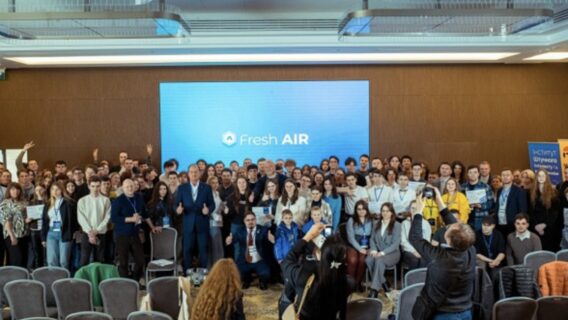
The fourth season of the Fresh AIR student hackathon has ended in Odessa. More than 40 teams from 15 cities defended their projects before a jury of leading IT companies. The prize fund this year has almost doubled to 100,000 hryvnias. dev.ua tells about the brightest developments of the participants.
The fourth season of the Fresh AIR student hackathon has ended in Odessa. More than 40 teams from 15 cities defended their projects before a jury of leading IT companies. The prize fund this year has almost doubled to 100,000 hryvnias. dev.ua tells about the brightest developments of the participants.
The hackathon was launched in 2023 by the Institute of AI and Robotics of the Odesa Polytechnic National University. There was one condition: the project must solve a real social problem. The participants' speeches provided an accurate cross-section of what concerns Ukrainian youth — from demining to psychological rehabilitation.
Projects were evaluated based on three criteria: relevance to the topic, quality of presentation, and implementation status—idea, MVP, or ready-made device. They also took into account how the project could be implemented on the market.
The most interesting projects
A sapper’s glove for $30. The Echo Glow team showed a robotic manipulator for working with explosives at a distance. The operator puts on the glove — the system reads movements and transmits their work in real time. Analogues on the market cost over $10,000, this control module costs $30. Separately, a remote demining device was presented by 13-year-old displaced schoolchildren from Kherson and Severodonetsk.
Sleep during alarms. A freshman developed the «Miracle» app, which monitors the direction of drones in real time. If there is no threat to your area, you continue sleeping. If there is, the system will wake you up. The idea came after the author ignored the night alarm, and a shaheed fell 100 meters from his house.
AI for agronomists. The SmartSight project turns an ordinary drone into a field monitoring system: AI detects early stages of plant diseases and gives a command for spot spraying. According to the developers, this allows saving up to 80% of herbicides.
PTSD at the wheel. The NeuroDrive team has developed a hardware-software complex for drivers who have survived shelling. A hypersensitive controller on the steering wheel reads micromovements, detects signs of anxiety or panic attacks — and generates a report for rehabilitation doctors.
Agrodrone is omnipotent. Students of the National University «Ostroh Academy» Roman Mychka and Anna Krystich presented a ground robotic drone designed for work in the agricultural sector. The development allows solving several urgent problems at once:
reduce fertilizer costs
to compensate for labor shortages
improve field processing accuracy
reduce negative impact on the environment
As the developers explained, the drone works on the principle of spot fertilization — only on the necessary areas, without processing the entire field. Currently, the project is at the stage of a fully working prototype. Both authors are second-year students of the specialty «Robotics and Machine Learning», and the development was funded by the university.
Winners
The first place went to the ColdBlooded team from Kharkiv Polytechnic Institute. Their CryoVision application, based on deep learning, automates the analysis of cell microimages: what a lab technician does manually in 10 hours, the system does in less than a second with an accuracy of 85,2%. The development has already been implemented at the Institute of Cryobiology and Cryomedicine in Kharkiv. «Manual analysis of one microsample takes from 10 to 20 hours and depends on the operator’s experience. Our application provides a complete list of data in less than a second: the number of cells, their average area, how many remained viable,» explains team member Yevgeny Ponomarev.
Second place was shared by two teams. Fennec (also KhPI) showed BlastSense — an autonomous network of acoustic sensors for detecting unexploded ordnance: microphones record the sound, the system determines the coordinates — and sappers get a point on the map instead of blindly combing hectares. «If one shell explodes, a cluster of others is almost guaranteed nearby,» say the developers. «Instead of combing hectares, sappers get a point on the map.» The team brought a working prototype to the final.
FutureAid from Odessa Polytechnic University has introduced an affordable hand rehabilitation system for patients after injuries. The system is significantly cheaper than analogues, suitable for home use, and transforms a monotonous treatment routine into a personalized automated process.
RealPhys came in third place with a solution for leg rehabilitation using a balance board and Minecraft. A person leans on the board and this movement controls the game. Therapeutic exercise becomes a motivating gameplay for wounded soldiers and children.
Four students of Odessa Polytechnic University last year asked the question: why there is still no effective evacuation control system. Not finding a ready-made solution, they wrote their own. The Midgard system analyzes data from video cameras and counts people in the building in real time. Midgard won fourth place with an ML-system for tracking personnel during air alarms: in real time it determines who is in the building, who is already in shelter and who did not respond to the signal.
«With the popularity of AI, technology takes on the task of „how to do it,“ while the engineer should focus on „why“ and „why not.“ The ability to solve business problems will be increasingly valued, rather than writing perfect code,» noted jury member Yuriy Evstafiev, head of the development direction in the southern region of EPAM.
«Schools teach hard skills, but almost no one teaches you how to speak confidently»: finalists of the Teens in AI 2026 hackathon told how their AI trainer Speachie works