Хочете будувати кар’єру в Data Science та AI? Vodafone Big Data Lab відкриває новий набір —>
Стас ЮрасовAI Eng
3 November 2026, 17:13
2026-11-03
“It is quite likely that very soon our Commander-in-Chief will make decisions based on the advice of artificial intelligence.” Brave1 Supervisory Board Chairman Bornyakov on bid data in war, and also on the right “to automatic killing”
Artificial intelligence will begin to independently make decisions about eliminating targets without an operator’s command through the Killzone concept (zones of continuous destruction), where automated clearing will work on the principle of a minefield.
Artificial intelligence will begin to independently make decisions about eliminating targets without an operator’s command through the Killzone concept (zones of continuous destruction), where automated clearing will work on the principle of a minefield.
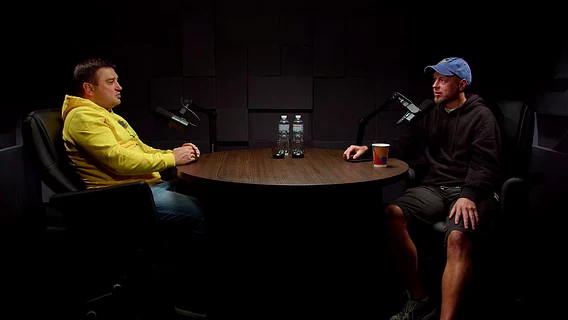
This was stated by Oleksandr Bornyakov, the chairman of the supervisory board of the defense-tech cluster Brave1, in a large interview with devua. The editorial staff of dev.ua publishes key theses on the future of autonomous warfare, the involvement of large language models in headquarters, and the real timing of the appearance of humanoid robots on the front.
The "Right to Kill" and the logic of Killzone
Answering the question of whether the right to open fire to kill will pass directly to algorithms, Bornyakov noted that in practice this line is already being erased, and the complete transfer of control to the machine will occur within clearly defined perimeters.
According to the former soldier, algorithmic destruction of targets in a combat zone is ethically and technically not much different from classical means of warfare:
"I think it will start with Killzone. Because it already works, in principle. When someone appears in Killzone, they rarely understand it: no one risks checking the color of the tape — they just dodged mines, and that’s it.
And when a 155-mm shell fires from its barrel, does it choose who to kill if it misses due to the wind? Nobody says: "Let’s make the shell smart so that it looks when it approaches." It just blows everything up. A minefield also has no mind, its own or someone else’s. The same will happen here: the AI will receive a task that it is forbidden to enter this perimeter, and the machine will destroy everything automatically."
Bornyakov confirmed that he is currently working directly on similar projects with a number of other Ukrainian developers. Their goal is to create autonomous circuits of drones, IRCs, and data exchange protocols without human intervention to hold kilometers of the front with minimal forces.
AI as an advisor to the Commander-in-Chief
Another area where artificial intelligence is likely to take on a leading role is Command Management Systems.
The Ukrainian military already possesses a unique dataset: systems like Delta accumulate hundreds of thousands of verified and structured video recordings of combat operations and force movements.
“This is ideal content for training models. If you give such an array to a system with logic at the level of modern Claude, it is capable of generating extremely accurate recommendations on tactics and operational planning. It is quite likely that very soon our Commander-in-Chief will make decisions based on the advice of artificial intelligence,” says the head of Brave1.
What about the "Army of Robots"?
Bornyakov considers the idea of mass use of humanoid combat robots, previously announced by Mikhail Fedorov, to be conceptually correct, but premature for the coming months.
"I believe in it, we will get to this point, but definitely not in six months — the technology is not yet ready for combat use. In addition, Terminator scenarios arise here. If everything is clear with an aerial drone (it is limited by charge and time in the air), then what to do if an autonomous humanoid on the ground is hacked, it turns around and goes the other way?" — concluded Bornyakov, noting that the pragmatic bet is now being made on drones and ground platforms, and not on humanoid machines.
«Чи є у мене талант, якщо комп’ютер може імітувати мене?». Штучний інтелект пише книги авторам Amazon Kindle. The Verge поспілкувався з авторами та виявив багато цікавого
Письменники-романісти використовують штучний інтелект для створення своїх творів. Видання про технології The Verge поспілкувалося з письменницею Дженніфер Лепп, яка випускає нову книгу кожні дев’ять тижнів, й дізналося про те, як працює штучний інтелект для написання романів. Наводимо адаптований переклад статті.
Have important news to share? Message our Telegram bot
Key events and useful links in our Telegram channel