Хочете будувати кар’єру в Data Science та AI? Vodafone Big Data Lab відкриває новий набір —>
Наталя ХандусенкоHot News
7 October 2025, 16:16
2025-10-07
Three American scientists win Nobel Prize in Physics for breakthrough in quantum mechanics
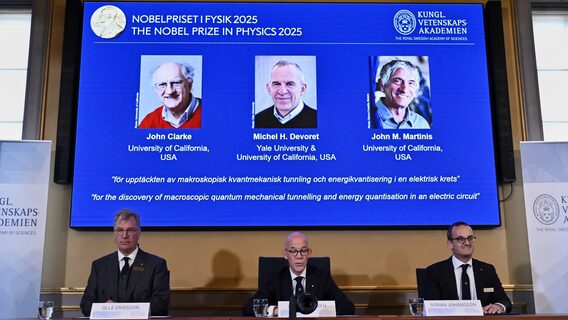
Three professors from American universities won the Nobel Prize in physics in Sweden on Tuesday for their research into quantum mechanics and electrical circuits. They will share the prize of 11 million Swedish kronor, or about $1.17 million.
Three professors from American universities won the Nobel Prize in physics in Sweden on Tuesday for their research into quantum mechanics and electrical circuits. They will share the prize of 11 million Swedish kronor, or about $1.17 million.
Who are these laureates?
John Clarke , a Cambridge graduate, has been a professor of physics at the University of California, Berkeley, since 1969. He is now a professor emeritus of graduate studies at that university.
Michel G. Devoret is a native of Paris, where he also received his doctorate. He is currently Professor Emeritus of Applied Physics at the Yale Quantum Institute at Yale University.
John M. Martinis received his Ph.D. from the University of California, Berkeley. After his teaching career, he worked with Google's quantum artificial intelligence team. He is also currently Professor Emeritus of Physics at the University of California, Santa Barbara.
What exactly was the prize awarded for?
The three scientists were honored for a series of experiments they conducted in 1984 and 1985 on electrical circuits. The research revealed that a process known as "tunneling" — a quantum mechanical phenomenon in which particles move directly through a barrier — can occur on much larger scales than previously thought.
Scientists have shown that tunneling and quantized energy levels can be observed even in systems "that can be held in the hand."
“Quantum mechanics is at the heart of all digital technology,” said Olle Eriksson, chairman of the Nobel Committee for Physics. The laureates’ research has led to new technologies that use these principles.