Стас ЮрасовHot News
29 August 2025, 09:07
2025-08-29
Kyivstar launches Starlink Direct to Cell: messaging and free access for subscribers. Detailed guide from dev.ua
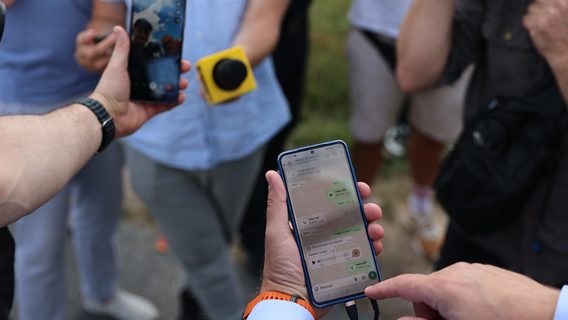
Kyivstar, Ukraine’s largest digital communications operator, this month conducted the first public test of Starlink Direct to Cell satellite communication in Ukraine — two smartphones successfully connected to the Kyivstar|SpaceX network and exchanged messages. The operator plans to launch the text messaging service in the fall of 2025. At the start, the service will be free for Kyivstar subscribers.
Kyivstar, Ukraine’s largest digital communications operator, this month conducted the first public test of Starlink Direct to Cell satellite communication in Ukraine — two smartphones successfully connected to the Kyivstar|SpaceX network and exchanged messages. The operator plans to launch the text messaging service in the fall of 2025. At the start, the service will be free for Kyivstar subscribers.
In this article, we will tell you in detail who can use the Direct to Cell service, what is needed for this, and how it will look from a technical point of view and for the subscriber.
How did the test go?
On July 18, Kyivstar tested Starlink Direct to Cell technology in Zhytomyr region. During the demonstration, the company’s CEO Oleksandr Komarov and the Minister of Digital Transformation Mykhailo Fedorov connected two smartphones to the Kyivstar|SpaceX satellite network and sent the first messages.
Technical details
During field tests, Kyivstar connected two regular 4G smartphones to the Kyivstar|SpaceX network in a testing area in Zhytomyr region. According to Speedtest results, the indicators were as follows: download ≈ 3 Mbps, upload (uplink) ≈ 0.5–0.6 Mbps (a benchmark that Komarov compared to 3G speed). This is a technology that was the most common mobile data transmission standard in Ukraine a few years ago.
Who will need it: cases and scale
Today, 96% of the population in the territory controlled by Ukraine has access to 4G from Kyivstar. This is only the coverage of settlements (excluding forests, mountainous areas, etc.). If we take into account the geographical criterion and the total area of the territory controlled by Ukraine (about 573 thousand km2), then approximately 395 thousand km2 are currently covered, which is 69% of this area.
«By launching a new technology, Kyivstar is betting on wide coverage: Starlink Direct to Cell is designed for a very wide range of users,» say the operator’s specialists.
First of all, this:
residents of remote regions and tourists;
drivers and representatives of logistics services;
farmers, construction companies and other businesses operating outside of ground coverage;
emergency services and government agencies that need a backup communication channel during emergencies.
«Starlink Direct to Cell technology does not replace the operator’s terrestrial communication, but complements the existing service and infrastructure,» the company explained.
Starlink Direct to Cell use cases in other countries
Examples from other markets cited by the operator include the use of D2C for emergency alerts (ETWS) in Japan, as well as applications for IoT scenarios (beehive monitoring in New Zealand).
Direct to Cell connectivity was instrumental in the rescue and recovery efforts following Hurricanes Helene and Milton in the US, the wildfires in Los Angeles and Oregon, the flooding in Central Texas, Cyclone Tam in New Zealand, and the flooding in the Nelson and Tasman regions of New Zealand.
Cost and availability: free at launch
Pilot tests have already started. It is noted that the exchange of text messages is planned «for the fall of 2025.» At the start, access to the Starlink D2C network will be free of charge for Kyivstar subscribers — at least for the duration of martial law. In the future, the tariff may be revised.
Voice communication and broadband internet are still in the plans, but their launch depends on the expansion of the Starlink satellite constellation (there are currently about 650 in orbit, this number will grow rapidly) and on optimizations of smartphone software and the network.
«We cannot talk about specific dates yet. It depends on SpaceX and the launch of the second generation of satellites,» said Alexander Komarov.
Support, SLA and cooperation with Starlink
Kyivstar emphasizes that service support is organized as follows: the operator receives and classifies incidents, conducts initial diagnostics, and, if necessary, addresses this issue to SpaceX engineering teams.
«Starlink has proven itself as a reliable partner. The partner’s engineering teams respond promptly,» the operator’s representatives say.
This approach should reduce the time it takes to fix failures, although some of the solutions will depend on cooperation with the American side and the speed of updating the satellite constellation.
Technical requirements and restrictions for subscribers
The main features of Starlink Direct to Cell: open horizon («open visibility of the sky») and type of smartphone. According to Kyivstar estimates, there are 15.8 million 4G smartphones with USIM in the operator’s network — these are potential users of the new technology. However, manufacturers are optimizing smartphone software for satellite modes, so they will work more efficiently.
In order to deploy Direct to Cell technology throughout Ukraine, Kyivstar is completing the refarming process, i.e. releasing a separate 5 MHz frequency band of its licensed spectrum for Direct to Cell.
Conclusions
By launching Direct to Cell, Kyivstar and Starlink have significantly expanded the capabilities of satellite communications in Ukraine. It will soon become available to millions of LTE smartphone owners anywhere in the country with a direct line of sight to the sky (access only in territory controlled by the Ukrainian government). This will be a significant support and additional communication service for Ukrainians who, in various difficult and unpredictable situations, need to have stable communications not only within populated areas.