Kyivstar can make all subscribers' smartphones satellite-enabled. Musk's LTE space stations will help. Here's how it will work
Yesterday, perhaps, an epochal event occurred in the Ukrainian telecom market. Kyivstar received permission to introduce Direct-to-Cell (D2C) service in Ukraine.
Yesterday, perhaps, an epochal event occurred in the Ukrainian telecom market. Kyivstar received permission to introduce Direct-to-Cell (D2C) service in Ukraine.
Why is this so important? Let’s take a closer look.
Direct-to-Cell is one of the new Starlink services that Elon Musk is rapidly pushing around the world. In fact, it’s only just getting started in 2024. The company is deploying a fleet of brand-new low-orbit satellites that aren’t part of the regular Starlink internet satellite fleet (although they can communicate with them).
Starlink declares on its website that there will be 400 such satellites (currently only the launches of the first batches are known, although in December 2024 Elon Musk announced that the formation of the first D2C flotilla was completed).
What is innovation?
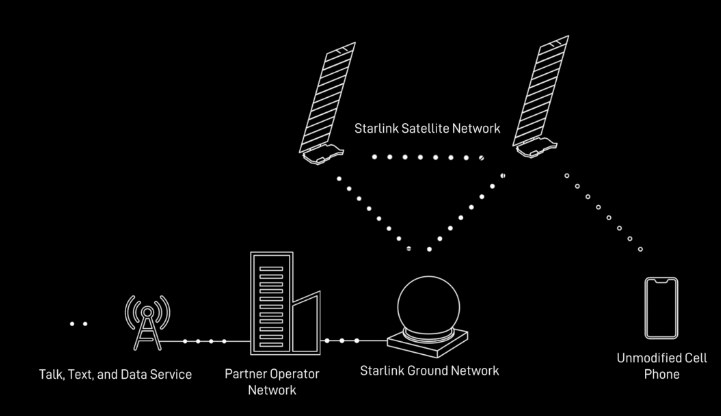
To describe these new satellites very simply: they are 4G base stations that orbit, but their antennas are modified to provide mobile coverage for smartphones on Earth.
This is the know-how of Starlink. Yes, there have been announcements of premium smartphones that had emergency satellite communication in their services before. For example, if you have an iPhone 14 or later, you can connect your device to a satellite to send text messages to emergency services, as well as share your location. But for this, your gadget must have the ability to connect to telecom satellites, using special radio frequency bands that are not used by regular cellular operators on Earth.
Starlink has broken this limitation. Its Direct-to-Cell operates in the same radio frequencies that our mobile operators use for LTE (4G) networks — 1.6-2.7 GHz. Kyivstar has the corresponding licenses for them, which it will share with Musk. This means that all LTE smartphones will have access to satellite communications by default.
For an ordinary user, it will most likely look like this: when he searches for a network on his smartphone, he will see, in addition to the regular Kyivstar network, also a satellite network. It will be possible to connect to it as to a roaming network abroad. It is also possible that subscribers will switch to the satellite network automatically in places where the terrestrial signal fades. This is the same principle that our operators implemented in 2022 with national roaming: where there is no Kyivstar signal, the subscriber will automatically be picked up by, for example, the Vodafone network (but with limited service functionality).
So what’s the plan?
Kyivstar reached an agreement with Starlink to use it in Ukraine at the end of 2024, becoming one of the first mobile operators in the world to do so. Before Kyivstar, there were only tests with T-Mobile in the US and One NZ in New Zealand.
Kyivstar has already announced that it will launch the first Starlink Direct to Cell services in the fourth quarter of 2025. These will be SMS and messaging.
Why only such limited functionality?
There is a simple answer to this question: there is not enough capacity for anything more. Direct-to-Cell completely breaks the entire paradigm of how mobile networks work. Just think about these facts.
A terrestrial mobile LTE cell typically has a radius of up to 30 km (and in urban areas with a large number of subscribers, up to 2 km). It is capable of serving a smartphone moving at speeds of up to 500 km/h.
Now we are transferring the LTE cell to a satellite. It will already move at a much higher speed — 15 km per second (!). In addition, it will fly at a distance of 300-600 km from the subscriber (on the range) and serve a cell whose radius will be tens of times greater than the radius of the largest terrestrial cell.
Let’s add here:
the influence of weather conditions on signal attenuation;
the low radiation power of the smartphone itself — 0.2 W (the satellite must somehow see it from orbit!).
Conclusion: It is extremely difficult to provide mobile communication services via satellite. This is not even the EDGE we are used to yet.
Will there be voice and video?
Of course, Starlink boasts in its service description that the first successful SMS test was completed within nine days of the satellite’s first launch, as well as successful video calls on X and WhatsApp, and connected IoT devices.
But all this is in «laboratory conditions». We connect not one, not a hundred, but several thousand subscribers to the satellite, who communicate simultaneously, and see what happens. Elon Musk said in December about a capacity of 10 Mbit/s on one beam of the satellite. Divide this by several thousand connected smartphones and we will get reality. Yes, for SMS or, perhaps, light Internet and SOS messages, this will be enough.
But calls and video streaming require much more power. Elon Musk promises to develop it. Kyivstar also promises that the next stage will be data transmission and voice calls, all as in regular cellular networks.
To do this, it is necessary to constantly increase the number of satellites, increase the power of the beam. This has already caused concern among T-Mobile’s competitors in the American market. Last year, they wrote a letter to the local telecom regulator (FCC) that it could have a negative impact on the operation of terrestrial 4G networks, reducing the quality of mobile Internet.
So it’s not all that simple here either.
What about money?
Another obstacle to using the D2C service is money. Due to the limited technical resources, connecting to satellite Internet from Kyivstar can become a premium service. At least, it would be very surprising if the operator offered it to everyone for free.
For example, the American T-Mobile announced the first commercial tariffs for D2C. This function will be free only in the premium 5G package. The rest of its subscribers will pay $10-15 per month for the satellite. By the way, an interesting detail — subscribers of other American operators can also purchase D2C from T-Mobile. However, for $20 per month.
I wonder if Kyivstar will offer satellite communication for lifecell and Vodafone Ukraine subscribers?
Conclusions
Satellite mobile cells are definitely a leap forward. A few years ago, it was hard to imagine: a regular LTE signal delivered from orbit!
But the service still has a lot of limitations and directly depends on how much money Musk will invest in the D2C fleet. So far, Starlink cannot actually operate this service on Earth without local telecom partners, such as Kyivstar and T-Mobile. The obstacle to this is that Starlink does not have the necessary radio frequencies for LTE. This is a limited resource that has long been sold out by local mobile operators in countries.
So Musk can become an independent player in the mobile market. But to do this, he needs to buy up local players in different countries with a ready-made subscriber base and ready-made frequency packages.
Expensive, but attractive. It is possible to create a global mobile operator. Goodbye roaming then. But that’s it, dreams.
Людині вживили в мозок нейрочип (не компанія Маска). Українські нейрофізіолог, інвестор і біотехнолог розповідають про ризик і важливість такої операції
Минулого місяця американська компанія Synchron вживила в людський мозок нейрочип. Крихітний нанокомп’ютер помістили до кровоносної судини мозку пацієнта, який страждав на боковий аміотрофічний склероз — рідкісне захворювання, що вражає моторну систему. Компанія провела першу подібну операцію в США, а до цього мала чотири такі самі в Австралії. Після неї пацієнти змогли надсилати повідомлення в месенджері та робити онлайн-купівлі. Ми зв’язалися з українськими експертами, щоб дізнатися про прорив і наслідки подібної технології.
Have important news to share? Message our Telegram bot
Key events and useful links in our Telegram channel