Хочете будувати кар’єру в Data Science та AI? Vodafone Big Data Lab відкриває новий набір —>
Валентин ШнайдерScience Pop
5 November 2025, 14:51
2025-11-05
Chinese scientists have shown a "floating" generator that generates electricity from rain without ground-based installations
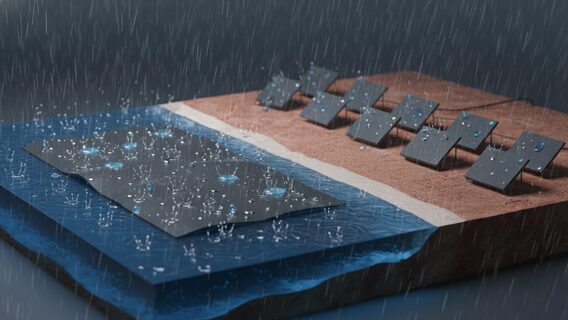
Researchers from Nanjing University of Aeronautics and Astronautics have created a lightweight generator that converts the energy of raindrops into electricity by simply floating on the surface of water. The device does not require massive metal bases or a separate platform on land, and can power small electronics and sensors during rainfall.
Researchers from Nanjing University of Aeronautics and Astronautics have created a lightweight generator that converts the energy of raindrops into electricity by simply floating on the surface of water. The device does not require massive metal bases or a separate platform on land, and can power small electronics and sensors during rainfall.
According to Interesting Engineering, the research team emphasizes that the main advantage is that the water itself acts as both the support and the bottom electrode. This has allowed for a weight reduction of about 80% and almost half the cost of the design compared to classic ground-based prototypes.
Instead of a rigid base under a thin insulating film, there is ordinary water. When a drop hits the film, it spreads, and the ions dissolved in the water immediately «pick up» the charge and conduct current. This scheme gives about 250 volts from one drop. This is a level that was previously obtained on heavier and more expensive stands with metal electrodes.
To prevent the surface from flooding during a downpour, micro-holes were made in the film: they drain water down and keep the working area «dry» for new drops. In tests, the device worked stably in cold and warm water, in salt and even in «blooming» lake water, the insulating layer does not collapse, and the water «base» does not rust.
The 0.3-square-meter demonstration module simultaneously lit 50 LEDs and charged capacitors in minutes. The authors say the units are easy to scale: they can be deployed on reservoirs, lakes, or in coastal areas where they don’t compete for land with solar plants or construction. Initial applications include powering autonomous water quality, salinity, and pollution sensors, and in rainy regions, additional «distributed» energy alongside solar and wind.
Previously, dev.ua wrote about how scientists from the China Aerodynamic Research and Development Center discovered that installing a plasma generator on drones can prevent air flow separation and improve aerodynamic performance.