Хочете будувати кар’єру в Data Science та AI? Vodafone Big Data Lab відкриває новий набір —>
Валентин ШнайдерRobots
21 May 2025, 13:40
2025-05-21
Chinese robot TRON1 learned to manipulate objects thanks to a new module
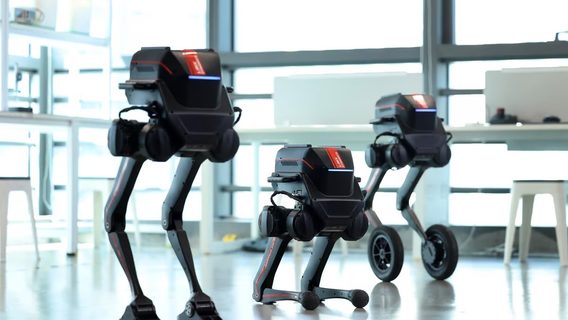
The TRON1 biped robot, developed by Chinese company LimX Dynamics, is now available in a new configuration with an optional mechanical arm. This expansion significantly increases its functionality in research projects related to mobile manipulation and AI.
The TRON1 biped robot, developed by Chinese company LimX Dynamics, is now available in a new configuration with an optional mechanical arm. This expansion significantly increases its functionality in research projects related to mobile manipulation and AI.
As reported by The Robot Report , the company presented the updated TRON1 at the ICRA conference in the US. The robot immediately attracted attention due to its resemblance to the bipedal machines from Star Wars — and not just its appearance. LimX positions TRON1 as a ready-to-use platform for scientific research in the fields of embodied AI, robotics, and general artificial intelligence.
The new manipulator is mounted on top of the body and allows for mobile manipulation, motion planning, and full-body control of the robot. LimX also notes that the new module allows for quick immersion in experiments without additional system preparation — this is especially valuable for universities and research laboratories.
TRON1 is built on a modular architecture. It can be optionally connected to an NVIDIA NX compute module and a voice interface with command recognition, as well as a depth camera and lidar for spatial navigation. All this together forms a powerful platform for creating more “human” robots with high adaptability to changes in the environment.
For its development, LimX received the RBR50 Robotics Innovation Award 2025, in particular for its multimodal approach to motion design.
LimX Dynamics has been around since 2005 and has the ambition to create general-purpose robots that can perform a wide range of real-world tasks. However, they are not the only ones to have made significant progress in this direction. Amazon recently unveiled its first robot with a tactile sensor, Vulcan.