Хочете будувати кар’єру в Data Science та AI? Vodafone Big Data Lab відкриває новий набір —>
Mariya BrovinskaAI Eng
17 November 2026, 09:00
2026-11-17
“My job is to give Claude Code tasks, and he does everything himself.” An IT father created an AI service for his son over the weekend that invents new LEGO models. Now he gets organic traffic from Google and has Zelensky and Svitolina figurines in his collection
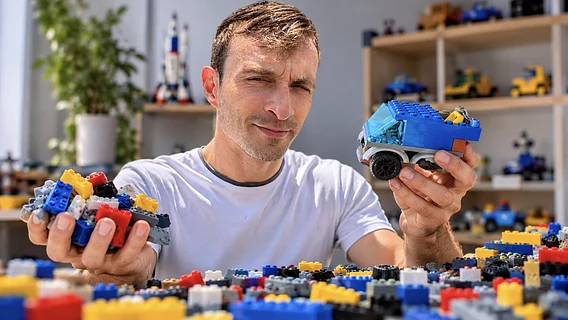
Ukrainian developer Oleksandr Gamalyuk created the Mister Blocks service to help his son invent new designs from LEGO parts that he already has at home. He developed the first version of the service in 20–25 hours with the help of Claude. After the launch, the project experienced an expected decline in traffic, but now the audience is growing again: the developer expects 500–600 users per day, sees the first organic conversions from Google and is expanding language support. Oleksandr told dev.ua how the AI-constructor works, why one model can cost several dollars and whether the author plans to turn the development into a business.
Ukrainian developer Oleksandr Gamalyuk created the Mister Blocks service to help his son invent new designs from LEGO parts that he already has at home. He developed the first version of the service in 20–25 hours with the help of Claude. After the launch, the project experienced an expected decline in traffic, but now the audience is growing again: the developer expects 500–600 users per day, sees the first organic conversions from Google and is expanding language support. Oleksandr told dev.ua how the AI-constructor works, why one model can cost several dollars and whether the author plans to turn the development into a business.
From a son’s game to an AI startup
The idea for Mister Blocks came from a family situation. Oleksandr Hamaliuk watched his son build something new with LEGO and thought it would be good to help the child find more ideas for construction. Not to offer ready-made sets with instructions, but to show what can be built from parts that are already at home.
"The idea came to me when I watched my son assemble something new from his LEGOs. I wanted to help his imagination: so that from the pile that is already at home, you can get a few creative ideas for what to assemble from it," says the developer.
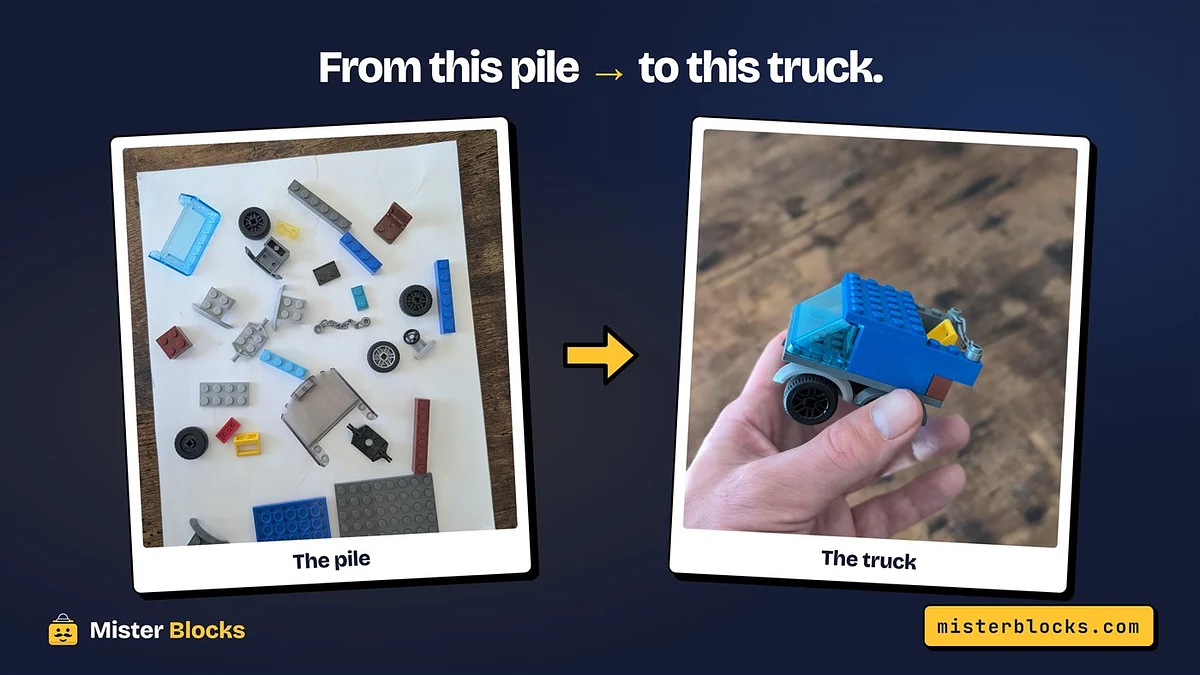
This is how Mister Blocks appeared — an AI service that, based on a photo of LEGO parts, determines what the user has, and then suggests new models and creates instructions for their assembly.
Oleksandr has experience working with AI products. His Instafill.ai, an AI-powered form filling service, is used by hundreds of businesses in the US, including public companies.
“I made Mister Blocks myself last weekend, with the active help of Claude Code. In total, the project took about 20–25 hours,” says Hamaliuk.
How it works
Working with the service starts with a photo. The user lays out LEGO in front of the camera so that the pimples on the parts are directed towards the lens. Then Claude analyzes the image: determines the types of elements, their sizes, colors, quantity and even the number of pimples.
“Claude Opus 5.5 has very strong image recognition, so it easily understands what is in the photo: the type of details, size, how many pimples, color, quantity. We actively use this same technology at Instafill.ai, where AI parses PDF files, so here I simply applied it to LEGO,” explains Oleksandr.
But recognizing the details is only half the battle. It’s much harder to get AI to design a structure that can be physically assembled. There is no ready-made algorithm that could take any LEGO set and automatically assemble any model from it. That’s why Claude designs the structure anew every time. For each model in the Claude Code catalog, he creates a separate small program that describes its shape and composition. When the user uploads their own photo, the AI independently arranges the parts in three-dimensional space. The bumps of one part must exactly match the holes of another.
In the early days of Mister Blocks, this didn’t always work. Claude would come up with designs that looked good on screen but were unstable or impossible to build in real life. The models also used too many different elements, often with rare details.
“After launch, most of the effort went into the quality of the models. At first, Claude was wrong: some models were unrealistic, some were physically impossible to assemble. In addition, they were not optimized: too many different, rare parts were used,” says the developer.
Therefore, he refined the verification system. Each generated design is analyzed by a separate program. It makes sure that the parts do not intersect, do not hang in the air and have support. The assembly sequence is also checked: a part cannot be installed before the one that holds it. If the model has wheels, they must rotate.
"Each part must rest on the bumps of another part or stand on a table, nothing is hanging in the air. Parts cannot intersect, the wheels must spin, and only those parts that are in the photo are used. The order of the instructions is also checked: a part cannot be placed before what is holding it," explains Hamaliuk.
If the check finds errors, Claude tries to fix them. The model is not shown to the user until it passes the check. If the problem cannot be fixed, the service notifies you.
After optimizing the design, fewer parts are used and mostly common elements that are easy to find in a regular LEGO box. Some of the parts can be replaced with analogues, so the absence of one element does not necessarily hinder assembly.
You can avoid taking pictures of the details and just ask AI to build something
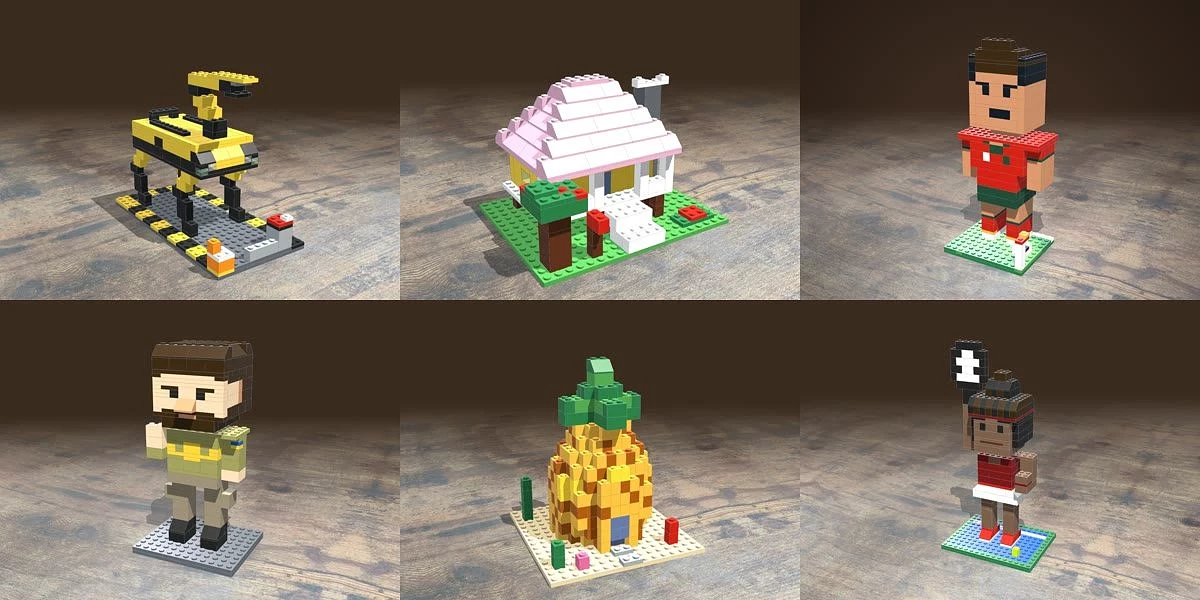
Mister Blocks has another scenario. Instead of uploading a photo of their own LEGOs, the user can simply write what they want to build. For example, a car, a robot, or a figurine of a famous person. There are already more than a hundred builds on the site, and Volodymyr Zelensky and Elina Svitolina are among the most popular, although most users are not from Ukraine.
In this case, Claude first searches the Internet for what the desired object looks like, and then designs a LEGO version of it. This is how models of famous people, robots, cars, and other objects appeared in the catalog.
Oleksandr prepared over 100 models in the catalog before the site started receiving a major user flow. Most of them he generated with the help of Claude.
"I wanted the site to have good models right away. It seems to me that most people come not to create, but to watch. They don’t know what to collect, they look for something interesting and fun, and then they sit down to collect," the author explains.
According to him, almost all the models in the catalog consist of simple parts that are found in most home LEGO sets.
For each construction, Mister Blocks creates instructions. It’s not just a set of images with a sequence of actions, but a 3D model that you can rotate, zoom in and out, disassemble into layers and see how the parts fit together. Each step shows you what parts are needed.
"This is probably the most useful thing on the site. The instructions are three-dimensional: you can go through them step by step, rotate the model, zoom in and out, move it. There is a button that "disassembles" the model into layers so that you can see exactly how the parts are connected to each other," says Hamaliuk.
The instructions can be printed as a booklet or saved as a PDF. The site also has an AI agent that you can ask questions about the design or request changes to it.
However, the result depends on the quality of the photo. If the details are not clearly visible, Claude may miss some elements. In this case, the user can upload additional photos from other angles or manually specify the amount of details.
"I recommend taking photos of details on a white background, such as a sheet of paper, with the dots facing the camera. If the photo is bad, Claude may miss some of the details," the developer advises.
Generating a single model takes several minutes. Due to the cost of computing, the service also has a daily limit on creating new designs.
There are enough users
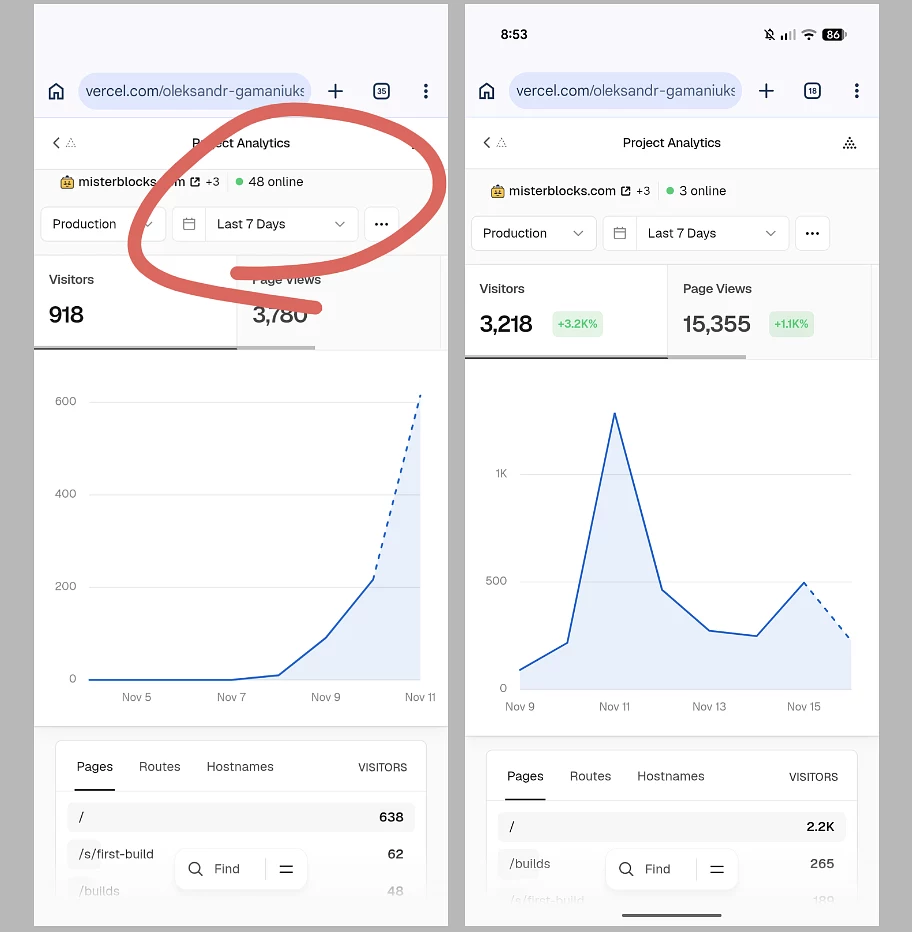
Oleksandr showed the first results of Mister Blocks shortly after its launch. At that time, the site had only been up for two or three days and had already received 918 visitors and 3,780 page views. At peak times, up to 48 people were on it at the same time.
The main stream of the audience came from Reddit. The developer’s post gained 21,400 views in the first 12 hours. The author also planned to launch on Product Hunt.
Dynamics of service visits in the first week after launch and later
After an initial surge, traffic dropped, but then started to recover. According to Oleksandr’s last update, he expected to get over 500–600 users by the end of the day.
“Everything is going very well with traffic. There was an expected decline after the launch, but traffic is recovering every day. Organic traffic from Google has also been added,” says Hamaliuk.
The emergence of search engine traffic is important for the further development of Mister Blocks. Previously, the developer considered organic traffic to the model catalog as one of the main ways to a stable audience. Now the service is starting to be found not only through publications on social networks and Reddit.
Polyglot service
At first, most visitors came from the United States. Users from European countries, including Germany, were also interested in the service.
Now Oleksandr is expanding language support. According to him, the service already has an English version, as well as localizations in Ukrainian, Portuguese, Spanish, and German. The developer is already seeing users who don’t speak English.
“With traffic, there are already non-English-speaking users. Adding a new language costs almost nothing, so we plan to support several dozen major European and Asian languages soon,” he says.
This could expand the service’s audience beyond users who find it on English-speaking platforms. After all, Mister Blocks is designed not only for tech enthusiasts, but also for parents and children who want to get new ideas for play.
One developer and Claude instead of a team
Oleksandr delegates as much work as possible to artificial intelligence. According to him, at Mister Blocks, all AI tasks are performed by Claude Opus 5.5: it recognizes details, designs models, corrects errors, and communicates with users.
“There are no other AI tools, and they are not needed. My job is to set tasks for Claude Code, and he does everything himself: from developing the site to optimizing models, brainstorming ideas, generating PDF instructions, and even sending emails to users,” Hamalyuk describes his process.
At the same time, behind this automation lies quality control work. It was up to the developer to determine what a physically feasible model meant, how to check the connections of parts, and what to do when the AI suggested a design that could not be assembled.
So even if Claude generates most of the output, the criteria for what is considered a good model is determined by a human.
How much does one AI model cost and how will the service earn money?
According to Alexander, the development of Mister Blocks itself was relatively inexpensive for him. The main expenses were a Claude subscription for $200 per month, as well as small payments for Cloudflare, Vercel hosting, and a MongoDB database.
But there is another cost item — model generation. It requires much more resources than it might seem from the user’s perspective.
"Each generated model really costs money, because it costs up to half a million AI tokens. That is, every time someone uploads a photo and generates a model, I pay a few dollars. So far, it’s normal, I cover it myself," the developer explains.
Mister Blocks is not currently monetized. There is a button on the site to pre-order a set of parts for a specific model, but for now it is just a demand test: no orders are placed and no money is debited.
“If I see that people are clicking the button and leaving their details for delivery, I will add orders for such sets,” says Oleksandr.
In addition, users can now change models via chat, publish their own designs in the gallery, and copy others'. Among the audience’s suggestions is integration with the official LEGO catalog. Then the user could enter the number of their set and see what else can be assembled from the parts included in it.
Alexander does not yet predict whether Mister Blocks will become a full-fledged business.
"If you can get free organic traffic from Google to the model catalog, yes, it could become a business. But for today’s site, it’s too early to talk about that," he concludes.
«Чи є у мене талант, якщо комп’ютер може імітувати мене?». Штучний інтелект пише книги авторам Amazon Kindle. The Verge поспілкувався з авторами та виявив багато цікавого
Письменники-романісти використовують штучний інтелект для створення своїх творів. Видання про технології The Verge поспілкувалося з письменницею Дженніфер Лепп, яка випускає нову книгу кожні дев’ять тижнів, й дізналося про те, як працює штучний інтелект для написання романів. Наводимо адаптований переклад статті.
Have important news to share? Message our Telegram bot
Key events and useful links in our Telegram channel