Хочете будувати кар’єру в Data Science та AI? Vodafone Big Data Lab відкриває новий набір —>
Олександр КузьменкоAI Eng
5 September 2026, 14:23
2026-09-05
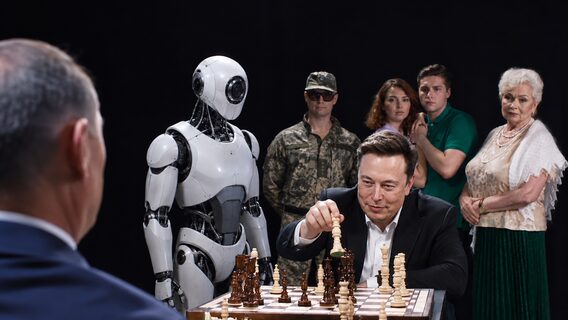
Elon Musk argued with Chess.com about AI's ability to completely "solve chess"
xAI and Tesla founder Elon Musk has entered into a public debate with gaming platform Chess.com over whether artificial intelligence will be able to fully master chess. The billionaire said that the number of intelligent moves in the game is limited, and that a superintelligence will find ways to mathematically compress positions.
xAI and Tesla founder Elon Musk has entered into a public debate with gaming platform Chess.com over whether artificial intelligence will be able to fully master chess. The billionaire said that the number of intelligent moves in the game is limited, and that a superintelligence will find ways to mathematically compress positions.
The discussion took place on the social network X (Twitter), Business Insider reports. The reason for the dispute was different interpretations of the computational complexity of chess: Chess.com representatives operated on the number of possible game options, while Musk estimated the number of permissible positions on the board.
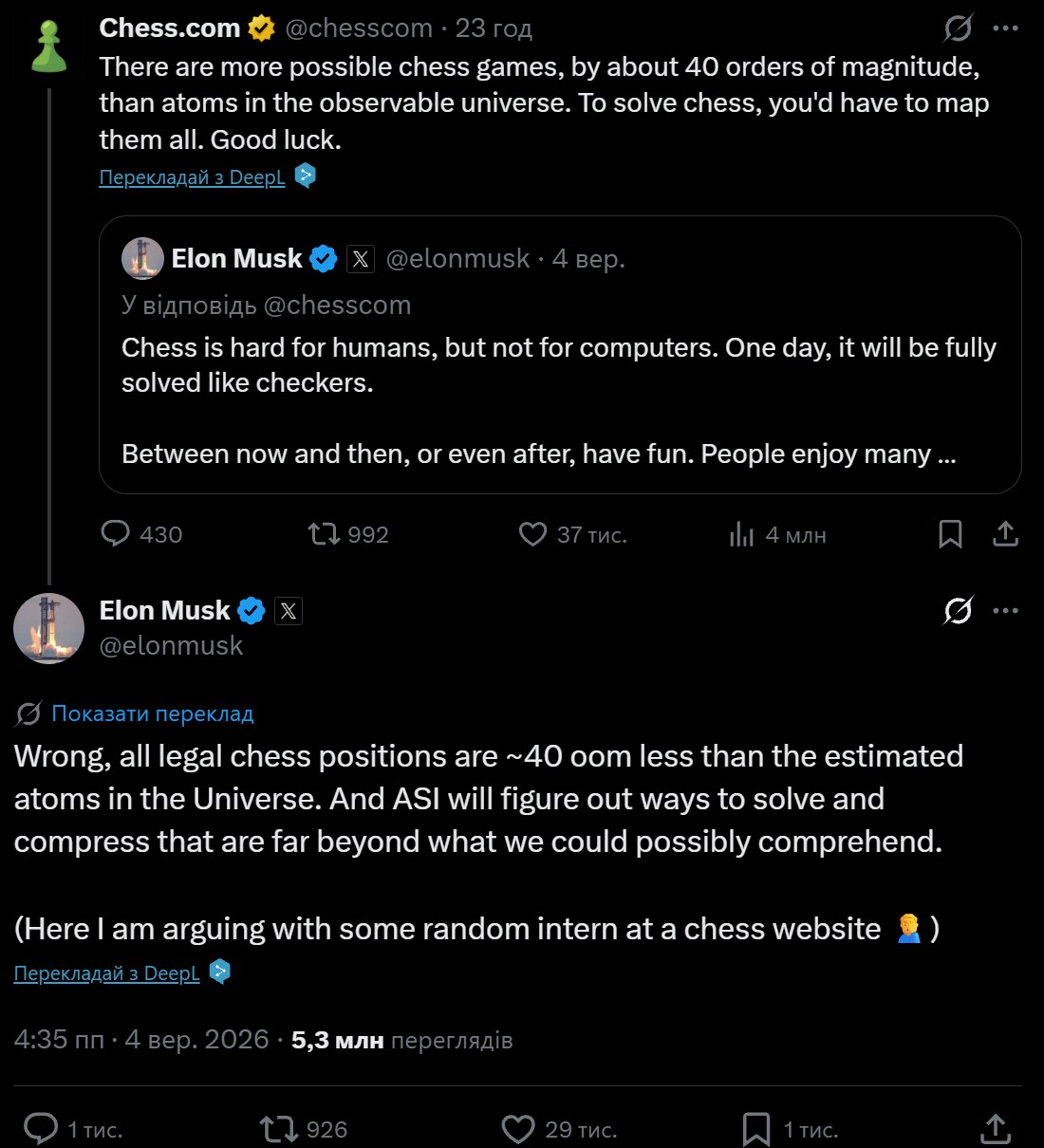
It all started with Musk’s claim that chess is difficult for humans but easy for computers, and that the game will eventually be completely mathematically calculated by artificial intelligence. «Until then, and maybe beyond, have fun. Humans enjoy many games and sports at which machines vastly outperform them,» the billionaire wrote.
In response, Chess.com noted that the number of possible chess games exceeds the number of atoms in the observable universe, so a complete solution would require a map of all these scenarios. Musk countered, noting that the number of possible chess positions is about 40 orders of magnitude smaller than the number of atoms in the universe, and that artificial superintelligence «will find ways to solve and compress that are far beyond what we can even fathom.»
Screenshot from X (Twitter)
Technically, both sides provided correct data, but used different terminology. Chess.com’s estimate refers to the total number of possible unique games (the Shannon number, roughly $10^{120}$), while Musk was referring to the number of legal positions for pieces on a 64-square board (roughly $10^{40}$ to $10^{50}$).
At the end of the argument, the businessman posted a facepalm emoji with the comment: «Here I am arguing with some random intern on a chess website.» The Chess.com account representative clarified that he was a full-time employee.
Musk’s companies have yet to achieve absolute dominance in chess. In a tournament of algorithms in 2025, xAI’s Grok 4 model reached the final round, but lost to OpenAI’s o3 neural network. The billionaire himself has previously been cautious about the game: in 2012, he canceled a tournament for Tesla employees, saying the company had no time for chess.
Як нейромережі бачать вільну та незалежну Україну? Тест dev.ua
Нейронні мережі для генерації зображень бачать світ по-своєму, їхню логіку зрозуміти часом зовсім неможливо. Але таки хочеться. На честь Дня Незалежності України редакція dev.ua вирішила провести невеликий експеримент.
Ми задали чотирьом різним нейронним мережам п’ять однакових запитів: «прапор України», «День Незалежності України», «український Крим», «перемога України» та «українці». Отриманими результатами ми ділимося з вами нижче.
У TikTok тепер можна генерувати фон за допомогою нейромережі. Ми протестували її та ділимося результатами
У TikTok з’явилася нова функція «Розумний фон». З її допомогою як фон для тіктоків можна підставляти згенеровані нейромережею зображення. Редакція dev.ua протестувала цю технологію і ділиться своїми враженнями.