Хочете будувати кар’єру в Data Science та AI? Vodafone Big Data Lab відкриває новий набір —>
Валентин ШнайдерCrypto
2 September 2025, 12:39
2025-09-02
Monobank has banned the withdrawal of crypto to private cards. How do they explain this?
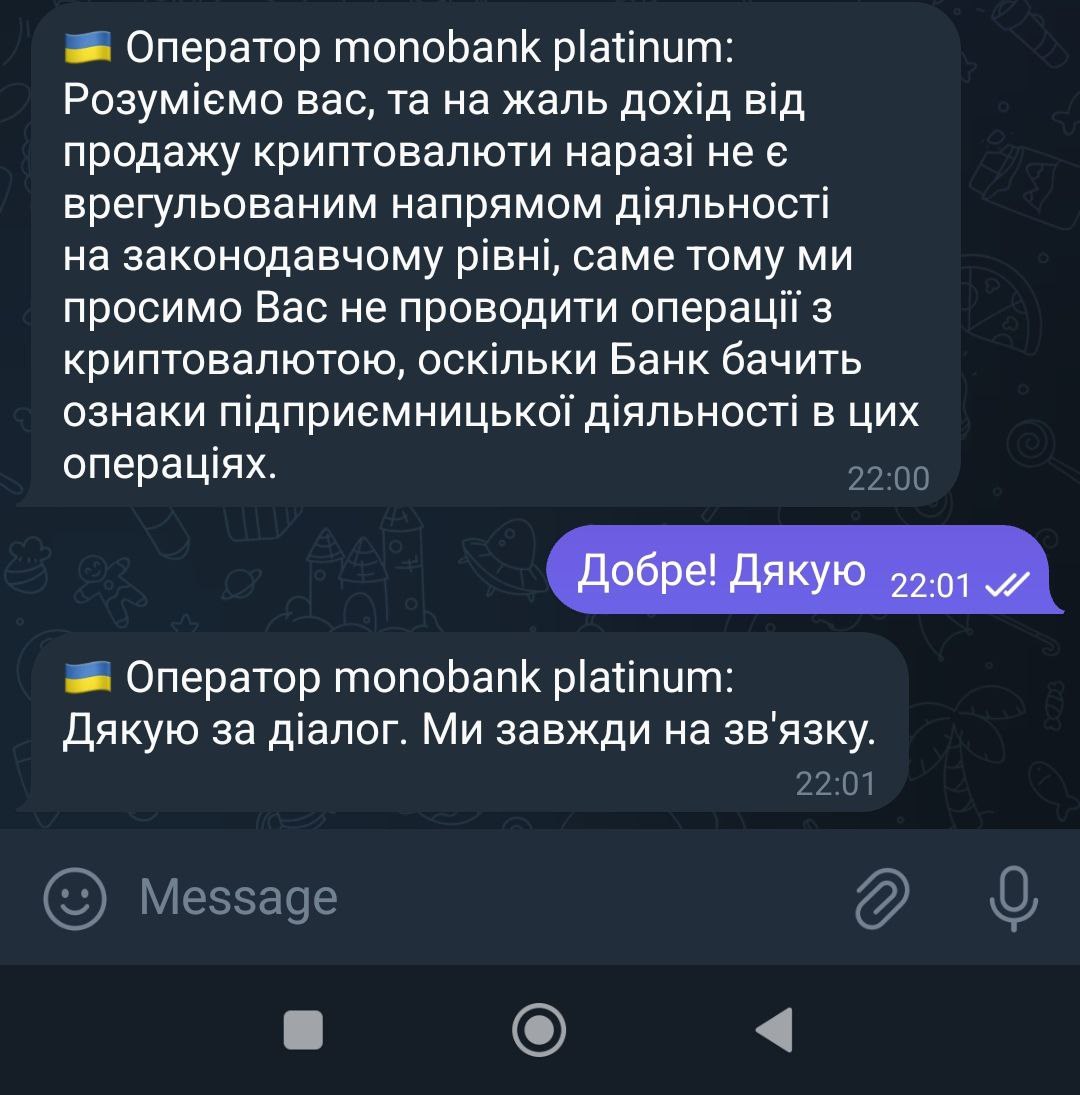
Monobank support explains to clients that income from the sale of cryptocurrency in Ukraine is still not regulated, so mass exchanges via P2P may qualify as entrepreneurial activity. The operator asks to refrain from such transactions and warns of possible consequences from the bank.
Monobank support explains to clients that income from the sale of cryptocurrency in Ukraine is still not regulated, so mass exchanges via P2P may qualify as entrepreneurial activity. The operator asks to refrain from such transactions and warns of possible consequences from the bank.
The problem is broader than one bank: Ukrainian financial institutions periodically block or suspend card services after P2P transactions, require confirmation of the origin of funds and explanations about the purpose of transfers. On the screen, the support service operator asks to refrain from such operations and warns of possible consequences from the bank:
In practice, this looks like this: if the client's profile falls into the "risk zone" (regular crypto exchanges, large volumes, atypical activity), the bank may temporarily stop operations, request income certificates, asset purchase history, screenshots of transactions, or confirmation of the source of funds. Often, financial institutions treat frequent exchanges as systematic earnings, which requires individual entrepreneur status and tax accounting. The monobank service rules also provide for the bank's right to block the card and conduct additional verification based on the results of financial monitoring.
Last year, the NBU imposed a limit on card P2P transfers for half a year, but in the spring of 2025 it did not extend the restriction. At the same time, the Rada is promoting a “tax framework” for crypto: the key idea is to distinguish between investment and entrepreneurial activity and introduce separate taxation rules. Until the final introduction of tax norms and the full launch of the regime for virtual assets, banks will continue to apply increased control to clients who regularly exchange cryptocurrency via P2P, and users should prepare evidence of the legal origin of funds and carefully plan withdrawals to cards.
Ukraine has not yet adopted a law on virtual assets ; exchanges are not officially integrated into the banking infrastructure, and VA transactions are viewed through the prism of financial monitoring. Therefore, any regular P2P transfers are perceived as an increased risk: the bank must identify the client, verify the source of funds and, if necessary, temporarily restrict access to the account until documents are received. This explains the waves of user complaints after exchanges via Binance P2P and other platforms and coincides with the position of bank compliance services, which are trying to prevent "gray" money flows from entering the payment system.
Previously, dev.ua wrote about how the head of the parliamentary committee on finance, tax and customs policy, Danylo Hetmantsev, predicted at the end of August that the Verkhovna Rada would consider a bill on the legalization of the crypto-asset market , but this never happened.
"Do you take customers for fools?" Gorohovsky reported that Samsung, Asus, Xiaomi are blackmailing Monomarket, which announced a 10% discount on all goods presented on the marketplace. Monobank is preparing an appeal to the Antimonopoly Committee of Ukraine
Айтішник не зміг оплатити житло на Airbnb картками ПриватБанку та monobank. У сервісі йому повідомили про санкції проти українських фінустанов. Що відбувається?














Comment hidden for violating commenting rules.
Comment hidden for violating commenting rules.