Хочете будувати кар’єру в Data Science та AI? Vodafone Big Data Lab відкриває новий набір —>
Марія БровінськаWar
18 June 2026, 09:00
2026-06-18
“The hardest thing is finding an engineer who can translate a problem into a technical solution.” 7 questions for the CEO of XTI Engineering, which creates demining equipment
Ukrainian defense tech has long ceased to be a niche industry. Companies attract hundreds of millions of hryvnias in investments, launch new production facilities, compete for engineers, and create technologies that reach the front every day. But how do the people who run these companies actually see the market?
In the new dev.ua column, we ask seven identical questions to the heads of Ukrainian defense tech companies. About the main problems of the industry, the shortage of personnel, overvalued technologies, the future of war, and the skills without which it is difficult to work in the defense industry today.
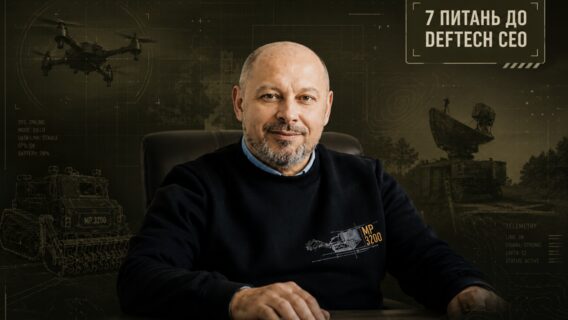
The first guest of the column is Oleksiy Kolesnik, director of XTI Engineering. The company specializes in the development and production of equipment for humanitarian demining and operates in the Kharkiv region, one of the regions where the war has the greatest impact on the daily work of engineers.
Ukrainian defense tech has long ceased to be a niche industry. Companies attract hundreds of millions of hryvnias in investments, launch new production facilities, compete for engineers, and create technologies that reach the front every day. But how do the people who run these companies actually see the market?
In the new dev.ua column, we ask seven identical questions to the heads of Ukrainian defense tech companies. About the main problems of the industry, the shortage of personnel, overvalued technologies, the future of war, and the skills without which it is difficult to work in the defense industry today.
The first guest of the column is Oleksiy Kolesnik, director of XTI Engineering. The company specializes in the development and production of equipment for humanitarian demining and operates in the Kharkiv region, one of the regions where the war has the greatest impact on the daily work of engineers.
What is the biggest problem facing Ukrainian softtech right now? What pain is bothering your business the most right now?
— The biggest challenge right now is war. It simultaneously complicates all processes and very clearly highlights what is really important — speed, flexibility, and the ability to adapt quickly.
For us, the biggest challenge is the lack of engineering personnel. The Kharkiv region is a front-line region, some specialists have relocated, some engineers are now in the Defense Forces of Ukraine. For the production of complex equipment, it is critically important that the team is close to the process — at the enterprise, during testing and directly in the field where the equipment is working.
— What technology is most overrated today? And what, on the contrary, is underrated?
Excessive multifunctionality is often overrated. Sometimes technologies try to be «for all occasions,» but in reality this complicates the system, makes it more expensive and less practical.
In the field, simple, clear, and reliable solutions for a specific task work best. It is often more efficient to have several separate tools than one «universal» one that does everything mediocrely.
What is underestimated today is the practical experience of operation. Not a presentation, not a render, but how the equipment behaves after hundreds of hours of operation in real conditions. In demining, the equipment must not only be effective, but also predictable in operation.
This is how the MP.3200 (soil preparation machine) was created — through constant feedback from people who work with the machine in the field.
Yes, as a manufacturer we can create large technological complexes and complex systems. But at the same time we believe that a good engineering solution is not always about scale or cost. It is about how accurately the technology covers the real task of the user.
— Who is the most difficult person for you to hire and why? How do you solve this issue?
The most difficult thing is to find practicing engineers who can «translate» a task from simple words into a specific engineering solution. When the client explains what he needs, and the engineer understands how to implement it technically.
It is also difficult to find «the right» person for the team — not only in terms of skills, but also in terms of approach and thinking.
We solve this by having the team work intensively, sometimes on weekends, because everyone understands the importance of what we do. And at the same time, we train engineers through practical tasks and real developments.
— What skill or skills are currently the most valuable for an engineer in defense tech? Why?
The most valuable thing now is the ability to work with reality, not with «ideal conditions.»
Even if a person has previously worked, for example, with agricultural machinery — tractors in the field — this is already a very strong base for defense tech. Because such a person understands the logic of loads, how the equipment behaves on different types of soil, maintainability, and the operation of mechanics in dirt, dust, and under constant load.
In demining, it is not «theoretically ideal» solutions that are very important, but rather equipment that works stably in real conditions. Therefore, engineers who know how to make solutions reliable, understandable, and effective in operation are valued today.
What does a civilian IT professional misunderstand about military technology?
In a civilian product, you can afford to spend longer testing or refining a solution. In defense tech, it is very important that the solution works stably here and now.
Sometimes the best solution is not the most complex, but the most predictable and understandable for the user, in our case, the demining operator.
What will war be like in 2-3 years from a technological point of view?
We do not claim to be experts in all military technologies, but speaking from the perspective of our experience — demining and ground robotics — several clear trends are visible.
On the one hand, there are even more robotic and remotely controlled solutions that allow minimizing human involvement where it is dangerous.
On the other hand, the value of simple, cheaper, and quickly scalable solutions that can be quickly deployed for specific tasks in the field will increase.
A separate important vector for our sphere is unification. There will be a growing demand for system compatibility, standardization, and clarity of technology for different operators. This is a movement from «individual complex developments» to more systemic and practical solutions that are easily integrated and quickly put into operation.
And separately in demining, the topic of protection will remain critically important — of equipment, operators, communication channels, and the stability of systems in real operating conditions.
What would you like to say to IT professionals who are hesitant about going to deftech?
Defense tech today is about creating solutions that have a direct impact in the real world. There is a very fast cycle here: you see an idea turn into technology, and technology turn into results in the field or on the battlefield.
And most importantly, what is highly valued here is not «ideality», but the ability to solve real problems. This is what drives the industry forward today.
«When investors saw the quality of the companies, they said it was time to expand this initiative.» Norwegian fund ready to invest 100 million euros in Ukrainian deftech startups