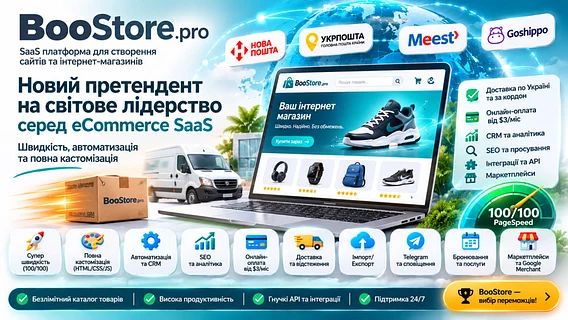
A new contender for global leadership among eCommerce SaaS: BooStore — speed, automation, and full customization
The Ukrainian IT market has long ceased to be just a platform for outsourcing. Today, products appear here that compete with global platforms in terms of technical level and ambition. BooStore.pro is just such a case: a SaaS platform for creating online stores that combines the simplicity of a cloud service with the freedom of your own CMS. Below is a detailed description of what it can do, how it differs from "closed" designers, and why it can be called a contender for world leadership in eCommerce SaaS.
The Ukrainian IT market has long ceased to be just a platform for outsourcing. Today, products appear here that compete with global platforms in terms of technical level and ambition. BooStore.pro is just such a case: a SaaS platform for creating online stores that combines the simplicity of a cloud service with the freedom of your own CMS. Below is a detailed description of what it can do, how it differs from "closed" designers, and why it can be called a contender for world leadership in eCommerce SaaS.
The material will be useful for store owners, marketers, SEO specialists, and developers who are looking for a platform without a "ceiling" in functionality, speed, and customization. And if you're ready to try it out, you can create an online store for free and see everything in your own catalog.
Content
History: from the Hotlist.biz directory to BooStore
BooStore did not come from scratch. The platform has been operating in the e-commerce market since 2010 — then it was known as Hotlist.biz. During this time, it has gone from an international catalog and store builder to a mature e-commerce ecosystem: delivery, payment, CRM, automation, SEO, and analytics modules have been tested by thousands of real projects.
In 2026, a complete rebranding and technological leap took place. The engine was rewritten to a modern architecture, significantly increasing speed, flexibility, security and functionality. This is not a cosmetic renaming, but a new level of the product. The name BooStore is a different quality: faster, cleaner and more open to customization.
An important detail: the platform does not depend on Git processes and heavy frameworks. You do not need to build a frontend, maintain a build, update npm dependencies or wait for CI. The code works directly, and platform updates do not break your site. Behind this are specialists with 20 years of experience in development and e-commerce — and over 15 years of experience in the platform itself.
Speed experienced by both the buyer and Google
Speed in BooStore is not a "refinement" or a paid module, but a basic feature of the architecture. The frontend runs on pure Vanilla JS: 0% jQuery, without React, Angular, and other heavy libraries. Less code means faster loading, fewer requests, better Core Web Vitals.
Practical figures that the platform targets: page cache 0.1–0.3 seconds, LCP 0.8–1.2 seconds, 5–10 requests per page, and real 100/100/100/100 in Google PageSpeed. This is not a lab result on an empty site, but behavior on real stores, in particular with large catalogs.
What exactly provides this speed:
caching pages and CSS into files, minifying styles;
lack of heavy JS frameworks and unnecessary external libraries;
WebP for images, lazy loading and size optimization;
minification and reduction of product images for lists and cards, including on mobile devices — the option can be enabled or disabled as needed;
block layout without tables, lightweight DOM and minimum queries;
cache that is automatically cleared after changes — without manual manipulation.
caching not only pages, but also large uploads and individual elements - with automatic cache updates when data on the site changes;
Another important principle is smart lazy loading. All libraries are not loaded by default: the script is connected only when there is content on the page with which it should interact. If the required block is not present, there is no unnecessary code. This directly affects the speed and Core Web Vitals.
This is critical for SEO: Core Web Vitals directly affect rankings, and speed directly affects conversions. Every extra second of loading time is worth orders, so speed is seen here as a product metric, not a technical detail. More about performance and capabilities can be found in the article about full functionality .
Full customization: more than a "designer"
The main difference between BooStore and most SaaS builders is full access to customization. Yes, there is a convenient visual editor and a large library of ready-made blocks: headers, banners, product grids, benefits, footers. But this is just a starting point, not a limitation.
You can edit HTML templates, CSS styles and scripts, create your own layout, insert your JavaScript and CSS directly into blocks. The code is automatically saved to files, supports async/defer, and the version in the file name changes after edits - there is no need to clear the cache manually. In terms of capabilities, it is close to a standalone CMS, but without the need to administer the server.
You can separately manage the general CSS of the site: connect your own style files, upload them to the platform, or create blocks with code. This way, global styles are stored in one place - you don't need to duplicate them in each block, and the design of the entire site changes quickly.
With JavaScript, the same logic applies: you can upload your JS files and use them, or create a block marked "CODE" — and it will automatically become a separate JavaScript file. The platform compiles the code itself, adds a file version for cache flushing, and supports async/defer, so inserting scripts does not require manual file uploads and does not slow down the speed.
Shortcodes instead of manual code
The platform supports shortcodes — short tags of the form {HOTENGINE-SC:…} or {MENU:…}. When the page is displayed, they are replaced with ready-made values or blocks: names, prices, links, user data, discount, cashback, lists of products and categories, as well as ready-made blocks (cart, selected products, language switcher). You insert the tag into the HTML or into the menu block — and get ready-made functionality without duplicating the code.
Callback functions: control site behavior
Callback functions are a mechanism when a certain action is performed on the site and an additional function is called. In simple words: an event occurred - your logic was triggered. For example, after adding a product to the cart, you can execute your own code, show your own pop-up window.
Example from the cart: callback_hotengine_cart_addresult ($result, $item_id) is called after adding a product, where $result is the status ("added", "removed", "instock_smaller"), and $item_id is the product identifier. There are other hooks: after a request to add to comparison, after changing the quantity of the product in the cart, after an error, to update the cart counter, etc.
Another important feature is to replace built-in system functions. After adding products to the cart, you can perform your own action: show your own popup, change the markup, load additional data. You are not tied to the standard platform window - the behavior becomes yours.
For developers, there is also a hotengine-marking service markup: data-* attributes with page type, ID, prices, balances, delivery data, varieties and cart. This is a “contract” between the core and your code: it is easy to build analytics, custom widgets, price highlighting and dynamic blocks on its basis. At the same time, the system filters dangerous constructs in HTML/CSS, so customization does not open a hole for XSS.
Another important feature: custom scripts and smart loading
Pop-ups and handlers after actions on the site are implemented by platform scripts. But these scripts can be replaced with your own - in a simple and convenient way. It is enough to declare the same global variable or function name at the beginning of your file as in the system, and then enter your handler. The script file is simply connected where needed.
This means you get full control over the behavior: you can leave the standard logic, replace it with your own, or connect your own script only for the desired page or block — without changing the platform core.
Catalog and search filter for different types of products
A large catalog cannot be made convenient without the right filter. In BooStore, the filter is built not "by name", but based on product types and characteristics: you create a product type, add characteristics and their values, and the platform automatically generates a search filter and comparison from them.
Search filter capabilities:
works for various types of goods - from clothing and shoes to appliances and products;
three ways to enter values: checkboxes, text and select;
smart search with auto-suggestions and AJAX recalculation without reloading;
comparison of products by characteristics;
hiding empty characteristics (hideempty) — shows only what is actually in the category;
insertion on any page with a shortcode, in the mobile menu and as a ready-made widget;
speed even on catalogs with hundreds of thousands of products.
The filter can be configured once and used in all languages of the site. For this, there is a built-in function of translating search filter values into many languages - there is no need to create separate filters for each language version. Detailed parameters and examples are in the instructions "Search filter and product characteristics" .
Form and popup builder
In addition to standard pages, BooStore has its own form builder and pop-up builder for these forms. This way, you can quickly create feedback, callbacks, questions, quick orders, and other requests — without third-party services.
Form builder features:
automatic mode: fields and scripts are created automatically;
field constructor: text, textarea, select, checkbox, radio, file, date, time, color, range;
e-mail, phone and URL validation, required fields, anti-spam;
functional forms: Callback, Consultation, Ask price, Quick order — with auto-hiding of unnecessary fields;
transfer of product data: ID, quantity, variety, price — the request is tied to a specific product;
notifications in Telegram, Viber, Web Push and e-mail, as well as auto-reply to the sender.
The popup builder allows you to create popups and bind them to any button or link. You can customize the width and height, title, close button text, callback functions after opening and for window buttons, and closing from within.
Automation: from imports to artificial intelligence
BooStore is designed for those who don't want to do everything manually. Automation is end-to-end here — from catalog filling to notifications and order management. A separate overview is available on the "Store Automation" page.
Key automation capabilities:
import and export of almost all data: CSV, XLS/XLSX, XML, YML, JSON, ZIP, Google Sheets, clipboard, FTP/HTTP/HTTPS;
auto-import on a schedule — up to 30 sources (the number depends on the product limit: the larger the catalog, the more sources you can connect), catalog and price updates, synchronization with 1C/BAS, L.Soft, TorgSoft;
asynchronous import without page reload with live progress and log;
automatic generation of product descriptions by characteristics, category and manufacturer;
automatic notifications about imports, orders, payments and deliveries;
auto-update of currency rates via the Monobank API;
generation of menus, sliders, widgets and content without manual layout.
Group editor and quick balance update
For large catalogs, it is critical to quickly change many products at once. The group editor allows you to massively change prices and markups, move products to categories and manufacturers, change availability and balances, copy and delete items. Select products by category, by code (SKU), by name, and other search and filter parameters.
Balance updates can be done manually via batch actions or automatically: on a schedule, after import, or after an order is placed. This gives you full control over availability without having to manually sort through thousands of cards. This is how the store with full balance automation works, for example, in the examples section below.
Big data, AI, and backups
Imagine you’ve created a shipping method, but later need to update many of those methods. You don’t have to do it one by one through the web interface: you can upload all the data to JSON, ask the AI to update the necessary fields, and import it back. You can also manage payment and shipping methods, settings, product variants, and other entities.
And all of this can be sent to a backup: there is a full backup of the site data with sending a backup copy to the mail. This is convenient both for mass changes and for security - before major updates you can always make an up-to-date backup.
It is worth mentioning the work with artificial intelligence separately. The platform has llms.txt and ready-made AI instructions, thanks to which the AI understands the structure of the site, blocks, shortcodes and styles. In conjunction with the built-in API, this allows you to quickly fill the store: generate articles, descriptions of categories and products, texts for manufacturers, as well as speed up the translation of the site. For owners of large catalogs, this saves dozens of hours of work.
APIs and integrations: an open platform, not a “black box”
BooStore has a full REST API (Commerce API) in JSON format. This means that the store can be managed programmatically: create and edit products, categories, manufacturers, collections, articles, pages, blocks, orders, reservations, reviews. Authorization is via Bearer-key or consumer_secret, with different levels of rights and rate-limit.
webhooks, Zapier, integration with 1C/BAS and external CRMs;
full unloading of orders in JSON (ORDERS FULL).
Additionally, there are AJAX endpoints for dynamically loading content: products, articles, reviews, delivery blocks, cart. This allows you to build dynamic pages without reloading and integrate your own interfaces. For developers, there is documentation, query examples, and a catalog of ready-made scripts.
Telegram store, notifications and collaboration
BooStore has a built-in store in Telegram — it's not a separate paid module, but part of the platform. You can create a Telegram catalog, accept orders, and manage them right in the messenger. For more information, see the article "Create a Telegram store."
In addition to the catalog, you can send newsletters to subscribers of the store's channel through the site's web interface: send messages to an individual person, a selected group of users, or all subscribers at once - without going to third-party services.
You can create a separate channel for customers. If a person subscribes and provides their email address, after placing an order with the same email address, they receive a notification in Telegram about the order creation and each change in the delivery status: "On the way", "Arrived at the branch", "Received". Managers see these same events in their channel.
The notification system supports several channels:
e-mail to the buyer and seller;
Telegram for managers and clients;
Viber;
Web Push;
private messages in the admin panel.
There is shared access for the team with flexible rights. The manager can open only the necessary sections: products, orders, blog, prices, customers, delivery or statistics. The administrator sees everything. You can prohibit editing another manager's orders or allow changes only to those products that the manager added himself. Each manager subscribes to order notifications, and critical settings remain with the owner.
CRM, orders and sales statistics
BooStore has its own CRM and sales statistics — without third-party services. You can collect a customer base, manage groups and mailing lists, see order history, and manage statuses.
To work with orders, the following is available:
printing orders - both individual and complete list of orders;
export of all orders to Excel for the desired period;
own order, payment and delivery statuses;
snapshots of the order, if it has changed;
separate statuses for the seller and buyer;
JSON-upload of all orders for external use without API;
webhooks: sending order data to external servers and CRM when creating or changing an order;
automatic receipt of the order number from an external CRM: the platform sends data in JSON and stores the received external order ID.
customer base, discount groups, cashback balances and email newsletters.
Flexible mobile menu
The mobile menu in BooStore is a separate “app-like” builder, not just a list of links. It has many options: position, width, opening animation, colors, icons, nested submenus, back button, background darkening, quick search, search filter, language switcher, contacts, and social links.
Key features:
different menus for different screens and devices — you can download a separate configuration depending on the screen size or device type;
binding to any site element: own call button instead of the standard one;
deferred content loading — only the shell is drawn first, and data (categories, filter, search) is loaded after clicking;
search filter in the form of a button with application-style opening;
custom callback functions for dynamic content and custom logic.
All of this is cached properly: the menu doesn't make unnecessary requests, opens quickly even on weak devices, and doesn't break Core Web Vitals. This is exactly the approach Google requires: minimal code, lazy loading, and fast interaction.
Payment: dozens of systems, holds, returns, and subscriptions
BooStore's payment capabilities are one of the strongest blocks. Dozens of systems are supported: Monobank (MonoPay), NovaPay, LiqPay, PrivatBank, Hutko, WayForPay, Fondy, iPay, Stripe, Square, PayPal, and others.
Available methods and capabilities:
Visa/MasterCard cards, Apple Pay, Google Pay, internet banking (Privat24, LiqPay, etc.);
hold (two-step payment): freezing of funds, confirmation or cancellation;
refunds — full and partial, based on sales statistics;
recurring payments and subscriptions;
installments and payment by parts (PayParts, Klarna, Afterpay, Affirm, credit);
PRRO and fiscalization for Ukrainian services;
multicurrency: UAH, USD, EUR, PLN, BYN, KZT and others;
formulaic markup before payment: +20+10% (percentage plus percentage) or +20UAH+10% (fixed amount in currency plus percentage) — taking into account the order currency;
invoices for payment without goods and a link to add goods to the cart;
payment only after checking the order or only via the link with the payment method.
Creating separate invoices via a link with a description and list of goods (or without goods);
Important: the platform does not charge a commission on payments - the percentages are set by the payment systems themselves. This is a significant advantage for stores with high turnover. Hold, returns, and subscriptions are available not only in the admin panel, but also via the API.
Multilingualism and multicurrency
BooStore supports over 10 content and interface languages, multicurrency, and correct SEO for each language. This is important not only for Ukraine, but also for entering Europe and the USA.
In practice:
separate language versions with CNC and hreflang;
translation of menus, categories, products, articles and characteristics;
automatic update of currency rates via the Monobank API;
automatic currency selection by language and manual exchange rate;
international payments (Stripe, PayPal, Square) and delivery via Goshippo;
the only filters that are automatically translated into all languages.
Multicurrency and multilingualism are closely related to taxes and shipping: you can set taxes by country and region, and for the US, automatic tax calculation by state and ZIP code. For more information, see the shipping section.
USA and EU: international markets
BooStore is fully ready for international markets — both the EU and the US. One store can work for multiple countries, languages, and currencies without separate installations.
Ready for international trade:
multilingualism, multicurrency and correct SEO with hreflang for each language;
taxes by country and region, and for the US, automatic tax calculation by state and ZIP code;
international payments: Stripe, PayPal, Square and others;
international delivery via Goshippo: USPS, UPS, FedEx, DHL Express, DHL eCommerce, Canada Post, Royal Mail and others;
creating TTNs and printing invoices directly from your office - without manual forms;
example of a store for the USA: apiisbeekeeping.com/en/ — with automatic tax and shipping calculation.
Thanks to this, an international store operates in one admin panel: languages, currencies, taxes, payments, and logistics are configured for each market.
Delivery: auto-creation of TTN and international logistics
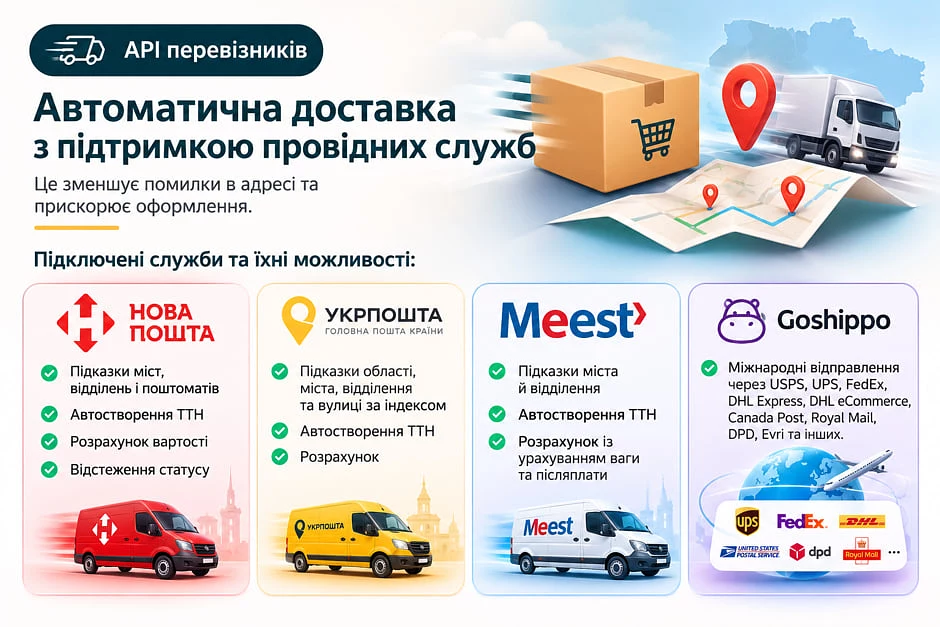
Delivery at BooStore is as automated as possible: address suggestions via API, auto-creation of a waybill (TTN), calculation of the cost according to the carrier's rates, and transfer of the track number to the buyer. A detailed overview is on the "Delivery Services" page.
When placing an order, auto-suggestions work: as soon as the buyer starts entering the city, street, branch number, or post office box, the system offers options from the carrier's API. This reduces address errors and speeds up the checkout process.
Connected services and their capabilities:
Nova Poshta: suggestions for cities, branches and ATMs, automatic creation of TTN, cost calculation, status tracking;
Ukrposhta: prompts for region, city, branch and street by index, auto-creation of TTN, calculation;
Meest: city and branch suggestions, auto-creation of TTN, calculation taking into account weight and cash on delivery;
Goshippo: international shipments via USPS, UPS, FedEx, DHL Express, DHL eCommerce, Canada Post, Royal Mail, DPD, Evri and others.
TTN creation modes:
disable — TTN is not created;
cash on delivery - the carrier collects money from the recipient;
payment by the recipient only for delivery;
payment by the recipient only for the goods;
without payment by the recipient - delivery is paid immediately.
Printing of invoices is also available: if the order includes a TTN, you can quickly print the carrier's form directly on the website. The TTN is created from your account in "Sales Statistics" or automatically when ordering - with full control of the sender, recipient, payment and dimensions.
Delivery settings are flexible for any market:
own taxes by region — country → region/state → city → street; for the USA — automatic calculation of tax by state and ZIP code;
flexible delivery costs: your own conditions, free delivery based on the amount, weight, volume or number of goods;
limiting delivery methods by region, city and street names;
suggestions for addresses, branches and post offices during entry - immediately after connecting the carrier's API;
automatic status updates by TTN and separate notifications for the seller and buyer.
SEO block: metadata, CNC, autotext and Schema.org
BooStore was created with strong SEO in mind. It has everything you would usually get from a dozen plugins: CNC, 301 redirects, sitemap, robots.txt, Schema.org, hreflang, llms.txt, and full meta tag control.
SEO toolkit includes:
meta title, meta description and meta keywords for all content types;
CNC addresses and database of 301 redirects with mass import;
sitemap.xml, robots.txt, llms.txt and indexing management;
built-in Schema.org markup for products, categories, articles and FAQ;
automatic texts in categories and SEO title separators;
automatic creation of product descriptions by characteristics, category and manufacturer;
generation of product descriptions based on articles and blog content;
multilingualism with hreflang and SEO for each language;
integration with AI for quick filling: articles, categories, manufacturers.
It is worth highlighting the automatic posts and templates in categories: you set the text structure once, and the platform substitutes the necessary data for each category. This scales SEO without manually writing hundreds of pages. And thanks to speed and Core Web Vitals, pages do not lose positions due to technical factors.
Support for the Ukrainian market and feeds
Booster supports not only the Ukrainian market, but also international channels. Each platform has its own format and settings - there is no need to collect one "universal" file and then edit it manually.
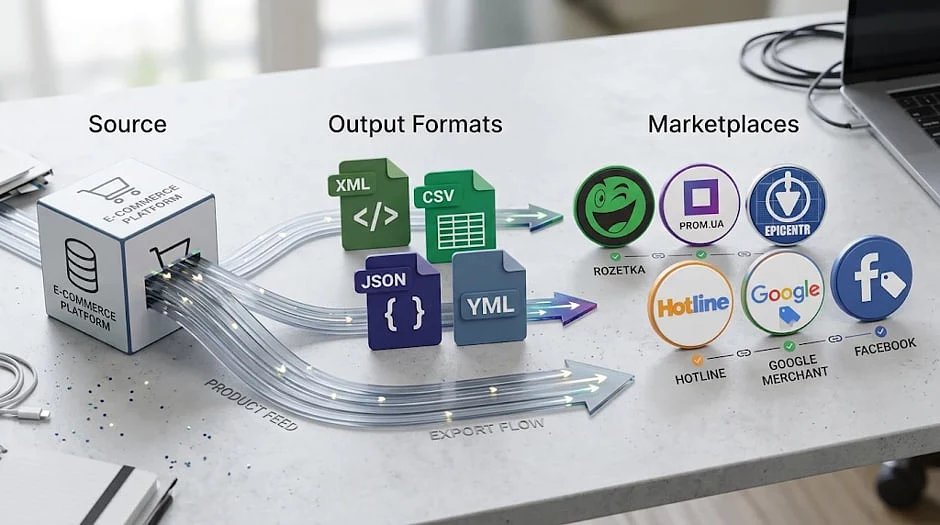
Where can you unload goods:
Prom.ua, Rozetka, Epicentr — separate feeds for each marketplace;
Hotline — a regular CSV feed;
Google Merchant (XML and CSV) and Facebook Product Feed — for global channels;
Yandex Market XML - with varieties and parameters;
CSV and JSON — for custom integrations and data exchange.
Markups are flexible: you can set a general markup in the upload, or you can set a separate one for a specific marketplace depending on the category. The markup can be fixed, percentage, or formulaic (for example, +10% or +20UAH+5%). You can also disable the upload of individual products and upload only the categories you need.
Feeds are cached and updated on a schedule, so even a large catalog loads quickly and doesn't slow down the site. For more information, see the Marketplace Uploads section.
Growth without limits and B2B
BooStore is designed for stores of any scale — from a small catalog to millions of products. Starting from 100,000 items, an individual Enterprise tariff is available with the removal of restrictions, in particular limits on the number of requests via API. More aboutSaaS without limitations .
For B2B and wholesale there are:
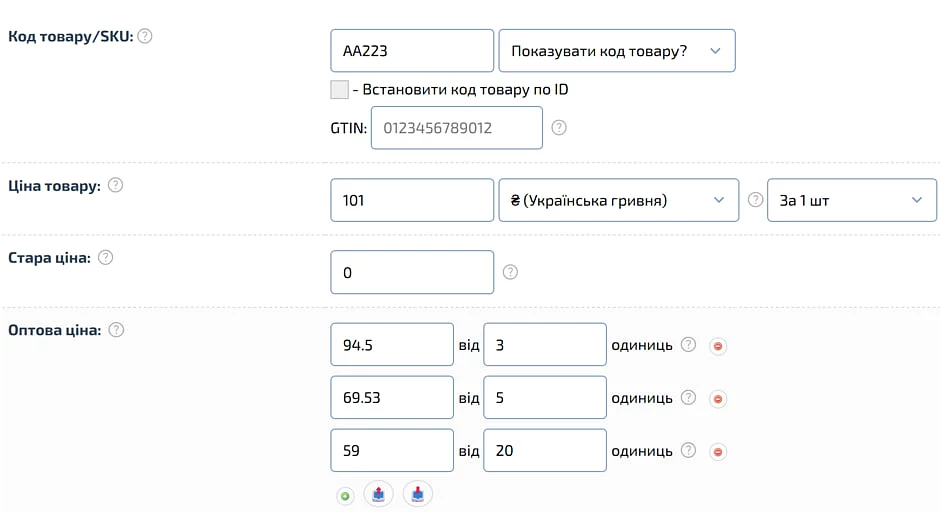
wholesale prices depending on volume and minimum wholesale quantity (MOQ);
customer groups with discounts and individual conditions;
hiding prices and the "Buy" button for guests;
minimum order amount and site closure with a password;
cashback and bonuses on the client's balance;
taxes, discounts, and flexible price display rules.
Turnkey implementation, support and individual development
In addition to self-launching, BooStore offers turnkey project implementation: design, content, payment and delivery settings, data transfer, SEO database. The team supports the store even after launch.
A separate direction is individual modules and modifications for business tasks. Often it costs significantly less than market analogues, because many integrations are created as reusable solutions and subsequently available to other users of the platform. You get a custom solution, but without the "price from scratch."
How much does it cost and what is available for free
You can create a store for free and indefinitely — up to 1000 products. The paid plan starts at $3/month, about the same as regular hosting, and removes limits, platform advertising, and opens up uploads and APIs. The platform does not charge a commission for payments.
Tariffs are based on the number of products: the larger the catalog, the higher the limit. For large stores with hundreds of thousands and millions of products, there is Enterprise with individual conditions. A list of free features and details is on the page"Free opportunities" ... And to evaluate everything in practice, you can create an online store and launch it without any investments.
Examples: from store to blog
Real projects speak best about the platform. Below are examples with different scenarios: first stores, then a content site. Links are given as plain text, without hyperlinks.
mirsemyan.com.ua/ua/ — a store with filters and fully automated balance updates.
apiisbeekeeping.com/en/ — a store for the USA with automatic tax calculation by region and state and delivery by dimensions.
jabra.store/ — Jabra headset store with a non-standard design.
vitawix.com/ua/ — a content site and blog with about 2,000 articles — proof that the platform is suitable not only for stores.
nechaieva.com.ua/ua/ — the website of this law firm, an example of a website with services and order forms
BooStore is a Ukrainian IT product that combines three things that are rarely found together: high speed, deep automation, and full customization. You get the simplicity of SaaS — no servers, updates, or technical support — and at the same time the freedom of your own CMS: access to HTML, CSS, JavaScript, callback functions, shortcodes, and JSON data.
Add to this a store in Telegram, dozens of payment systems with hold and returns, automatic logistics with TTN, a powerful SEO block, API, work with AI, growth to millions of products, and a team with almost 20 years of experience - and it becomes clear why BooStore can be called a new contender for world leadership among eCommerce SaaS .
The easiest way to check this isCreate an online store for free , upload your catalog and see how everything works on a real assortment.