Іван КругловGadgets
3 November 2026, 10:34
2026-11-03
I'm tired of paying the cloud for my own ideas: why my next AI lives right in the system manager
I caught myself with a strange feeling the other day. It’s two in the morning, the deadline is burning brightly, and the project concept is almost ready on the monitor. I just need to generate a few key frames. I hit the prompt, press Enter… and see something familiar to me: "High demand. Please wait," or another message that my AI subscription limit has been reached.
I caught myself with a strange feeling the other day. It’s two in the morning, the deadline is burning brightly, and the project concept is almost ready on the monitor. I just need to generate a few key frames. I hit the prompt, press Enter… and see something familiar to me: "High demand. Please wait," or another message that my AI subscription limit has been reached.
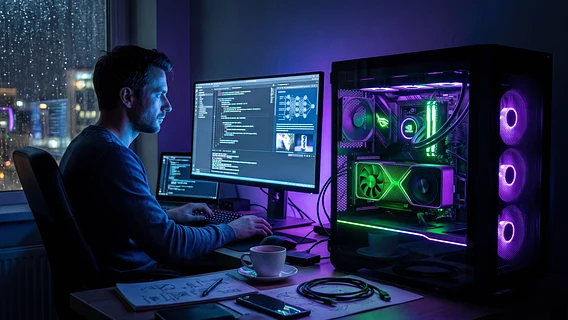
At this moment, all I can hear in the room is the quiet hum of my computer. And I suddenly thought: wait, there’s a couple thousand dollars worth of hardware in front of me, and I’m sitting and waiting in line on someone else’s server in California :). What’s more, I’ve just fed this server raw client work and my own ideas, which tomorrow will easily become part of someone’s dataset for further training.
Familiar?
We at dev.ua constantly write about AI, digital hygiene, and autonomy, but I myself have quietly gotten hooked on the cloud subscriptions needle. That’s why when the guys from the Brain computer technology network and NVIDIA offered us to test the fresh NVIDIA GeForce RTX 50 Series line, I didn’t care about abstract benchmarks in games. I wanted to understand one thing: can local AI finally replace browser services in real daily work?
Short answer: yes, and there is no desire to go back at all.
The Psychology of the Enter Button Without a Network Connection
The main thrill of local AI isn’t even speed. It’s primarily peace of mind.
You unplug the network cable, turn off Wi-Fi — and nothing breaks. The neural network is deployed on your device, calculations are spinning inside the case. Your financial reports, legal contracts, strange art experiments or raw backend code will never end up on someone else’s servers. In a world where corporate leaks have become commonplace, this is probably the only way to sleep peacefully.
The second point is a purely Ukrainian context. During blackouts, the Internet sometimes goes down first (especially if you are on mobile), even if the workplace is powered by a station. The cloud ChatGPT turns into a pumpkin, while the local model continues to write documentation, render visuals, and look for bugs.
Previously, the main barrier was hardware: heavy models mercilessly choked video cards, forcing generations to wait for minutes. The new generation of RTX 50 Series with 5th generation tensor cores and support for ultra-fast formats like FP4 has removed this bottleneck. The response has become almost instantaneous, as if you were communicating with a colleague in the next chair.
Okay, but what to do with this in practice?
When you hear about local models, most people associate them with bearded Linux guys writing endless scripts in the console. In fact, everything is much more practical now. Here’s how it works in completely different areas, if you analyze the workflows without marketing water.
Designers, 3D artists and visualizers: from idea to finished frame in seconds
Routine is the enemy of creativity. How many hours does it usually take to bring a static image to life for a client or find the right texture on stock photos? Local AI cuts those corners.
Take a simple sketch or a ready-made 3D render and the neural network on your PC automatically turns it into a smooth 4K video: adds realistic camera movement, smoke, light reflections or rain. Need a specific texture of old wood or scratched metal? Instead of an hour of searching, just type in the query and in a moment you will get ready-made detailed materials for Blender or Unreal Engine.
No paid streams, other people’s copyrights, and waiting for the final calculation — you experiment live until you find the perfect angle.
Developers: your own "señor" right in the code editor
If you’ve tried to feed a large project to a cloud AI, you know the pain: the model constantly "forgets" neighboring files, takes a long time to think due to internet ping, and the company’s security is sounding the alarm because closed code is being sent to other people’s servers.
With a local assistant, things are radically different. You run a model (like DeepSeek-Coder) right in your VS Code or PyCharm. It sees your entire architecture, instantly suggests the necessary features, finds bugs, and writes tests without a single second of delay.
Moreover, the power of the RTX 50 Series allows you to deploy an entire virtual team: while one neural network writes code, another checks it for vulnerabilities in parallel, and a third prepares documentation. And all this runs locally — quickly, without subscriptions and without the risk of leaking trade secrets.
Analysts, financiers and lawyers
This is where privacy becomes a matter of survival. Uploading an audit report or a customer database to an open cloud is a direct violation of the NDA. But running a local RAG (for example, through the same NVIDIA ChatRTX) is pure magic. You feed the system a folder with hundreds of PDF contracts over five years and ask: “Where are we prescribed fines of more than 10% and in which applications?” The model produces a squeeze with exact links to the pages in three seconds. Zero bytes leaked out.
Podcasters, streamers, and video makers
NVIDIA Broadcast has been doing wonders for a long time, but the new series takes it to the next level. Real-time algorithms cut out the sound of construction work behind a wall, draw the correct direction of gaze (Eye Contact) if you are reading a release plan from a monitor, and neatly keep you in the frame without a physical operator. And the cover art for the releases is generated in an adjacent window right when the audio track is exported.
A habit-changing experience
You know what’s the most interesting thing? After a few weeks of intensive work with local AI, returning to browser tabs becomes simply strange. The feeling disappears that your working tools do not belong to you, but to the vendor, who can change the subscription rules, block the account or raise the price every Tuesday.
Of course, the ticket to this world is good hardware. But if your computer is a production machine, then GeForce RTX 50 Series cards pay for themselves not with frame rates, but with hours of saved time and peace of mind for your data.
I think we’re on the cusp of a personal computing renaissance. The internet gave us the cloud, but it’s modern hardware that’s giving us back autonomy.
Build your perfect AI PC with Brain
Creating a powerful workstation for local AI requires a detailed approach: it is important not only to choose the right graphics card with sufficient VRAM, but also to choose a reliable power supply, fast RAM, and an efficient cooling system that can withstand long creative sessions.
Experts from Brain, one of the largest retailers of computer equipment in Ukraine, will always help you with this.
With over 25 years of experience in the market, Brain offers over 250,000 products, over 70 stores across the country, and convenient online shopping. Brain experts will help you choose the optimal PC configuration for any task and budget — from ready-made builds to individual solutions for working with local artificial intelligence.