Хочете будувати кар’єру в Data Science та AI? Vodafone Big Data Lab відкриває новий набір —>
Наталя ХандусенкоHot News
21 October 2025, 14:36
2025-10-21
An eye microchip the thickness of a human hair allows the blind to read again: how the technology works
Eye implants could be a lifesaver for patients with geographic atrophy (GA), a late stage of dry age-related macular degeneration (AMD), which affects more than 5 million people worldwide.
In this disease, common among older people, cells in a tiny area of the retina gradually break down. The result is a loss of central vision (it becomes blurry or distorted) and an inability to distinguish colors and small details.
Innovative technology can change the daily lives of people with this disease, for example, allowing them to read and write.
Eye implants could be a lifesaver for patients with geographic atrophy (GA), a late stage of dry age-related macular degeneration (AMD), which affects more than 5 million people worldwide.
In this disease, common among older people, cells in a tiny area of the retina gradually break down. The result is a loss of central vision (it becomes blurry or distorted) and an inability to distinguish colors and small details.
Innovative technology can change the daily lives of people with this disease, for example, allowing them to read and write.
How the technology works
The implant, called Prima, was developed by the California Biotechnology Science Corporation.
The procedure involves implanting a tiny photovoltaic microchip, 2 mm by 2 mm in size and about the thickness of a human hair, under the retina.
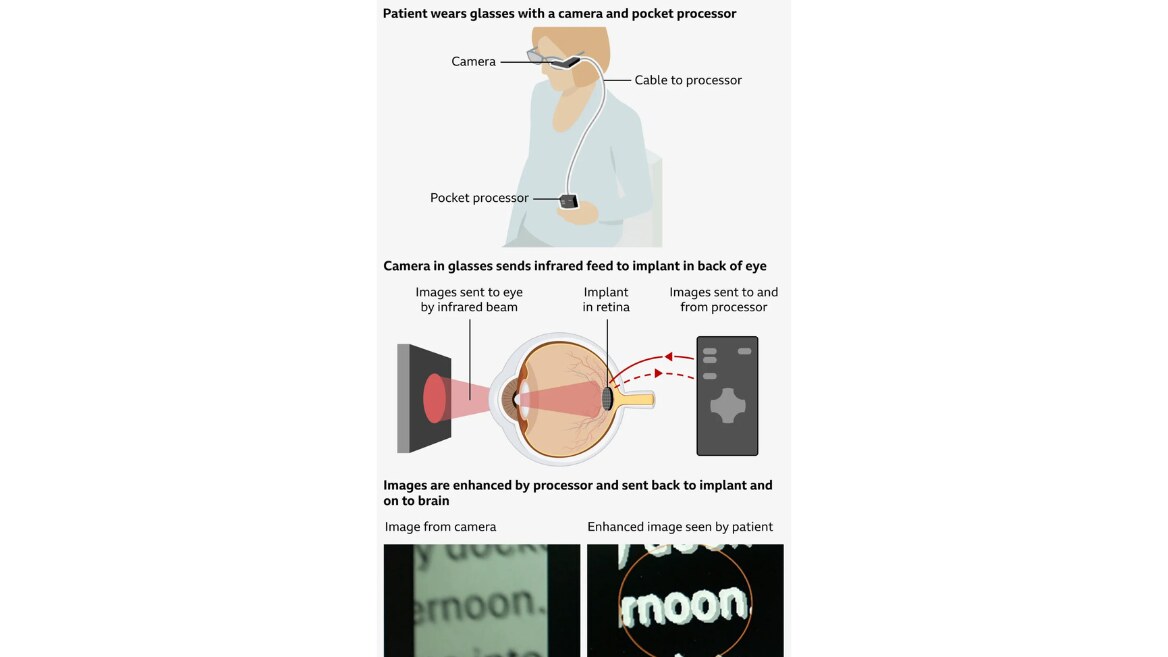
Patients then wear glasses with a built-in video camera. The camera sends an infrared beam of video images to an implant in the back of the eye. The implant, in turn, transmits them to a small, pocket-sized processor for enhancement and clarity.
Then, through the implant and optic nerve, the images are sent back to the patient's brain, restoring partial vision.
Trial
The Prima implant trial involved 38 patients with geographic atrophy in 5 European countries.
Of the 32 patients who had the device implanted, 27 were able to read again using their central vision. After a year, this corresponded to an improvement of 25 letters, or five lines, on the ophthalmological chart.
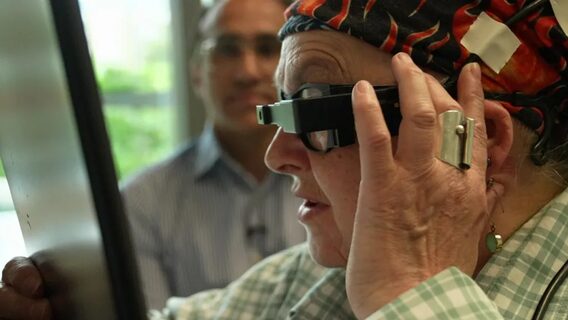
Among the patients taking part in the trial is 70-year-old British woman Sheila Irwin, who began losing her central vision more than 30 years ago due to the death of retinal cells.
But after the implantation, which took place about three years ago, Sheila is delighted with her progress.
"I can read my mail, books, do crosswords and Sudoku," she told the BBC.
Sheila doesn't use the device outdoors. Part of that is because it requires a lot of concentration—she has to hold her head very still to read—and she doesn't want to become overly dependent on the implant.
The future of technology
The Prima implant is not yet licensed, so it is not available outside of clinical trials.
Perhaps this technology could be used to help people with other eye conditions in the future.
Dr Peter Bloomfield, director of research at the Macular Society, called the results "encouraging" and "fantastic news" for those who currently have no treatment options.
“Artificial vision can offer great hope to many, especially after previous disappointments in the field of dry AMD treatment.
"We are now closely monitoring whether the Prima implant will be approved for use here in the UK and, crucially, whether it can become available on the National Health Service (NHS)."